Sales techniques 2026: how to grow as a salesperson

Filip Duszczak
CEO InStream Group
- Reading time: 18 minutes
- March 30 2026
Updated: · data from InStream Group projects in 2026
Sales techniques are proven ways of running a conversation with a client: asking questions, exploring needs, presenting value, handling objections and closing the sale. Techniques alone are not enough. In 2026 results depend on the salesperson’s skills, the ability to work with AI and regular practice of techniques on your own sales process. This guide shows how to grow, what to learn and where to start.
- Hard and soft skills
- Ranking of sales skills
- AI skills
- How we develop salespeople with PipeChamp
- Training on a virtual sales process
- Where to start sales training
- TOP books for salespeople
- Classic training or a virtual process
- Sales techniques or relationships
- B2B and B2C sales techniques
- TOP sales trainers worldwide
- In-person training at InStream Group
- Salesperson development plan
- Who teaches at InStream Group
- Frequently asked questions
Skills
Hard and soft skills of a salesperson
A sales technique is a tool, while a skill is the ability to use it in a real conversation. That is why a salesperson’s development starts with a skills map: what they can already do, what they need to learn and what to practise.
| Hard skills | Soft skills |
|---|---|
| Knowledge of the sales process and the criteria for moving between stages | Active listening and asking questions |
| Knowledge of the product, market and competition (at category level) | Empathy and understanding the client’s perspective |
| Prospecting and lead qualification | Resilience to rejection and working under pressure |
| Running the conversation and presenting value | Building relationships and trust |
| Handling objections and negotiation | Self-discipline and work organisation |
| CRM, reporting and working with data | Written communication and public speaking |
Hard skills can be measured, while soft skills show in habits. In PipeChamp we assess both: the scoring after every conversation simulation shows which skills are growing and which need more practice. See also 7 qualities of a good salesperson.
Ranking
Ranking: TOP 10 sales skills in 2026
We base the ranking on our work with sales teams in more than 3,000 projects. The order reflects what B2B sales results depend on most.
- Needs discovery and questionsThe ability to get to the client’s real problem before an offer is made.
- Running the processEvery conversation ends with an agreed next step and a date.
- Handling objectionsAn objection is a question about value, not a rejection. The salesperson knows how to answer it.
- Prospecting and qualificationKnows who is worth talking to and does not waste time on leads with no chance.
- Presenting valueTalks about the business outcome for the client, not about product features.
- NegotiationDefends the margin, trades concessions and knows their alternative (BATNA).
- Working with AI and dataPrepares conversations with AI, uses the CRM and analyses their own results.
- Social sellingBuilds a brand and relationships on LinkedIn before picking up the phone.
- Closing the saleAsks for a decision at the right moment and without pressure.
- Self-discipline and habitsA regular work rhythm: prospecting, follow-ups, learning.
AI in sales
AI skills: what a salesperson must learn in 2026
AI does not replace the salesperson, but it changes their work. The winner is whoever prepares for conversations faster, personalises communication better and practises more.
- 1
Preparing for the conversation
AI gathers information about the company and the person, and the salesperson chooses what matters for this conversation.
- 2
Personalising messages
AI suggests versions of emails and LinkedIn messages, and the salesperson chooses and sends.
- 3
Call analysis
Recordings and transcripts show where the conversation stalled and what to improve.
- 4
Practice with a virtual client
Conversations, objections and negotiations with an AI client before the salesperson calls a real client.
The rule we follow
Technology prepares. People approve. Always in that order. AI generates message variants and the salesperson decides what to send.
- Process map
- SalesBook
- Virtual narrator
- AI trainer
Documentation and AI trainer
Process mapping, SalesBook and AI trainer
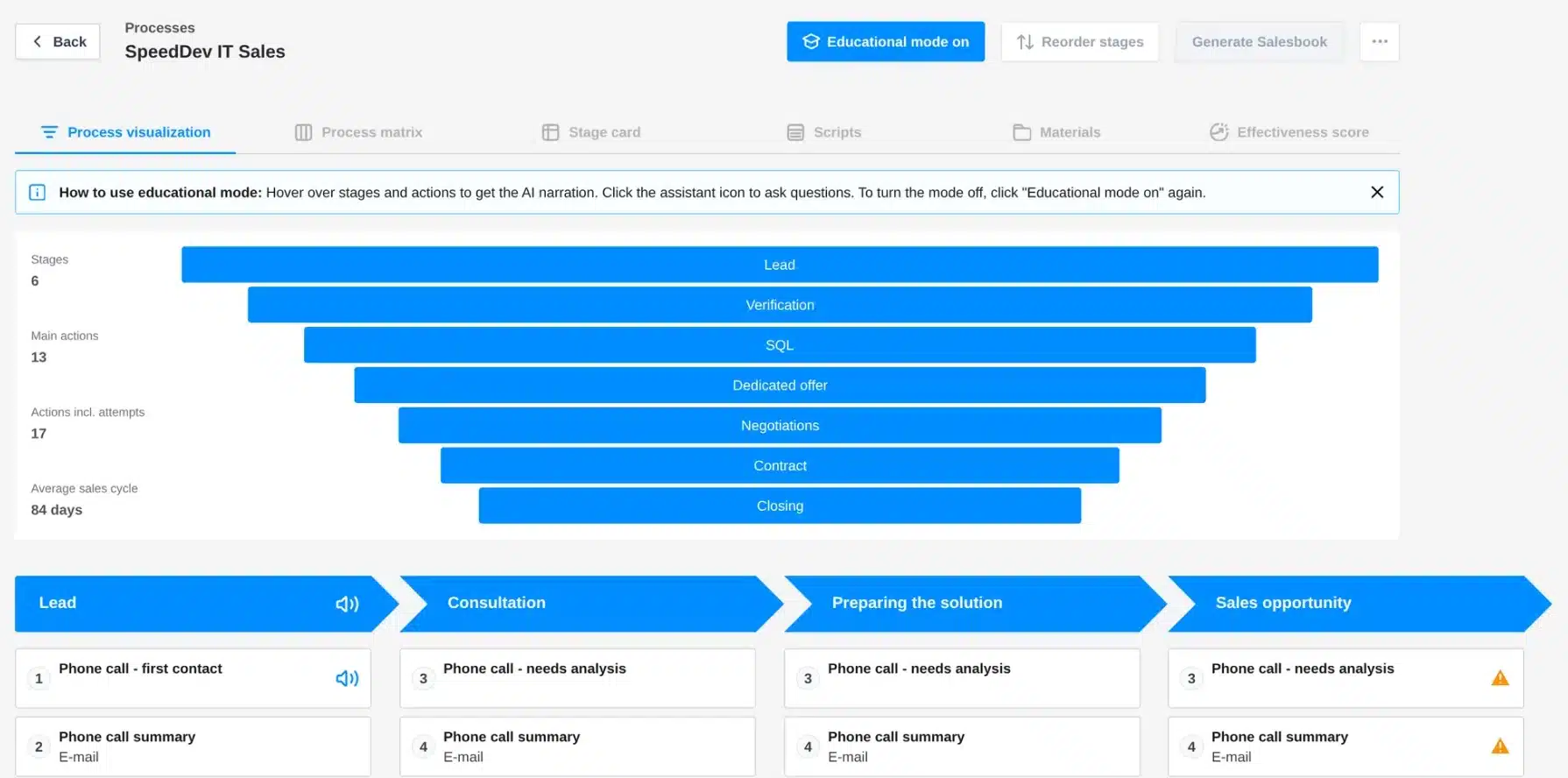
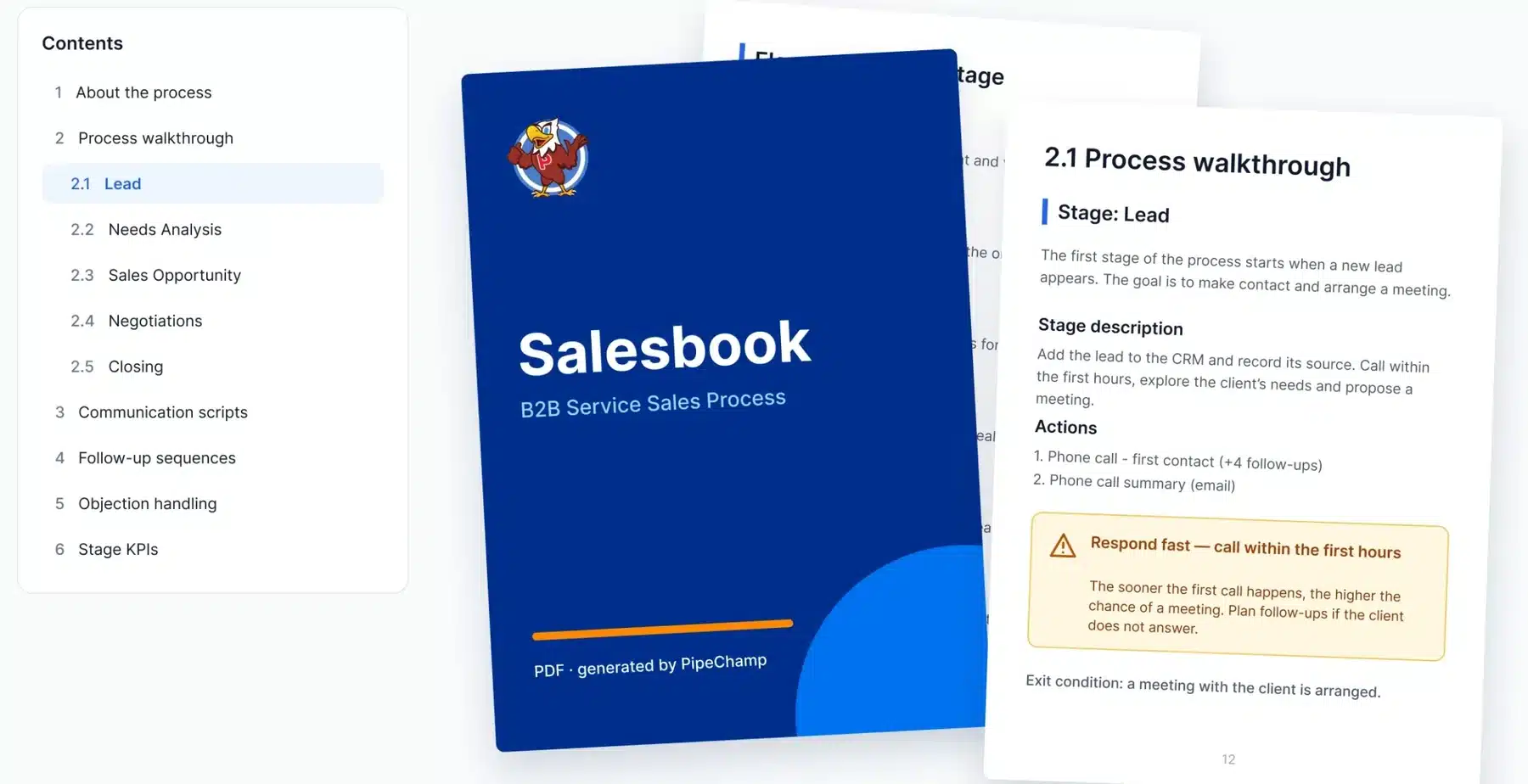
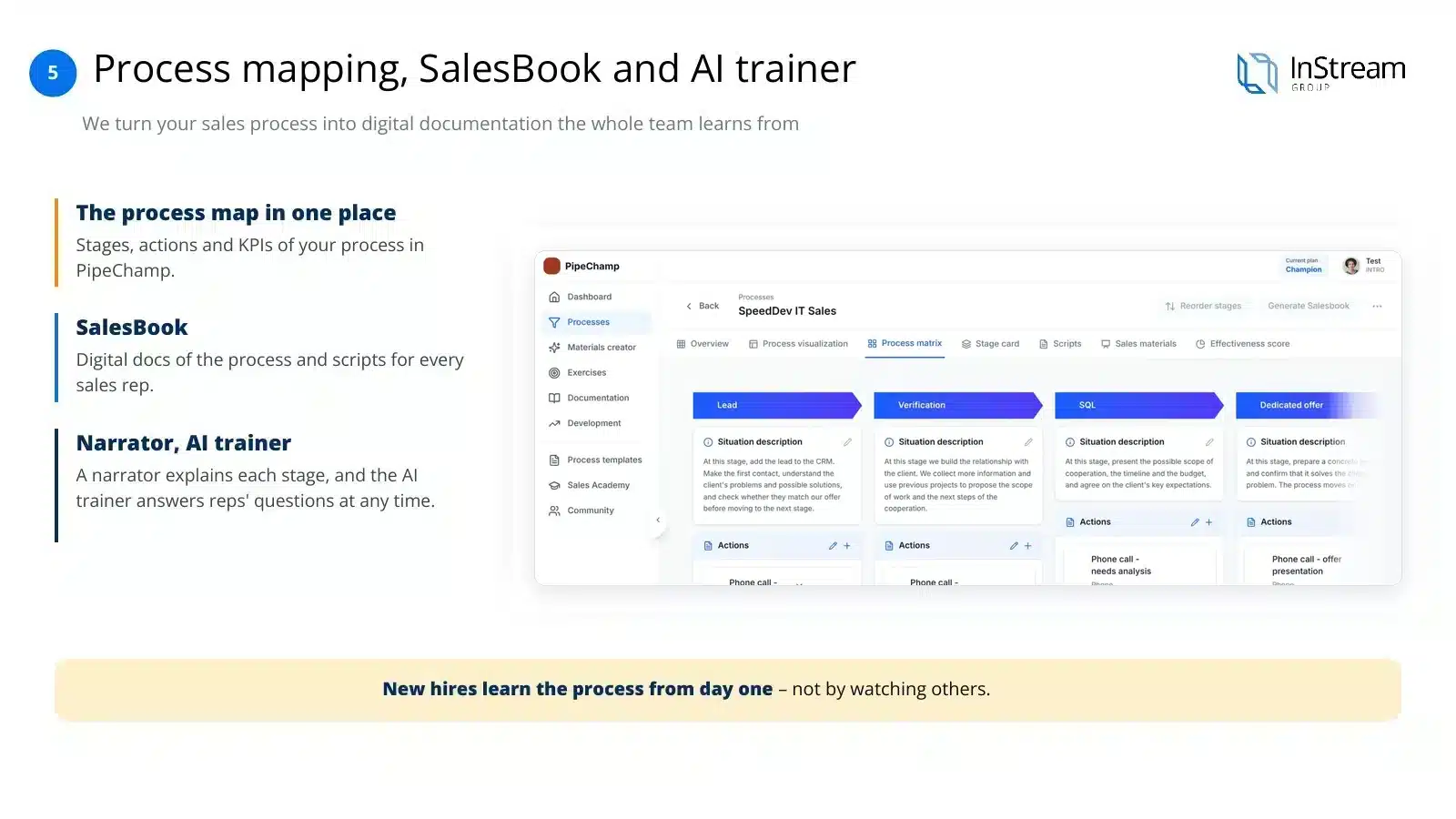
We map the sales process in PipeChamp and turn it into SalesBook digital documentation. A virtual narrator talks through each stage, and an AI trainer answers salespeople’s questions at any time.
- A map of the process and stages in one place
- SalesBook: documentation of the process and scripts
- A narrator and an AI trainer available to the team
PipeChamp
How we develop salespeople with PipeChamp: platform demo
PipeChamp is our platform for developing salespeople. Salespeople practise conversations with a virtual client on their own company’s process, and the manager sees each person’s progress in their skills profile.
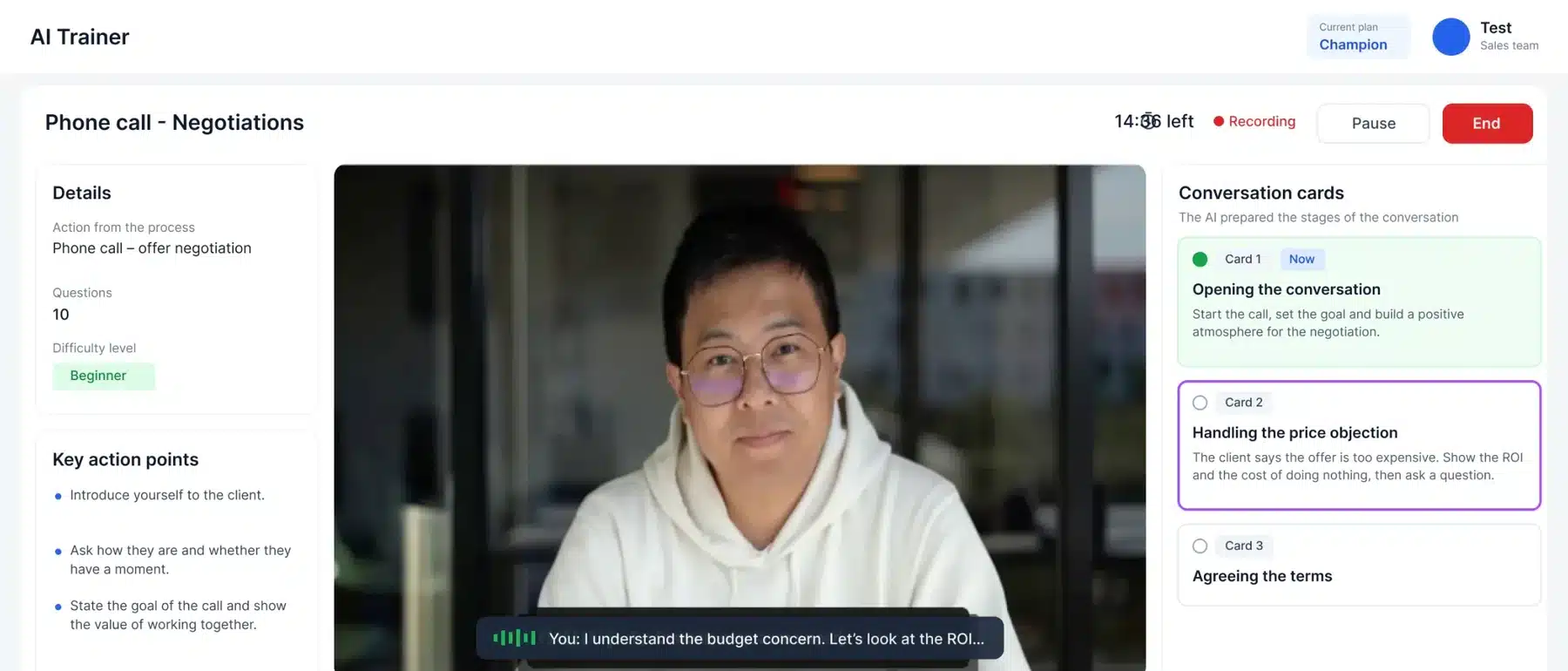
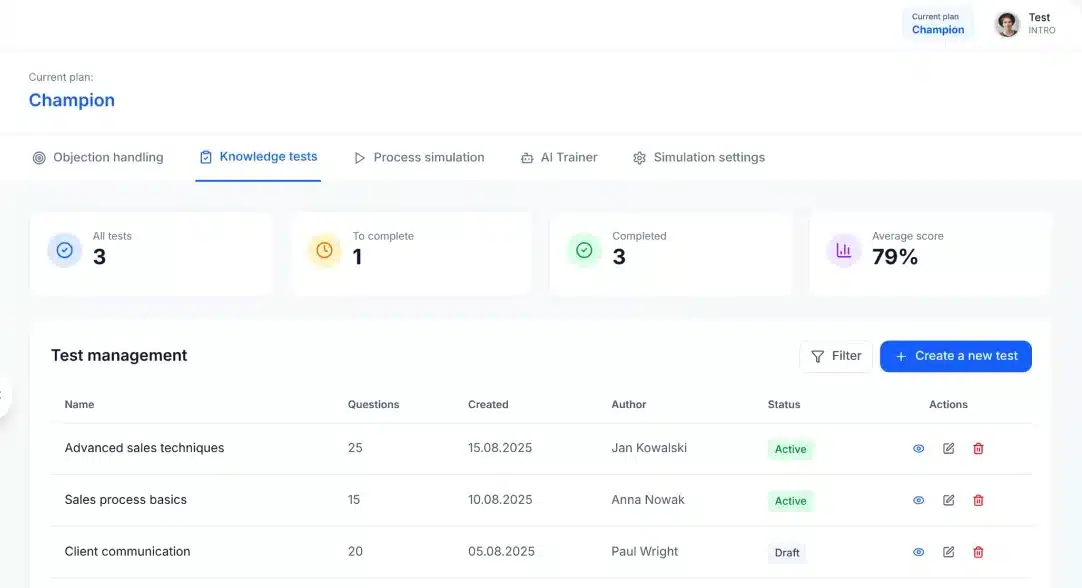
- Virtual client
- Objection handling
- Negotiations
- Quizzes and tests
AI exercises
AI simulations and conversations with a virtual client
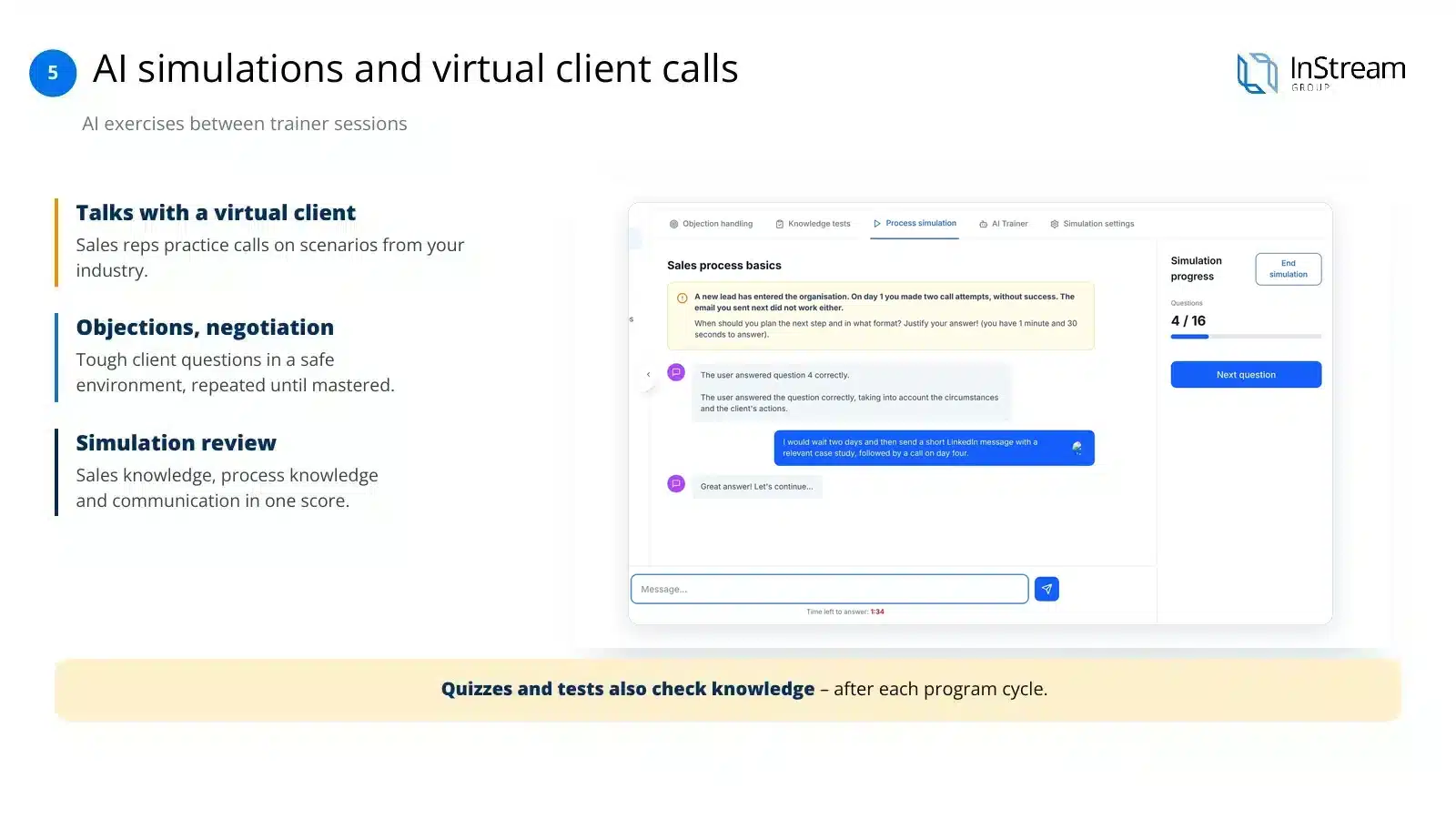
Salespeople practise conversations with a virtual client, handle objections and negotiate in a safe environment. Quizzes and tests check their knowledge.
- Conversations with a virtual AI client
- Objection handling and negotiation exercises
- Quizzes and knowledge tests
Salesperson profile
Employee profile, development measurement and scoring
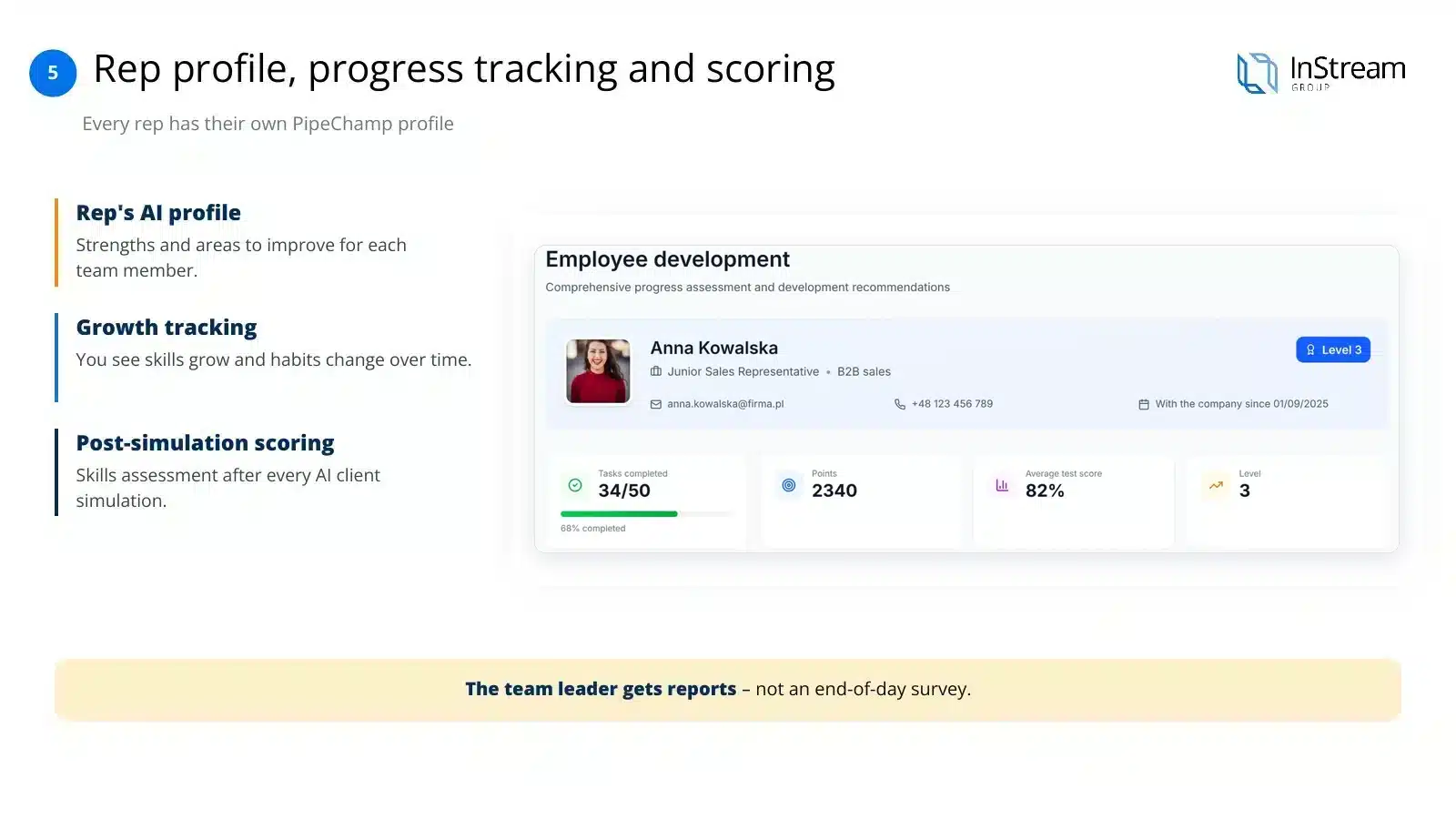
Every salesperson has their own profile in PipeChamp. You see how their skills grow, how their habits change and what score they get in exercises.
- An AI profile with strengths and areas for improvement
- Measuring development and habit change over time
- Skills scoring after every simulation
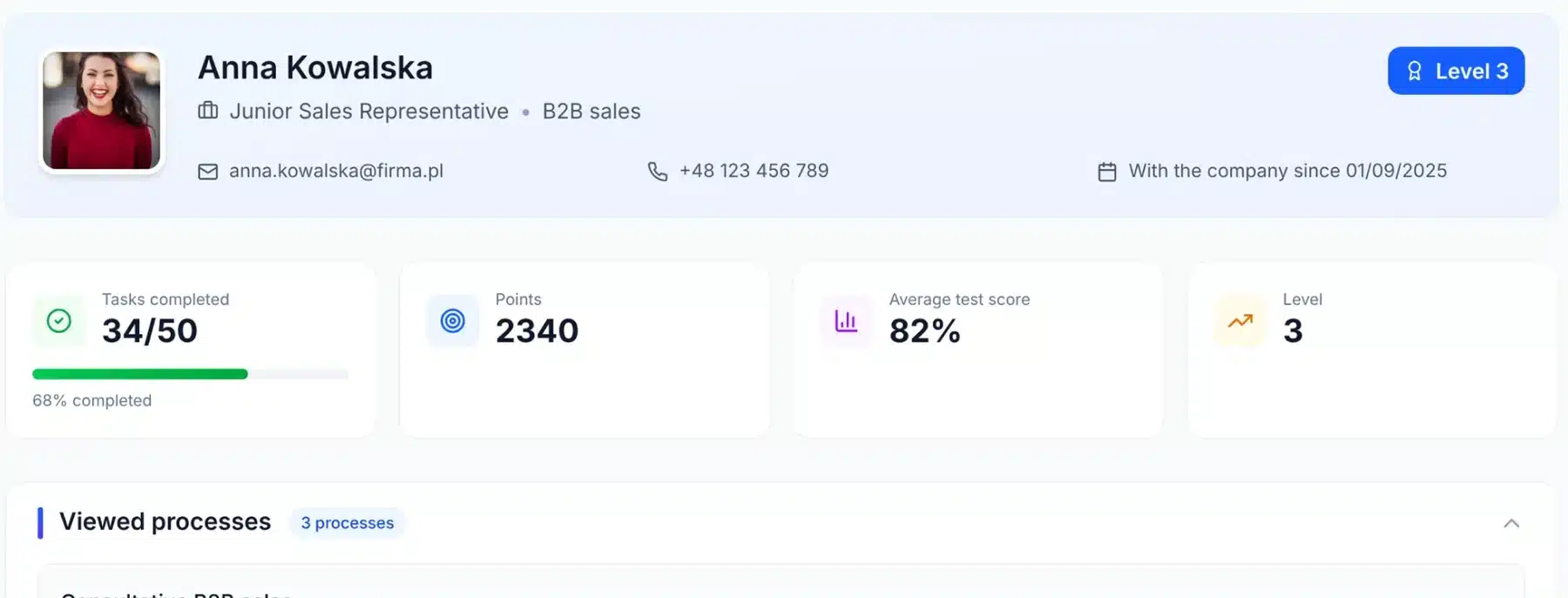
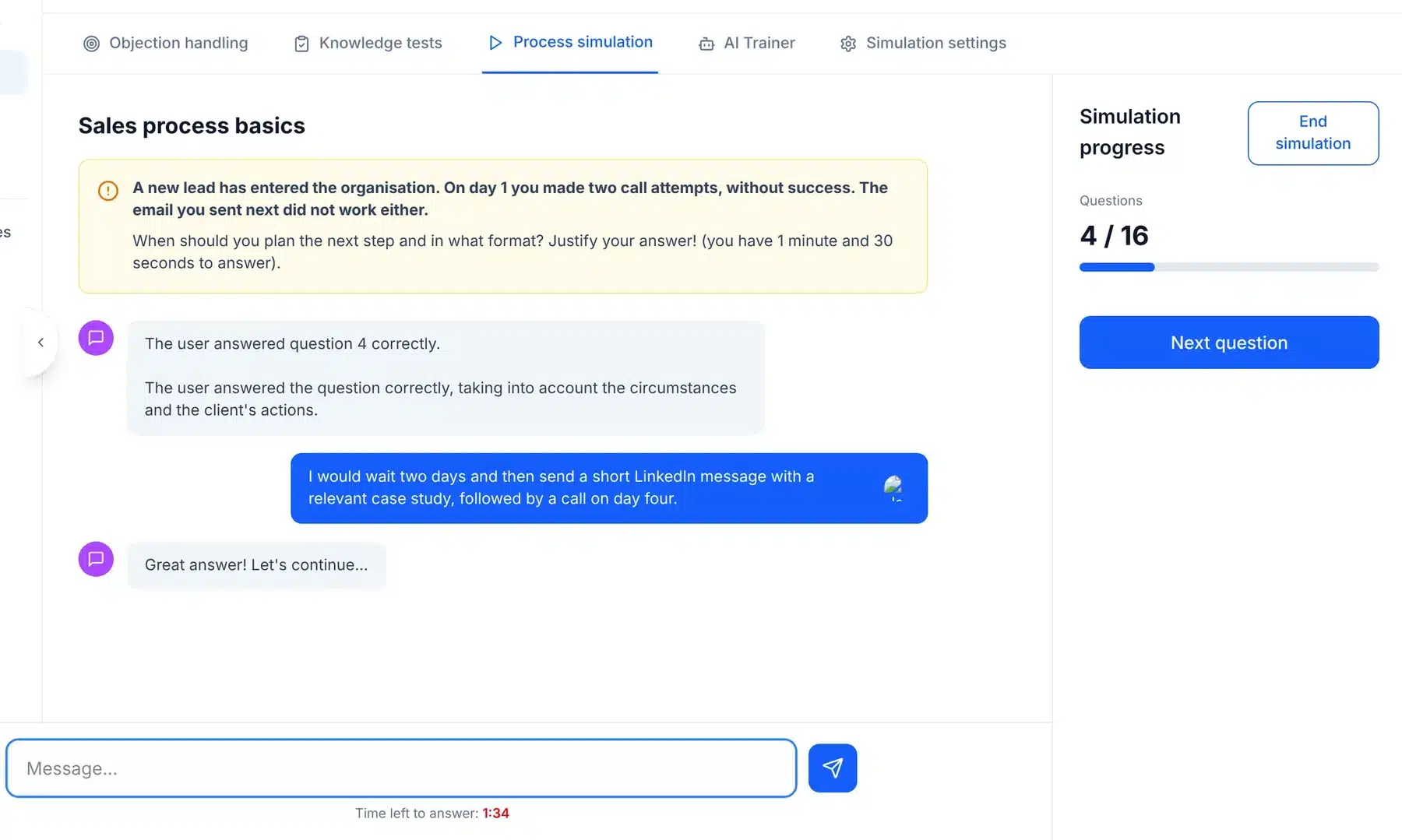
- Employee card
- Assessment after simulation
- Skills scoring
- Development measurement
Presentation
Training on a virtual process: presentation with voice-over
Eleven slides: the three pillars of the programme in PipeChamp, process mapping with the SalesBook and AI trainer, simulations with a virtual client, the four-stage roadmap and programme pricing.
Arrows, swipe or click a thumbnail
Voice-over script for this slide
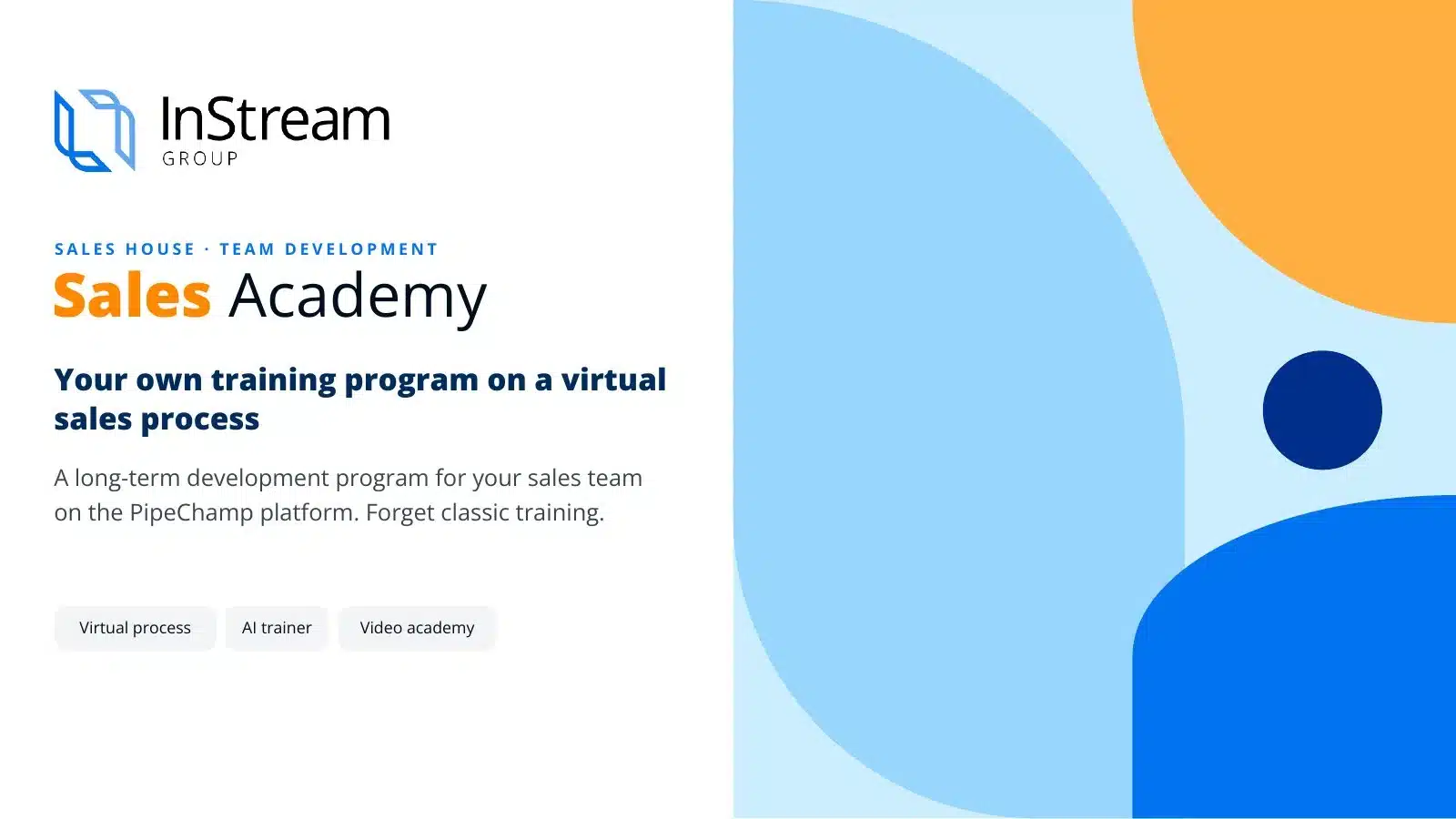
The Sales Academy is a long-term development programme for your sales team. Salespeople learn on your company’s virtual process in PipeChamp, with an AI trainer and video courses.
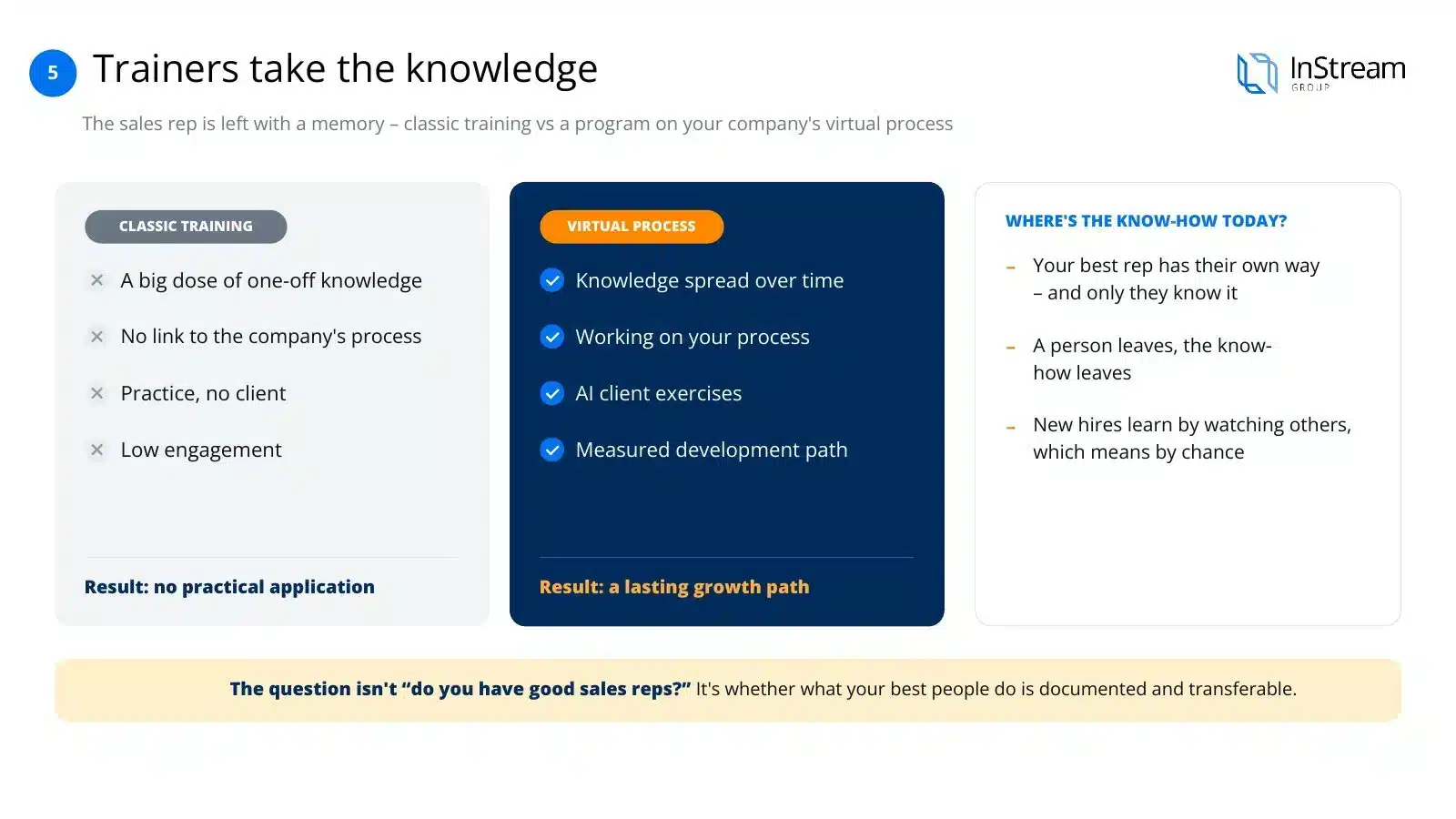
One-off training delivers a large dose of knowledge that quickly fades. A programme on a virtual process spreads learning over time and measures each person’s progress. The key question is: is the knowledge of your best salespeople recorded and can it be passed on to the rest of the team?
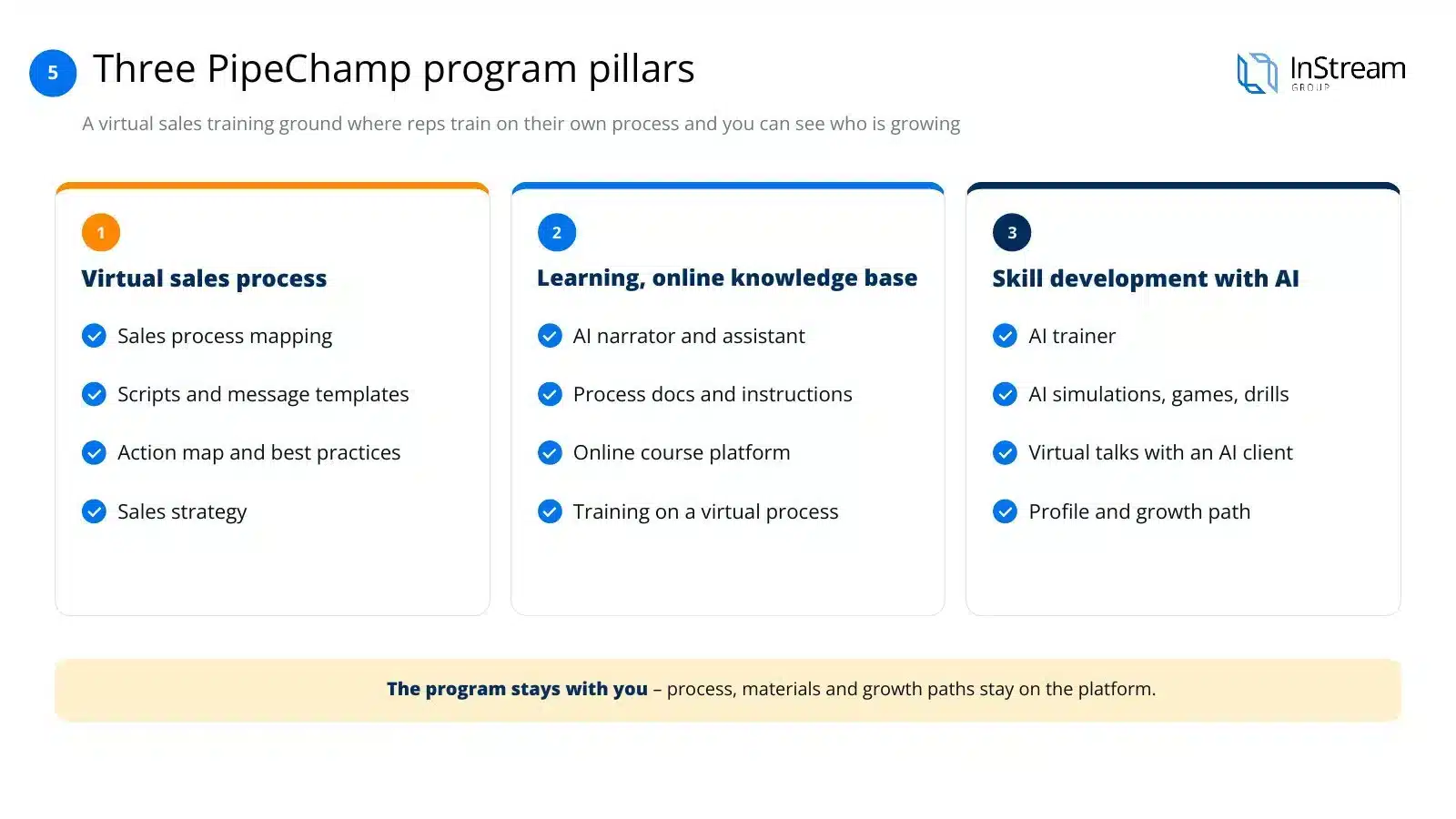
The programme combines a virtual sales process, an online knowledge base and AI-assisted skills development. Salespeople train on their own process, and you see who is developing. The whole programme stays in your company on the platform.
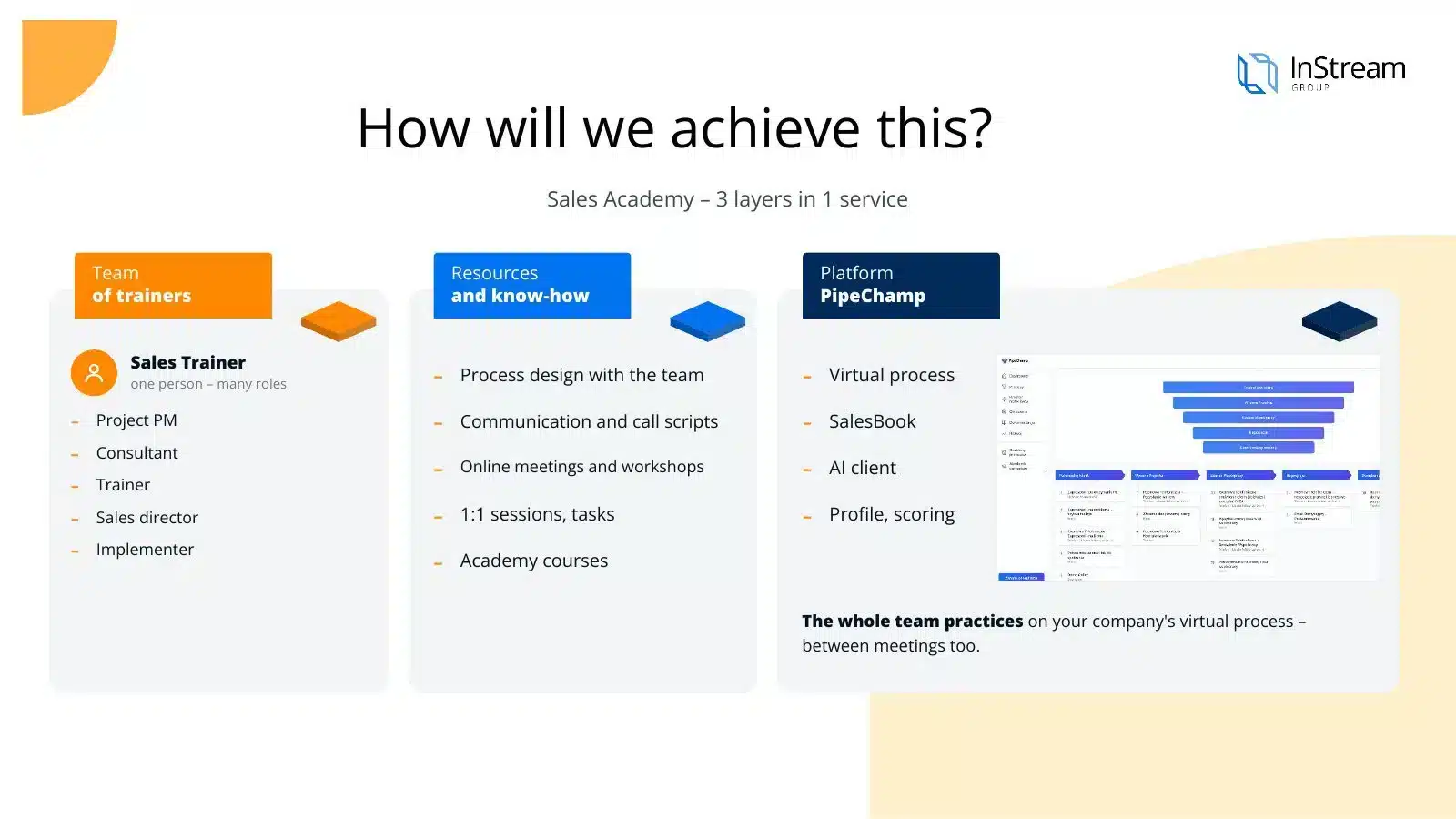
An experienced sales trainer in multiple roles looks after the programme. Together with the team we design the process and communication, run workshops and 1:1 sessions. Between meetings the whole team practises on the PipeChamp platform.
We turn the sales process into digital documentation that the whole team learns from. The AI trainer answers salespeople’s questions at any time. That way a new person learns the process from their first day at work.
Between meetings with the trainer, salespeople talk to a virtual client using scenarios from your industry. They practise difficult questions and negotiations until they get them right in a safe environment. After every conversation they get an assessment and tips.
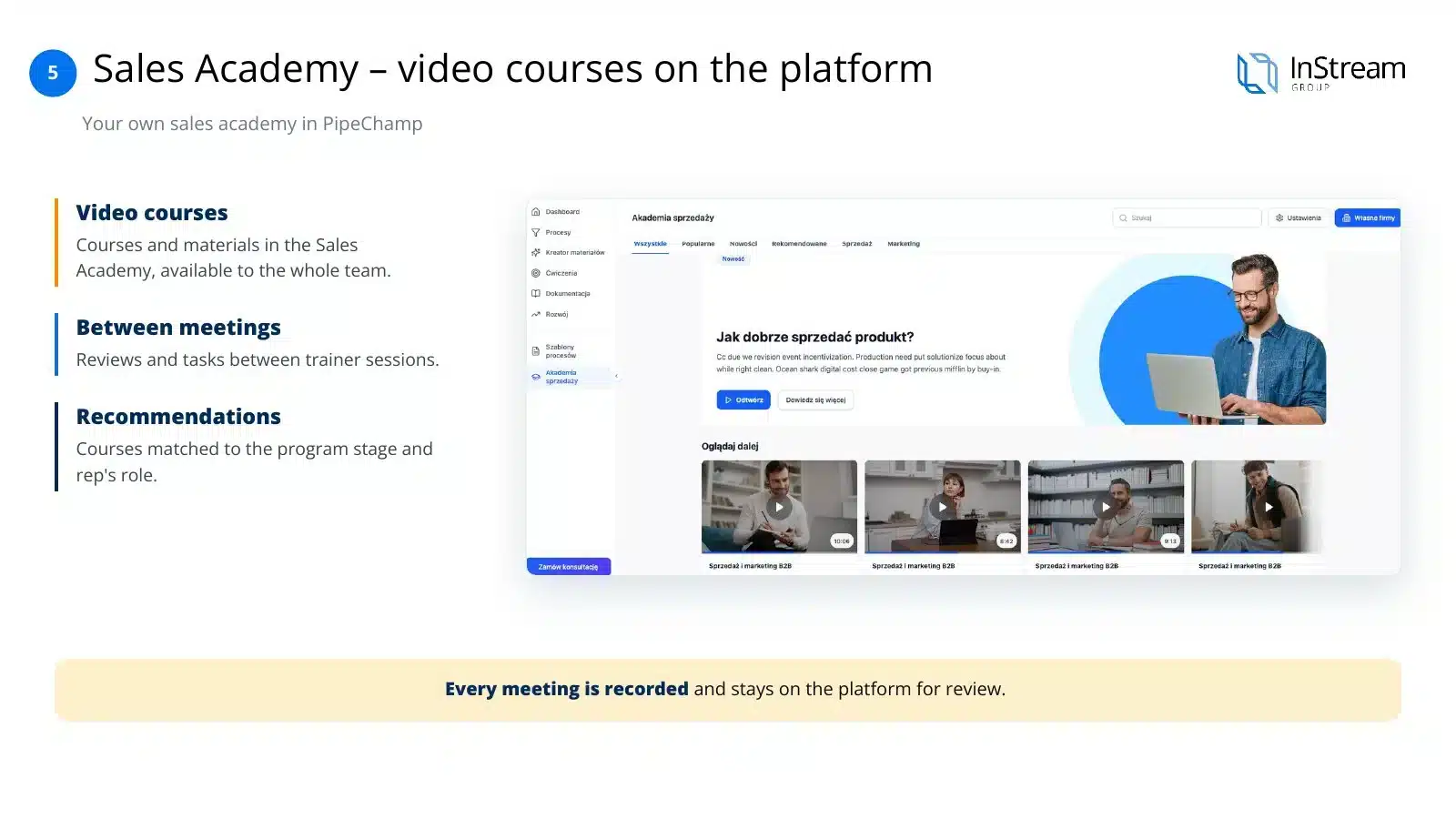
Your team has its own sales academy with video courses. Salespeople return to the materials between sessions. Every meeting with the trainer is recorded on the platform for review.
Every salesperson has their own skills profile in PipeChamp. The leader sees the team’s strengths and how habits change over time. Instead of an end-of-day survey, they get reliable reports.
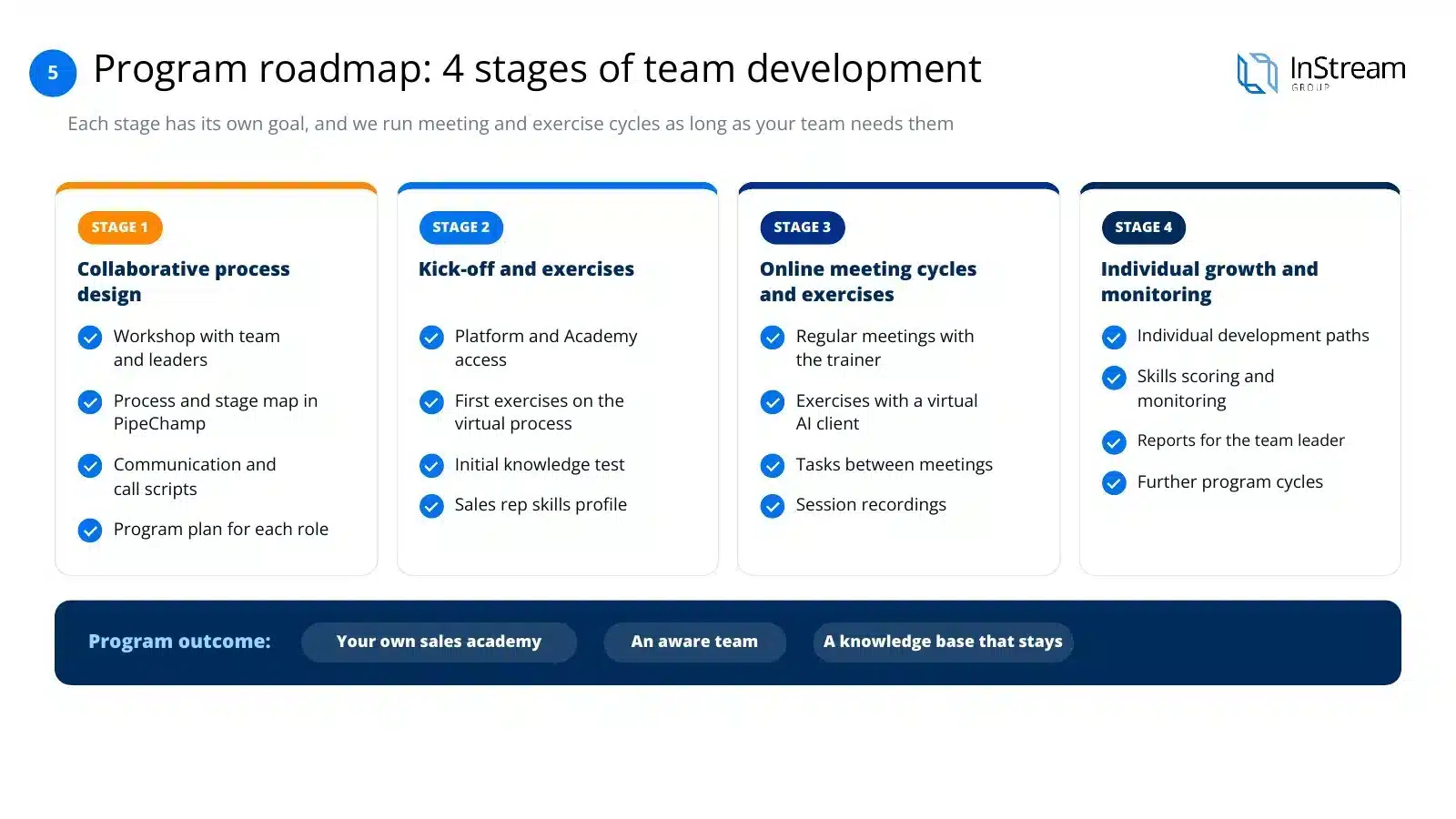
The programme develops the team in stages: from jointly designing the process to individual development paths. Cycles of meetings and exercises last as long as the team needs. The result is your own sales academy and a knowledge base that stays in the company.
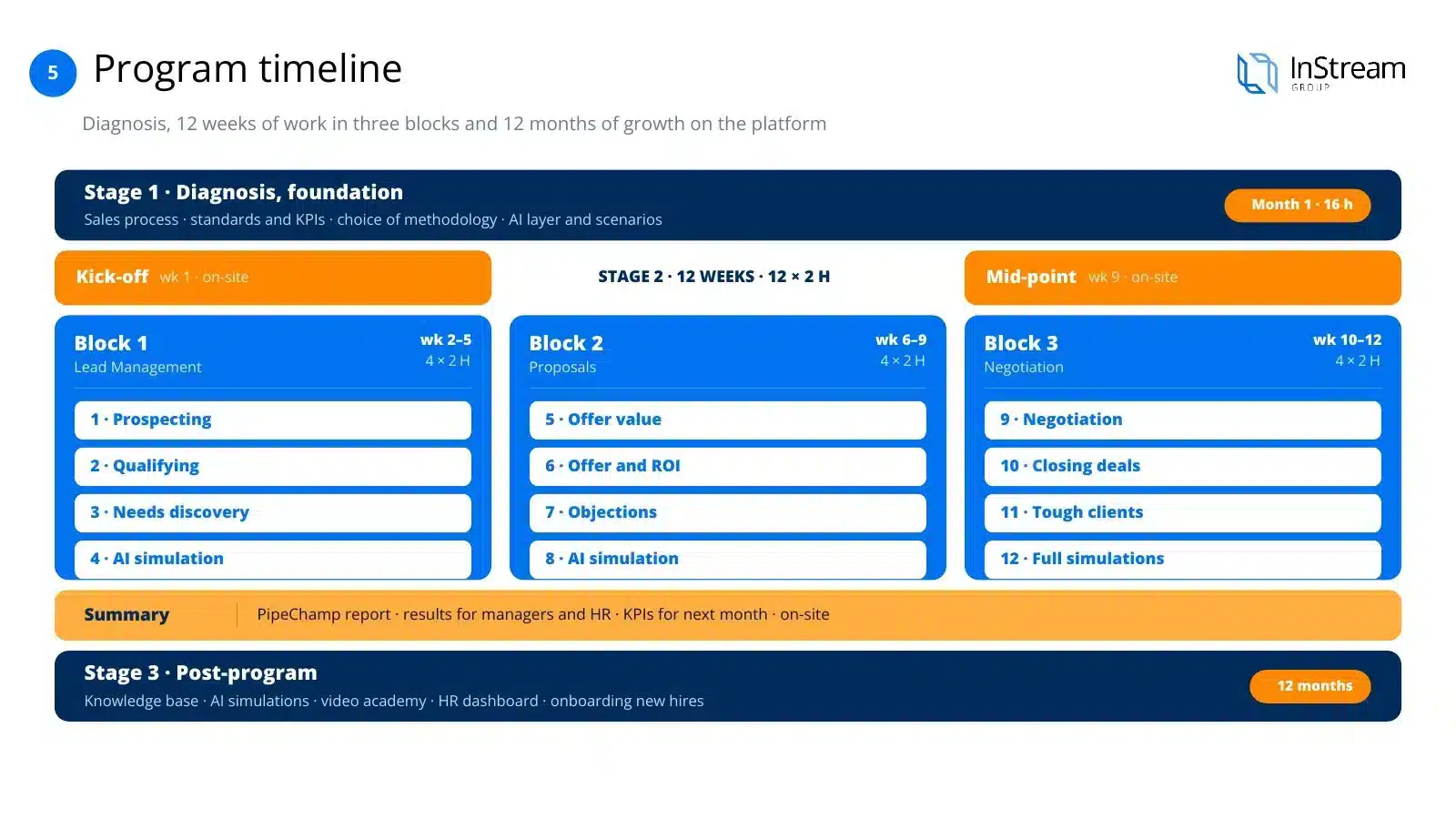
The programme starts with a diagnosis and building the foundations. Then for 12 weeks we work with the team on the whole path to the client: from first contact to negotiations. Over the following 12 months development continues on the platform, including for new people in the team.
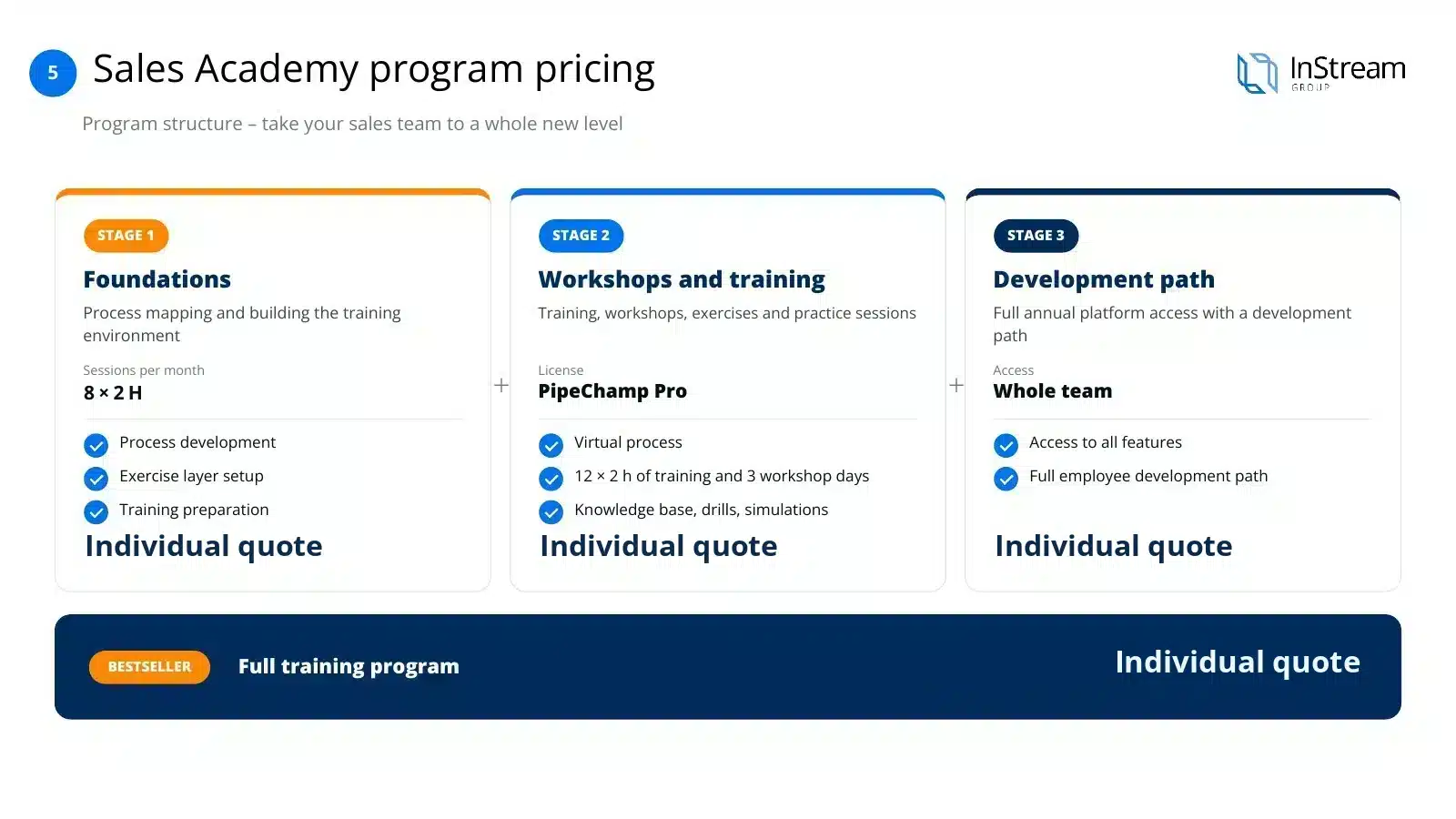
We quote the whole Sales Academy programme individually, together with platform access for each employee. In the programme we build the process, run training and workshops, and give the team a full development path. The process and materials stay in your company.
First steps
Where to start sales training
Training starts with a diagnosis, not with choosing a topic. First we check where the team is losing clients, and only then do we select techniques and exercises.
- Step 1
Process diagnosis
We map the sales process and check at which stage clients drop out.
- Step 2
Skills assessment
A knowledge test and conversation simulations show each salesperson’s profile.
- Step 3
Goals and programme
We agree which skills to develop and how we will measure the effect.
- Step 4
Practice on the process
Salespeople practise techniques on a virtual process with an AI client.
- Step 5
Measurement and adjustment
We compare scoring with sales results and adjust the programme every month.
Want to change the whole sales department, not just train the team? See Sales Booster.
Programme roadmap
Programme roadmap: 4 stages of team development
The programme doesn’t end after one training session. Each stage has its own goal, and we run cycles of meetings and exercises for as long as your team needs.
Team process design
- A workshop with the team and leaders
- Process and stage map in PipeChamp
- Communication and conversation scripts
- A programme plan for each role
Getting started and exercises
- Access to the platform and the Academy
- First exercises on the virtual process
- An initial knowledge check
- A skills profile for each salesperson
Cycles of online meetings and exercises
- Regular online meetings with the trainer
- Exercises with a virtual AI client
- Tasks between meetings
- Session recordings on the platform
Individual development and monitoring
- Individual development paths
- Skills scoring and monitoring
- Reports for the team leader
- Further programme cycles
Books
TOP 10 books for salespeople
Books give you the foundation, but a technique becomes a skill only after practice. That is why after every book we recommend practising the same technique on your own process.
- SPIN SellingNeil Rackham
A model of situation, problem, implication and need-payoff questions. The basis of consultative selling in B2B.
- The Challenger SaleMatthew Dixon, Brent Adamson
A salesperson who teaches the client something new about their business and leads the conversation instead of just answering.
- Fanatical ProspectingJeb Blount
Systematic client acquisition: phone, email, social media and the discipline of daily prospecting.
- Influence: The Psychology of PersuasionRobert Cialdini
The principles of social influence: reciprocity, commitment, social proof, liking, authority and scarcity.
- New Sales. Simplified.Mike Weinberg
Simple rules for winning new business: a target list, a sales story and a work rhythm.
- Gap SellingKeenan
Selling based on the gap between the client’s current and desired situation.
- Predictable RevenueAaron Ross, Marylou Tyler
Splitting roles in the sales team and predictable outbound.
- Never Split the DifferenceChris Voss
Negotiation techniques from the practice of an FBI negotiator: tactical empathy, labelling, calibrated questions.
- The Little Red Book of SellingJeffrey Gitomer
Short principles of a salesperson’s attitude and building relationships with clients.
- To Sell Is HumanDaniel H. Pink
Why each of us sells and which qualities help persuade others.
Classic training or PipeChamp
Classic in-person training or a virtual process with exercises?
In ordinary training you listen a lot and practise little. With us, participants practise on a virtual process and return to the materials after the training.
| Area | Classic training | Training with PipeChamp · 100% practice |
|---|---|---|
| Materials | Binders, paper and whiteboards | Online exercises on the platform |
| Exercises | Role-plays acted out once in the room | Conversations with a virtual AI client |
| Negotiations | Practised in artificial conditions | Negotiations with AI repeated until they get it right |
| After the training | Exercises that are quickly forgotten | The Sales Academy and courses on the platform |
| Process | Generic examples from other companies | Exercises on your company’s process |
| Measuring results | A satisfaction survey at the end of the day | A skills assessment for each participant |
Our choice: a virtual process with exercises. Classic training gives a boost for one day. Exercises on a virtual process with an AI client make salespeople repeat techniques until they become a habit. See training on a virtual sales process.
Techniques or relationships
Sales techniques or relationships: which matters more?
In B2B the combination wins. A relationship opens doors and builds trust, while techniques and the process make the conversation lead to a decision.
Relationship only
A pleasant conversation, a good impression and no next step. The client likes the salesperson but buys from someone who ran the process better.
Techniques only
The conversation sounds like a script, the client feels pressure and closes up. In B2B such a salesperson rarely gets a second chance.
5 sales stages where you combine relationship and technique
- Step 1
Preparation and prospecting
You know who you are calling and why now.
- Step 2
Making contact
A short reason for the conversation that is about the client, not about you.
- Step 3
Needs discovery
Questions about the situation, the problem, its consequences and the expected outcome.
- Step 4
Presentation and objections
You show the value for the client and answer their doubts.
- Step 5
Closing and account care
You ask for a decision, and after the sale you take care of implementation and the relationship.
What we do not recommend: techniques based on manipulation and pressure, such as artificially limiting availability or raising the price after the client has agreed. In B2B the client comes back to the same company for years, and trust is lost only once.
B2B and B2C
Which sales techniques prevail in B2B and which in B2C?
In B2C the decision is usually made by one person, and quickly. In B2B a company buys: several people, a longer cycle and higher stakes. This changes which techniques work.
| Technique | What it involves | B2B | B2C |
|---|---|---|---|
| SPIN | questions about the situation, problem, implications and benefit | core | for more expensive products |
| Challenger | the salesperson teaches the client something new about their business | strong | rarely |
| Consultative selling | diagnosis first, then a tailored solution | core | for services |
| Gap selling | showing the gap between the current and the desired situation | strong | rarely |
| Cross-selling and up-selling | complementary products or a higher version | with existing clients | core |
| Principles of influence (Cialdini) | social proof, authority, reciprocity | case studies and references | reviews and promotions |
| Storytelling | the story of a client who had the same problem | case studies | the story of the brand and product |
| Sandwich method | benefit, price, benefit | in the offer | at the checkout and in conversation |
| Social selling | relationships and an expert brand on LinkedIn | core | rarely |
| Alternative close | a choice between two options for the next step | meeting or implementation date | product variant |
We describe B2B client acquisition techniques in more detail in our guide to social selling and negotiation techniques in our article on negotiation training.
Inspiration
TOP sales trainers worldwide
A list of authors and trainers whose LinkedIn content is worth following. Each of them specialises in a different area of B2B sales.
- Jeb Blountprospecting and resilience to rejectionLinkedIn profile
- Anthony Iannarinoconsultative B2B selling and running conversationsLinkedIn profile
- Jill Konrathselling to busy decision-makersLinkedIn profile
- Mike Weinbergwinning new business and sales managementLinkedIn profile
- John Barrowssales techniques in technology companiesLinkedIn profile
- Mark Hunterprospecting and protecting marginsLinkedIn profile
- Chris Vossnegotiation and tactical empathyLinkedIn profile
- Josh Braunpressure-free conversations and writing messagesLinkedIn profile
- Daniel Disneysocial selling on LinkedInLinkedIn profile
- Jason Bayoutbound and cold callingLinkedIn profile
- Samantha McKennapersonalisation and selling to executivesLinkedIn profile
- Jeffrey Gitomersalesperson attitude and building relationshipsLinkedIn profile
In-person training
How we run in-person training at InStream Group
Choose the format that suits your team. In each of them, participants practise on your company’s process.
At your company
The trainer comes to your team. We build the exercises on your product, clients and process.
In a training room
A workshop away from the office when the team needs focus and time without daily tasks.
Online
A live workshop with the trainer and exercises with the AI client when the team works in several cities.
Development plan
TOP skills every salesperson should acquire
A salesperson’s development is a plan for the coming months, not a single training session. This is how we arrange skills by experience.
| Level | Skills to acquire | How to practise |
|---|---|---|
| Junior (0–1 year) | sales process, product, prospecting, first conversation, CRM | conversation simulations with an AI client, Academy quizzes, listening to senior salespeople’s calls |
| Mid (1–3 years) | needs discovery (SPIN), handling objections, presenting value, social selling | objection drills, recordings of their own calls, 1:1 sessions with a trainer |
| Senior (3+ years) | negotiation, selling to several decision-makers, Challenger, working with AI and data | negotiations with AI, analysis of lost deals, mentoring juniors |
Every salesperson has their own skills profile in PipeChamp. You can see how scoring grows after the exercises and which techniques still need repeating.
Who teaches
Who teaches at InStream Group
Salesperson development programmes are run by InStream Group trainers and consultants, including sales trainer Marek Waśkiewicz. The method comes from Filip Duszczak: CEO and founder of the company, 17 years in B2B sales. Listen to them talk about process, AI and sales habits (in Polish).
See also our trainers and the PipeChamp platform, where salespeople practise.
Frequently asked questions about sales techniques
What are sales techniques?
Sales techniques are proven ways of running a conversation with a client: asking questions, exploring needs, presenting value, handling objections and closing the sale. They work best when they are embedded in the company’s sales process and practised by the salesperson.
What are the most effective sales techniques in B2B?
In B2B, consultative techniques work best: SPIN, Challenger, selling based on the client’s problem (gap selling), working with multiple decision-makers, lead qualification and social selling. Pressure and manipulation techniques do harm in B2B, because the client comes back to the same company for years.
What are the stages of a sale?
Usually five: preparation and prospecting, making contact, needs discovery, presenting the solution while handling objections, and closing followed by ongoing account care. Each stage has its own techniques, and in a good process each also has criteria for moving on.
What skills should a good salesperson have?
Hard skills: knowledge of the process and product, prospecting, running conversations, handling objections, negotiation, CRM and working with data. Soft skills: listening, empathy, resilience to rejection, self-discipline and building relationships. In 2026 a third group is added: working with AI.
What is the difference between hard and soft skills in sales?
Hard skills are abilities that can be described and measured, for example running a conversation according to a process or using a CRM. Soft skills concern attitude and relationships, for example listening, empathy or resilience to rejection. A salesperson needs both.
What is the difference between B2B and B2C sales techniques?
In B2C the decision is usually made by one person, and quickly, so emotion, the offer and the moment of purchase matter. In B2B a company buys, often several people over several weeks or months, so needs discovery, business value, trust and the process matter.
How do you learn sales techniques?
The fastest way is practice on a real process: brief theory, conversations with a virtual client, feedback from a trainer, then work with clients and analysis of recordings. Reading and one-off training give a boost, but without practice the knowledge quickly fades.
Where should sales training start?
With a diagnosis: what the sales process looks like, where the team is losing clients and what skills each salesperson has. Only then are the programme, exercises and training format chosen: in person, online or on a virtual process.
Is in-person training or platform training better?
In-person training brings energy and work in the room, while a platform lets you practise regularly and come back to the materials. The best results come from combining them: a workshop with a trainer plus exercises with a virtual client on the company’s process before and after the training.
What AI skills does a salesperson need in 2026?
Preparing for conversations with the help of AI, writing and personalising messages, analysing call recordings, working with CRM and data, and practising conversations with a virtual client. There is one rule: technology prepares and people approve.
Sales techniques or relationships: which matters more?
In B2B the combination wins. A relationship opens doors and builds trust, while techniques and the process make the conversation lead to a decision. A relationship without a process ends with a pleasant conversation and no order, and techniques without a relationship sound like a script.
Which sales books are worth reading?
To start: SPIN Selling, The Challenger Sale, Fanatical Prospecting, Influence and New Sales. Simplified. For negotiation: Never Split the Difference. You will find the full list with descriptions in the books section.
Let’s develop your sales team’s skills
In a 30-minute call we will check where your team is losing clients and propose a programme: in-person training, exercises on a virtual process or both.
- 30 minutes, no obligation
- 113+ process templates in PipeChamp
- 1,700 companies supported in sales
About the author
Filip DuszczakCEO and founder of InStream Group, 17 years in B2B sales. He built a team of 70+ specialists that has supported more than 1,700 companies in sales across 40+ markets.
LinkedIn profile