Negotiation techniques 2026: methods that work in B2B sales

Filip Duszczak
CEO InStream Group
- Reading time: 18 minutes
- November 15 2026

Updated: · based on negotiation exercises in PipeChamp and the SalesBooster programme
Negotiation techniques are specific, repeatable moves in a conversation: how you open, give concessions, ask questions and respond to pressure. You use them to carry out the negotiation strategy you set before the conversation. The strategy says what you want to achieve and where your limit is, while the technique says how to do it at a given moment.
- 1,700+ companies supported in sales
- 250+ CRM implementations
- 113+ sales process templates in PipeChamp
In short
- Techniques only work when there is a strategy behind them: a goal, a concession limit and an alternative (BATNA).
- We describe 17 techniques in three groups: value-building, hard (use with care) and buyer tactics you need to recognise.
- Every technique comes with an example phrase, pros and cons.
- The right technique depends on your industry, the deal value and whether the relationship should last for years.
- Whether a technique is fair depends on intent: does the client leave the conversation fully informed and free to choose?
- The fastest way to learn techniques is practice with an AI virtual client on your own sales process.
- Types of negotiation strategy
- Why strategy beats technique
- Classroom training or virtual client
- 17 techniques with pros and cons
- The InStream Group method
- Video: practice in PipeChamp
- Traits of a good negotiator
- TOP negotiation books
- Techniques by industry
- Technique or intent
- Books on sales techniques
- InStream training demo
- FAQ
Trusted by 1,700 companies from Poland and around the world
Foundation
Types of negotiation strategy: the foundation for techniques
Before you choose a technique, choose a strategy. The same technique fits one strategy and hurts in another.
- win-win
Collaboration
When in B2B
Long relationships, multi-year contracts, account growth.
Techniques that fit
- Bundling variables
- Options to choose from
- Calibrated questions
- Concession for concession
- win-lose
Competition
When in B2B
One-off deals and tenders.
Techniques that fit
- Anchoring
- Decreasing concessions
- BATNA
- Time pressure
Compromise
When in B2B
Similar power on both sides and little time.
Techniques that fit
- Concession for concession
- Decreasing concessions
- lose-win
Accommodation
When in B2B
A deliberate investment in a strategic client.
Techniques that fit
- A concession with a condition (reference, case study, longer contract)
Avoidance
When in B2B
Terms below your BATNA.
Techniques that fit
- BATNA
- Withdrawing the offer
Strategy, method and technique: the difference
- 01
Strategy
What you want to achieve and where your limit is.
Example: collaboration with a minimum price and a list of trade-offs instead of a discount.
- 02
Method
How you run the whole negotiation.
Example: the Harvard method, interest-based negotiation.
- 03
Technique
A single move in the conversation.
Example: anchoring, silence, a calibrated question.
A full overview of strategies, BATNA and ZOPA is in our article on negotiation training: virtual client and negotiation strategy.
Strategy
Why strategy matters more than technique
A salesperson who knows 30 techniques but not their own limit still ends the conversation with a discount. A technique is a tool, and the strategy says when to use it.
How much profit a discount takes at different margins is shown in the table on the impact of negotiation on sales results.
Learning techniques
Classroom training or virtual client: how to learn negotiation techniques
You cannot learn techniques from slides. You have to repeat them in conversation until they work under pressure. Here are three ways to learn:
Lecture and case study
- Number of repetitionsLow
- Scenario from your processRarely
- FeedbackGeneral
- Manager’s timeLow
- Progress trackingNone
Role-play with a trainer
- Number of repetitionsA few per session
- Scenario from your processYes, if the trainer prepares it
- FeedbackFrom the trainer after the conversation
- Manager’s timeHigh
- Progress trackingTrainer’s assessment
AI virtual client (PipeChamp)
- Number of repetitionsUnlimited
- Scenario from your processYes, the “Negotiation” stage of your process
- FeedbackAI trainer after every conversation, with flashcards
- Manager’s timeLow
- Progress trackingScore on the competence card
The best results come from combining both: the trainer demonstrates the technique and runs role-plays, and salespeople repeat it with the virtual client until it works. More on this approach: virtual sales process training.
Want to see a conversation with an AI virtual client?
Book a demoCheat sheet
The most popular negotiation techniques: 17 methods with pros and cons
Each technique has a one-sentence definition, an example phrase you can use with a client, and its pros and cons in B2B sales.
Choose a technique from the list. Each one has an example phrase, when to use it, the risk, and its pros and cons.
Value-building techniques: use them
Technique 1 of 17 · Value-building techniques
1. First offer with a rationale
You open with your own proposal and immediately explain what the price is based on.
We propose €11,000, because the price includes implementation and three months of support.
You set the reference point for the whole conversation.
The buyer gets an argument to defend the price internally.
Requires good market knowledge.
An offer that is too high without a rationale damages trust.
Technique 2 of 17 · Value-building techniques
2. Anchoring (high opening)
The first number in the conversation shifts how all later numbers are judged.
Projects of this scale usually fall between €14,000 and €16,000.
Leaves room for concessions.
Works even on experienced buyers.
An extreme anchor ends the conversation.
Does not fit tenders with a public price list.
Technique 3 of 17 · Value-building techniques
3. Concession for concession
You trade every concession for something: timing, volume, contract length or a reference.
I can extend the payment terms if we sign a 12-month contract.
Protects your margin.
Teaches the buyer that nothing is free.
Requires a list of trade-offs before the conversation.
Makes hard negotiations longer.
Technique 4 of 17 · Value-building techniques
4. Decreasing concessions
Each concession is smaller than the previous one.
The first adjustment is 5%, the next one 2%. We cannot go further.
Signals that you are approaching your limit.
Limits further demands.
Requires a plan of steps before the conversation.
Used mechanically it looks like a game.
Technique 5 of 17 · Value-building techniques
5. Bundling variables
You negotiate several elements at once: price, timing, scope and payment terms.
Let’s keep the price and agree what we change in scope and schedule to fit your budget.
Moves the conversation from price to value.
Makes a win-win outcome easier.
The package is harder to calculate.
You need to know who approves the package on the client side.
Technique 6 of 17 · Value-building techniques
6. Options to choose from
Instead of one price you offer two or three versions.
We have a basic, standard and full package. Which one fits your plan best?
The conversation is about which option, not whether to buy.
The client matches the scope to the budget.
Too many options paralyse the decision.
Differences between options must be clear.
Technique 7 of 17 · Value-building techniques
7. Calibrated questions
You ask “how” and “what” questions that hand the problem back to the other side.
How are we supposed to deliver this scope on this budget?
You uncover the buyer’s real constraints.
You do not have to say “no”.
Requires practice with tone of voice.
Asked too early they sound evasive.
Technique 8 of 17 · Value-building techniques
8. Labelling emotions
You name out loud what you hear in the buyer’s words.
It sounds like you are worried about implementation during peak season.
Lowers tension in the conversation.
The buyer clarifies the concern on their own.
A wrong label irritates.
Can come across as patronising.
Technique 9 of 17 · Value-building techniques
9. Mirroring
You repeat the last two or three words of the other person as a question.
Too expensive compared with your current supplier?
Encourages the other person to elaborate.
Builds rapport without extra arguments.
Overused, it sounds mechanical.
Does not work by email.
Technique 10 of 17 · Value-building techniques
10. Silence
After making an offer or hearing a demand, you wait for the other side to respond.
That is our proposal. (pause)
The other side often softens its position on its own.
It costs nothing.
Hard for many salespeople.
Online it can look like a connection problem.
Technique 11 of 17 · Value-building techniques
11. BATNA as leverage
You calmly show that you have an alternative if no agreement is reached.
If we cannot find common terms, we have another project in that time slot.
Gives you strength without aggression.
Helps you turn down bad terms.
A bluff about alternatives is easy to check.
Overemphasised, it sounds like a threat.
Hard techniques: use with care
Technique 12 of 17 · Hard techniques
12. Time pressure
An offer or a condition is valid until a specific date.
We can reserve this implementation slot until Friday.
Speeds up the decision.
Organises the schedule on both sides.
A fake deadline destroys credibility.
The buyer can easily check it.
Technique 13 of 17 · Hard techniques
13. Withdrawing the offer
When the buyer stalls and keeps adding demands, you withdraw part of the terms.
With further scope changes we can no longer keep the free training.
Stops the stream of new demands.
Clearly shows your limit.
Risks ending the talks.
Does not fit long relationships.
Technique 14 of 17 · Hard techniques
14. Splitting the difference
Both sides split the gap between their offers in half.
Let’s meet halfway.
Ends the conversation quickly.
Gives both sides a sense of fairness.
Rewards whoever opened with an extreme anchor.
It is the shortest route to a discount.
Buyer tactics: recognise and respond
Technique 15 of 17 · Buyer tactics
15. Salami
The buyer asks for small concessions one by one until together they eat your margin.
Response: Let’s collect all your expectations before I answer each of them.
After agreeing on price, more “small” requests keep coming.
Collect the list of demands, price them together and trade every concession for something.
Technique 16 of 17 · Buyer tactics
16. Dead fish
The buyer makes an absurd demand and then “generously” drops it in exchange for your concession.
Response: I understand that demand is off the table. Let’s go back to what we agreed.
The demand is unrealistic and the buyer drops it quickly.
Do not treat dropping the demand as a concession you have to pay for.
Technique 17 of 17 · Buyer tactics
17. Good cop, bad cop and the absent authority
The other side plays two roles, or the buyer hides behind a board decision.
Response: Who besides you makes the decision? Let’s invite that person to the next meeting.
One person pushes and the other “helps”. Or every agreement needs “the boss’s approval”.
Treat both roles as one party and establish at the start who decides.
Anchoring, time pressure and “final price” from the defensive side are covered in our article on negotiation methods and strategies.
Want to practise these techniques on your company’s sales process?
Book a demoThe InStream Group method
The InStream Group method: practice on a virtual process and a negotiation strategy
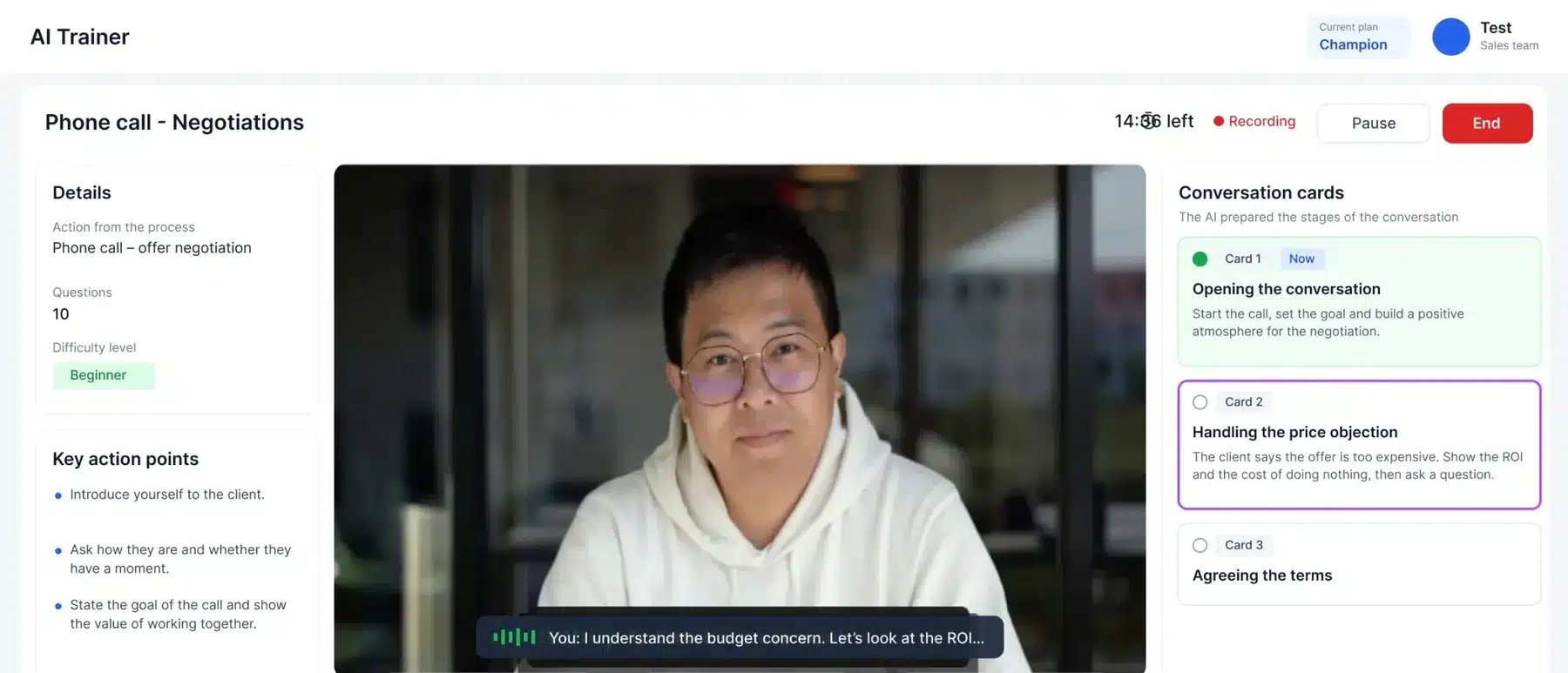
We practise techniques on your company’s sales process in PipeChamp, not on textbook examples. This way salespeople train exactly the conversations they have with clients.
- Step 1
Process and negotiation stage
Your company’s sales process in PipeChamp with a separate “Negotiation” stage.
- Step 2
Negotiation strategy
A strategy sheet for the stage: goal, limits, concessions and trade-offs.
- Step 3
Choosing techniques
4–6 techniques matched to your industry and your clients.
- Step 4
Sparring with a virtual client
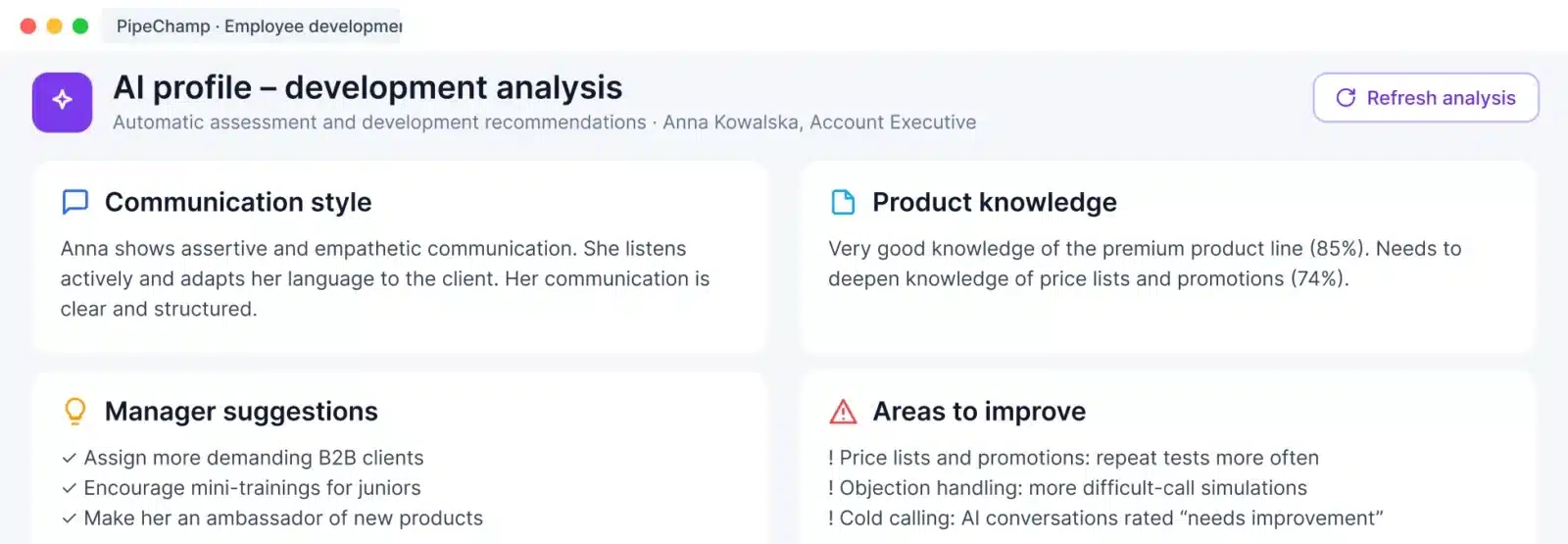
Conversations with an AI client, AI trainer flashcards and a score on the competence card.

Video
Video: what practice in PipeChamp looks like
See in three minutes how a salesperson practises conversations on a virtual sales process: with a virtual client, an AI trainer and a competence card that shows progress.
Virtual sales process trainingSalesBooster
Negotiation techniques practised on your company’s process
In SalesBooster your team practises techniques with a virtual client in PipeChamp, and we write the negotiation strategy into the sales process and the CRM.
- A dedicated trainer-consultant for 4 months
- Negotiation strategy and concession policy for your offer
- PipeChamp with an AI virtual client
- CRM implemented and results measured
Clients and their stories
Our clients' success and satisfaction matter most to us. Join more than 1,700 companies worldwide for which we have generated leads.
Case study
Emitel × InStream
Cold Email campaign: boosting in-building mobile network coverage.
105 hot leads350% of the guarantee deliveredClient testimonial
Mr Staff Support
Recruitment of drivers and workers from Asia. Magdalena talks about working with InStream.
Case study
Studio201 × InStream
Cold Email campaign for a software house: apps and AI implementations.
119 hot leads3 signed contractsClient testimonial
Packon
Cardboard packaging manufacturer. Konrad Wijata talks about working with InStream.
Case study
Personal System × InStream
Cold Email campaign for a permanent and temporary staffing agency.
40 hot leads in 3 months17,000+ messagesClient testimonial
Proexwork
Staffing agency. Maciej Krutul talks about working with InStream.
Case study
StethoMe × InStream
LinkedIn: the CEO's personal brand and US market outreach in 4 months.
607 invitations13.5% acceptance rateCase study
Iguana Group × InStream
Cold Email campaign to schools: sports equipment.
43 hot leads419 repliesClient testimonial
HSK Consulting
Employee hiring services. Jarosław Multan talks about working with InStream.
Client testimonial
MAAG Gear
LinkedIn campaign, 2 years of working together. Krzysztof Orłowski talks about working with InStream.
Client stories
See how we help companies like yours
Testimonials, case studies and campaign results from our clients in Poland and around the world.
See client storiesCompetences
TOP traits of a good negotiator
Each of these traits can be practised. For each one we give a single behaviour to start with.
Reading
TOP books on negotiation
Six books that develop your negotiation technique. Classics such as “Getting to Yes” are covered in our article on negotiation training.
- Difficult counterparts
Getting Past No
William Ury. How to handle a conversation when the other side attacks, stonewalls or plays dirty tricks.
- Preparation
Bargaining for Advantage
G. Richard Shell. Six foundations of effective negotiation and a test of your own negotiation style.
- Analysis
Negotiation Genius
Deepak Malhotra, Max H. Bazerman. Research on cognitive biases in negotiation and how to use it.
- The client’s decision
Start with No
Jim Camp. Why the right to say no gives both sides peace of mind and how to build the conversation around decisions.
- Improvisation
The Art of Negotiation
Michael Wheeler. Negotiation as learning during the conversation, not acting out a script.
- Questions
Ask for More
Alexandra Carter. Ten questions that help uncover both sides’ interests before making an offer.
Industries
Techniques by industry: how to match techniques to your market
The same technique works differently in a construction tender and in a SaaS licence negotiation. The choice depends on how the buyer compares offers and how long the relationship lasts.
Choose an industry to see which techniques work and which to avoid.
IT and SaaS
- Options to choose from (packages)
- Calibrated questions
- Concession for concession, for example a longer contract for a better rate
Fake time pressure and splitting the difference on licences.
Manufacturing and industry
- First offer with a cost rationale
- Bundling volume, timing and logistics
- BATNA
Good cop, bad cop and bluffing with the purchasing department.
Professional services
- Options to choose from
- Labelling concerns
- Negotiating scope instead of price
A discount without changing the scope of work.
Logistics and transport
- Bundling (volume, fixed routes, payment terms)
- Decreasing concessions
Splitting the difference when rates are compared with freight exchanges.
Distribution and wholesale
- Concession for concession (volume, thresholds)
- Decreasing concessions
- Silence
Withdrawing offers from regular clients.
Construction
- BATNA
- Bundling schedules and advance payments
- Recognising salami in contract amendments
High anchors in public tenders.
Want to match techniques to your industry and offer?
Book a demoEthics
Technique or intent: when a technique becomes manipulation
A technique is neither fair nor manipulative in itself. What matters is the intent and whether the client leaves the conversation fully informed and free to choose. Test yourself with three questions:
- Anchoring
Fair useA high offer justified by value and scope.
Manipulative useAn invented list price you then “discount” from.
- Time pressure
Fair useA real deadline, for example the availability of the implementation team.
Manipulative useA made-up deadline you move after every refusal.
- BATNA
Fair useA real alternative you mention calmly.
Manipulative useA competing offer that does not exist.
- Silence
Fair useTime to think after you make an offer.
Manipulative useDragging out silence to embarrass the other person.
- Labelling
Fair useNaming a concern in order to resolve it.
Manipulative usePlaying on emotions to rush the signature.
Reading
Books on sales techniques that help in negotiation
Good negotiation starts earlier, in the conversation about needs. These books teach the kind of selling that leaves less to negotiate.
- Questions
SPIN Selling
Neil Rackham. Situation, problem, implication and need-payoff questions that build value before the price conversation.
- Insight for the client
The Challenger Sale
Matthew Dixon, Brent Adamson. The salesperson who teaches the client and leads the conversation.
- Diagnosis
Gap Selling
Keenan. Selling based on the gap between the client’s current and desired state.
- System
You Can’t Teach a Kid to Ride a Bike at a Seminar
David Sandler. The Sandler method and an up-front contract at the start of every conversation.
- Influence
To Sell Is Human
Daniel H. Pink. Why moving others is a skill everyone needs, not only salespeople.
- Process
Predictable Revenue
Aaron Ross, Marylou Tyler. How to split roles in a sales team so the pipeline becomes predictable.
Want to build these skills in your team? See our sales training for salespeople.
Demo
Negotiation training demo at InStream
In the demo we will show you live what negotiation technique training on a virtual sales process looks like.
- A sales process with a “Negotiation” stage in PipeChamp
- A conversation with an AI virtual client
- AI trainer flashcards and the salesperson’s competence card
- A training plan for your team
Invest in your sales team
Fill in the form. We'll get back to you within 10 minutes.
Frequently asked questions about negotiation techniques
What are negotiation techniques?
Negotiation techniques are specific, repeatable moves in a conversation: how you open, give concessions, ask questions and respond to pressure. You use them to carry out the negotiation strategy set before the conversation.
What are the most popular negotiation techniques?
The most widely used techniques are anchoring, a first offer with a rationale, concession for concession, bundling variables, calibrated questions, silence and BATNA. Buyers often use salami, the dead fish and good cop, bad cop.
What is the difference between a negotiation technique and a strategy?
A strategy defines the goal, the concession limit and the alternative if no agreement is reached. A technique is a single move in the conversation that carries out the strategy, for example anchoring or silence.
What is the dead fish technique?
One side makes an absurd demand and then drops it in exchange for a concession from the other side. The best response is not to treat dropping an unrealistic demand as a concession.
What is the salami technique?
The buyer asks for small concessions one by one until together they take a large part of the margin. The response is to collect all demands before deciding and to price them together.
Are negotiation techniques manipulation?
Not by definition. Whether a technique is fair depends on intent: does the client leave the conversation fully informed and free to choose. Invented deadlines and non-existent competing offers are manipulation.
How many negotiation techniques should you know?
A few techniques practised well for your own industry are enough, usually four to six, plus the ability to recognise the most common buyer tactics.
Which negotiation techniques work in purchasing?
On the purchasing side, BATNA, bundling variables (volume, timing, payment terms), calibrated questions and decreasing concessions work best. Salespeople should be able to recognise the same techniques in buyers.
How can you practise negotiation techniques?
Most effectively in conversations based on scenarios from your own sales process: role-play with a trainer and repetitions with an AI virtual client, for example in PipeChamp, where an AI trainer assesses every conversation.
Which book on negotiation techniques should you read first?
Good starting points are the classic of interest-based negotiation, “Getting to Yes” by Fisher, Ury and Patton, and “Getting Past No” by William Ury on difficult counterparts.
SalesBooster
Want your team to negotiate with techniques, not discounts?
In SalesBooster we build the negotiation strategy into your sales process, match techniques to your industry and practise them with a virtual client in PipeChamp.
- 17 techniques with pros and cons
- Virtual client practice in PipeChamp
- 1,700+ companies supported in sales
About the author
Filip DuszczakCEO and founder of InStream Group, 17 years in B2B sales. He built a team of 70+ specialists that has supported more than 1,700 companies in sales across 40+ markets.
LinkedIn profile