Personal branding in sales: a guide for 2027

Filip Duszczak
CEO InStream Group
- Reading time: 35 minutes
- November 20 2026

Updated: · a guide for 2027 · data from InStream Group projects
A personal brand (personal branding) is the picture of your expertise that forms in your clients' minds before they ever talk to you: what you are an authority on, who you help and why it is worth asking your opinion. In B2B sales it is everything a decision-maker finds about you on LinkedIn, in Google and in AI assistants' answers before replying to your message.
In short
- A personal brand shortens the distance before the first sales conversation: the client knows who you are before they pick up the phone.
- You build it over quarters: a well-organised profile, regular content, a network in your target group and one image in every channel.
- In 2027 it also works in AI search engines, which describe experts based on their public content.
- Your personal brand is your capital
- Types of personal brands
- Average profile vs leader profile
- LinkedIn Marketing demo
- How to rebuild your profile
- How a brand affects sales
- Test: rate your brand
- Presentation with voice-over
- Client reviews
- Where to build a personal brand
- Employees' personal brands
- Personal brand vs company brand
- Visibility in Google and AI
- Brand consistency: an example
- How we build brands
- Client videos
- Calculator: reach your goal
- How to measure results
- Most common mistakes
- Pricing 2027
- Profile ranking
- FAQ
Trusted by 1,700 companies from 40 countries
Why it matters in 2027
Your personal brand is your capital
A personal brand is an asset that works for you in every sales conversation. In 2027, as the web is flooded with AI-generated content, the value of what AI cannot fake keeps growing: your name, your experience and your clients' trust.
The client checks you out before replying
Before a decision-maker answers your message or accepts a meeting invitation, they open your profile and read your last two posts. That minute decides whether the conversation happens at all.
The decision is made when you are not there
According to Gartner, B2B buyers spend only 17% of their buying time meeting potential suppliers. The rest is filled with what they find about you on their own. Your personal brand takes part in a conversation you are not physically in.
AI describes you based on your content
ChatGPT, Gemini and Google AI Overviews build answers from public sources and LinkedIn is one of them. Without a profile and posts, an AI assistant has nothing to learn about you from.
AI content is everywhere, a human is rare
The more automated posts and messages there are, the more an expert with a face, a voice and an opinion of their own stands out. You cannot buy that advantage in a tool.
People trust people, not logos
The LinkedIn algorithm shows posts from people more often than posts from company pages. Your network is reach that the company page cannot get to.
Capital that stays with you
Your network, recognition and reputation grow with every month of work. It is one of the few investments in sales that gains value over time.
Personal brand vs personal branding: are they the same?
Yes, in practice they are synonyms. To be precise: a personal brand is the result, the picture of you in your clients' minds. Personal branding is the method you use to build that picture deliberately: you choose topics, channels and proof of expertise. The concept was popularised by Tom Peters in his article "The Brand Called You".
What a personal brand is not
It is not a CV, because a CV talks about the past while a brand says what you can do for the client today. It is not popularity, because a thousand reactions from outside your target group do not bring a sales conversation. It is not a stunt or a one-off project: it is work spread over quarters.
Source: Gartner, "The B2B Buying Journey". We have completed 446 LinkedIn projects for B2B companies.
Personal branding with Sales House
Let's build your personal brand on LinkedIn
In a 30-minute call we will review your profile, agree on the goal of your brand and show you how we work on it in our Lead Astra platform.
- 446 LinkedIn projects
- 1,700 companies from 40 countries
- 30 minutes, no obligation
Types of personal brands
Types and archetypes of personal brands in B2B
In B2B sales we see five types of personal brands. Each has a different goal and a different publishing rhythm. Choose the one that fits your role: it determines your topics, formats and channels.
- Leader / CEO
The face of the company
Market vision, decisions and company values. Builds trust in the whole organisation and opens doors to boardrooms.
- Hands-on expert
Knowledge from projects
Data, conclusions and methods from their own work. This is the person who answers "how to do it" and gets quoted by AI.
- Salesperson-advisor
A trusted partner
Client problems, case studies and practical advice. Their posts turn into sales conversations.
- Creator / educator
The industry's teacher
Guides, videos, webinars and a newsletter. Builds reach and a community around a topic.
- Company ambassador
The voice of the team
An employee who shows what work looks like behind the scenes and the company culture. An employee advocacy programme has dozens of such people.
Your LinkedIn profile: how we rebuild profiles
An average profile or a leader's profile?
Your profile is the foundation of your personal brand on LinkedIn. You can see the difference immediately: in what a client, the LinkedIn algorithm and an AI search engine see when someone asks about you or your industry.
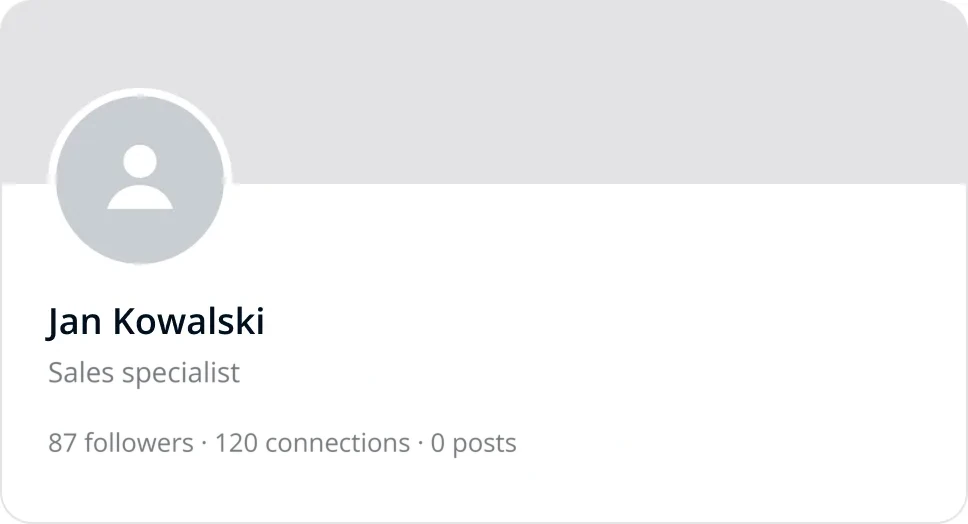
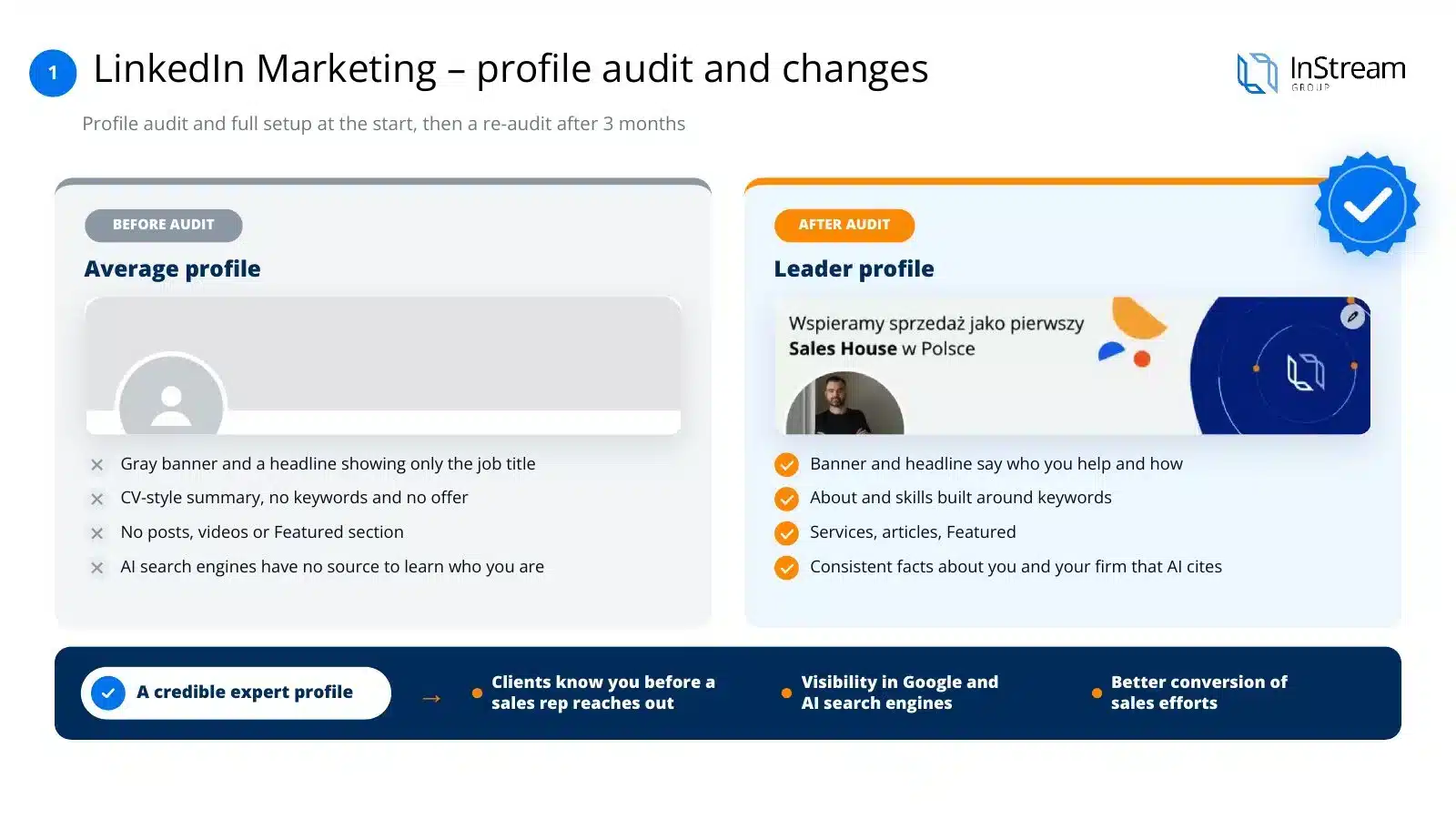
- A grey background and a headline that only states the job title
- A CV-style summary, with no keywords and no offer
- No publications, videos or Featured section
- AI search engines have nothing to learn who you are from
I couldn't find any reliable information about this person or what they do.
- The banner and headline say who you help and how
- About and Skills sections optimised for keywords
- Regular posts, videos and interviews that build knowledge about you
- Consistent information about you and your company that AI search engines cite
CEO of InStream Group, the first Sales House in Poland. On LinkedIn he shares knowledge about B2B sales, building sales teams and lead generation.
linkedin.cominstreamgroup.comIllustrative example. AI search engine answers depend on the question, the model and the available sources.
LinkedIn Marketing demo
See how we build leaders' personal brands on LinkedIn
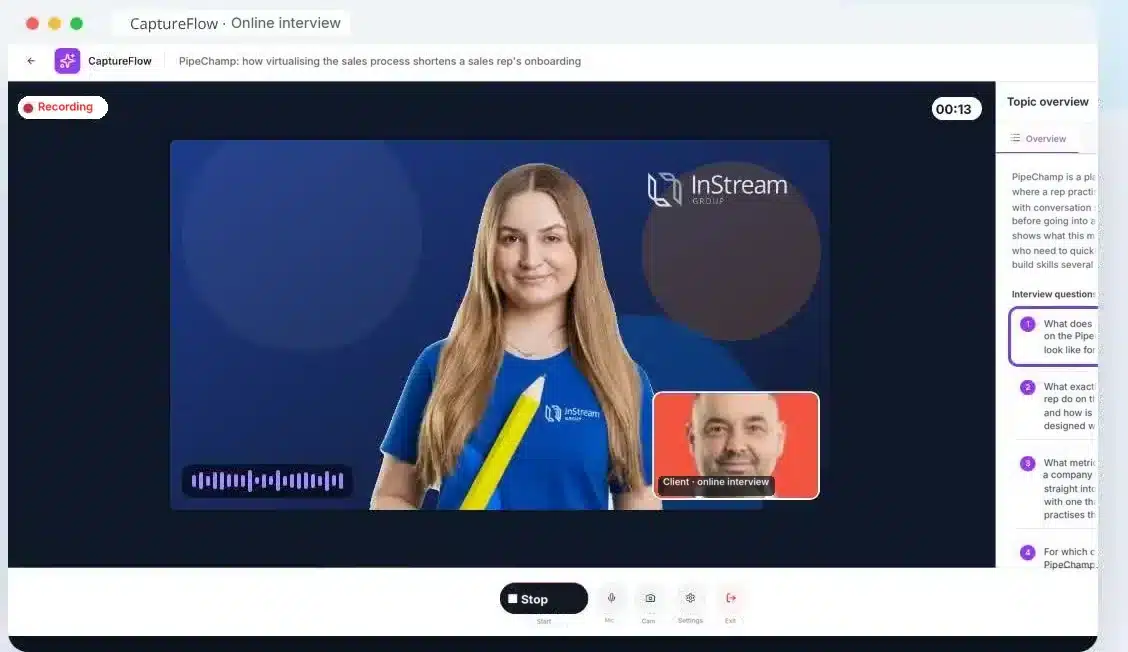
In under 4 minutes you will see the whole process: from strategy and an online interview, through posts and videos, to analytics in the platform.
Content is created on our platform: from the idea, through an online interview and recording, to publication and analytics. AI prepares drafts and the team refines them together with you.
- Posts
- Video posts
- Online interviews
- AI analytics
- Planning
What you will see in the video
The video shows work on a leader's personal brand step by step: a strategy meeting and choosing topics, an online interview with questions prepared in advance, turning one recording into posts and video posts, approving content in the Lead Astra platform calendar, and monthly analytics of reach, engagement and new contacts.
Rebuilding your profile
How to rebuild your LinkedIn profile: 7 steps
The seven steps we follow when we rebuild a profile after an audit. The same order works when you start on your own.
- 01
Goal and audience
Write down who should land on your profile and what they should do once they are there.
- 02
Headline
Up to 220 characters: who you help, with what and how you prove it.
- 03
Photo and banner
A portrait on a plain background. The banner shows your logo and 3–5 keywords.
- 04
About
The first 2–3 sentences are visible without expanding. Up to 2,600 characters: your story in the client's context and an invitation to get in touch.
- 05
Featured and services
A case study, an interview, a presentation and services from the LinkedIn list.
- 06
Experience and skills
Results instead of duties and 5 skills you want to be found for.
- 07
Network and content
Invitations to your target group and a publishing plan. A profile without activity loses reach.
Profile audit
What to fix in your profile first
In a profile audit we check more than 15 elements. Eight of them account for most of the effect, so that is where to start. As long as your profile looks like a CV for a recruiter, every post works at half power.
Profile photo
Sharp and bright, on a plain background, a portrait shot. It is the first thing the person you invite to connect sees.
Background photo
Your logo and 3–5 keywords about what you do. It works like a company business card and sets the first impression.
Headline
The pattern: role at company – I help whom with what. It is the only text shown next to every comment you make and in search results.
The "About" section
Up to 2,600 characters. The first two sentences must make people stop, then your story from the angle of the client's problem, and finally an invitation to get in touch.
Experience
Describe your roles in terms of results, not duties. It builds credibility before anyone asks for references.
Skills
A few phrases you want to be found for. LinkedIn treats them as search categories.
Services
Filled in as precisely as the LinkedIn list allows. A visitor immediately knows what they can come to you with.
Featured
Articles, recordings, interviews and presentations. The only place in your profile where you show proof instead of claims.
How a brand affects sales
How a personal brand affects B2B sales: the numbers
A personal brand does not replace the sales process. It works where the salesperson is not present: in the time buyers spend on their own research. Four figures from Gartner research show how little of that time is spent talking to you.
17%
of the buying process is the time B2B buyers spend meeting all potential suppliers. When they compare several, a single salesperson gets about 5–6%.
67%
of B2B buyers prefer to go through the buying process without contact with a sales rep. Before they call, they want to know who they are talking to.
77%
of buyers rate their last B2B purchase as very complex or difficult. They look for someone they can trust with that decision.
6–10
decision-makers take part in a complex B2B purchase. Each of them checks you separately: your profile, posts, interviews and reviews.
Sources: Gartner, "The B2B Buying Journey" (17%, 5–6%, 77%, 6–10 decision-makers) · Gartner, press release of 9 March 2026 (67%).
A strong personal brand
- A leader's profile with a clear headline and offer
- Regular posts, videos and interviews
- Visibility in Google and in AI assistants
- A network in your target group
- One image in every channel
What it changes in the funnel
The decision-maker knows you before they pick up the phone. An invitation from a recognised expert is not a cold contact, so the conversation starts with trust rather than introductions. In negotiations you talk about value, because the client compares your expertise and not just the price.
Funnel stages
No brand or a strong brand: 4 stages of sales
This is how a personal brand changes the course of a sale at every stage. We describe the mechanism we see in LinkedIn projects, without promising specific percentages, because they depend on the industry, the offer and the publishing rhythm.
- ReachprospectingNo brandAn invitation from an unknown person with an empty profile. The decision-maker does not know who you are, so they ignore the message or put it off.With a brandThe decision-maker has seen your posts and comments. They are more willing to accept an invitation from an expert in their industry and read the message to the end.
- Credibilityfirst conversationNo brandThe first minutes of the conversation go on introductions and proving that the company exists and has experience.With a brandThe client knows your views, case studies and way of thinking. The conversation starts with their problem, not with your CV.
- Closinggroup decisionNo brandEach decision-maker checks you separately and finds nothing but the offer. The decision drags on, because nobody wants to take on the risk.With a brandThe buying team finds consistent proof of expertise: publications, interviews, client reviews. It is easier to get the whole group to agree.
- Negotiationsposition and priceNo brandThe client compares mainly on price, because they see no difference between suppliers. A discount becomes the main argument.With a brandYou negotiate as an expert the client chose themselves. It is easier to defend the value of the offer than to drop the price.
Personal brand vs personal selling
Personal selling is the direct contact between a salesperson and a client: a conversation, a presentation, negotiations. A personal brand is the picture of that salesperson the client already has before the conversation starts. The brand prepares the ground, personal selling turns it into a contract.
Personal brand vs social selling
Social selling is the stage where visibility turns into a conversation: you reach the decision-maker directly, with a message that relates to their situation. The order works one way: visibility, reach, interest, meeting, retention. See how we run social selling on LinkedIn.
A 2-minute personal brand test
Rate your personal brand
Tick what you already have. Each item has its own weight and the indicator will show whether you already have a personal brand and what percentage of it is ready. The result is calculated in your browser, we do not save anything.
Your personal brand
0%
Your brand is just emergingClients have nowhere to learn about you yet. Start with your profile and headline, then set a steady publishing rhythm.
Calculated in your browser, no data saved.
- 0–39%
Your brand is just emerging
Clients have nowhere to learn about you. Start with your profile, headline and first posts.
- 40–69%
Brand under construction
You have the foundations. What is missing is regularity, proof and presence outside LinkedIn.
- 70–100%
You have a personal brand
Your brand works for sales. Time to scale it: video, media, speaking and your team.
Presentation with voice-over
LinkedIn Marketing: how we build leaders' personal brands
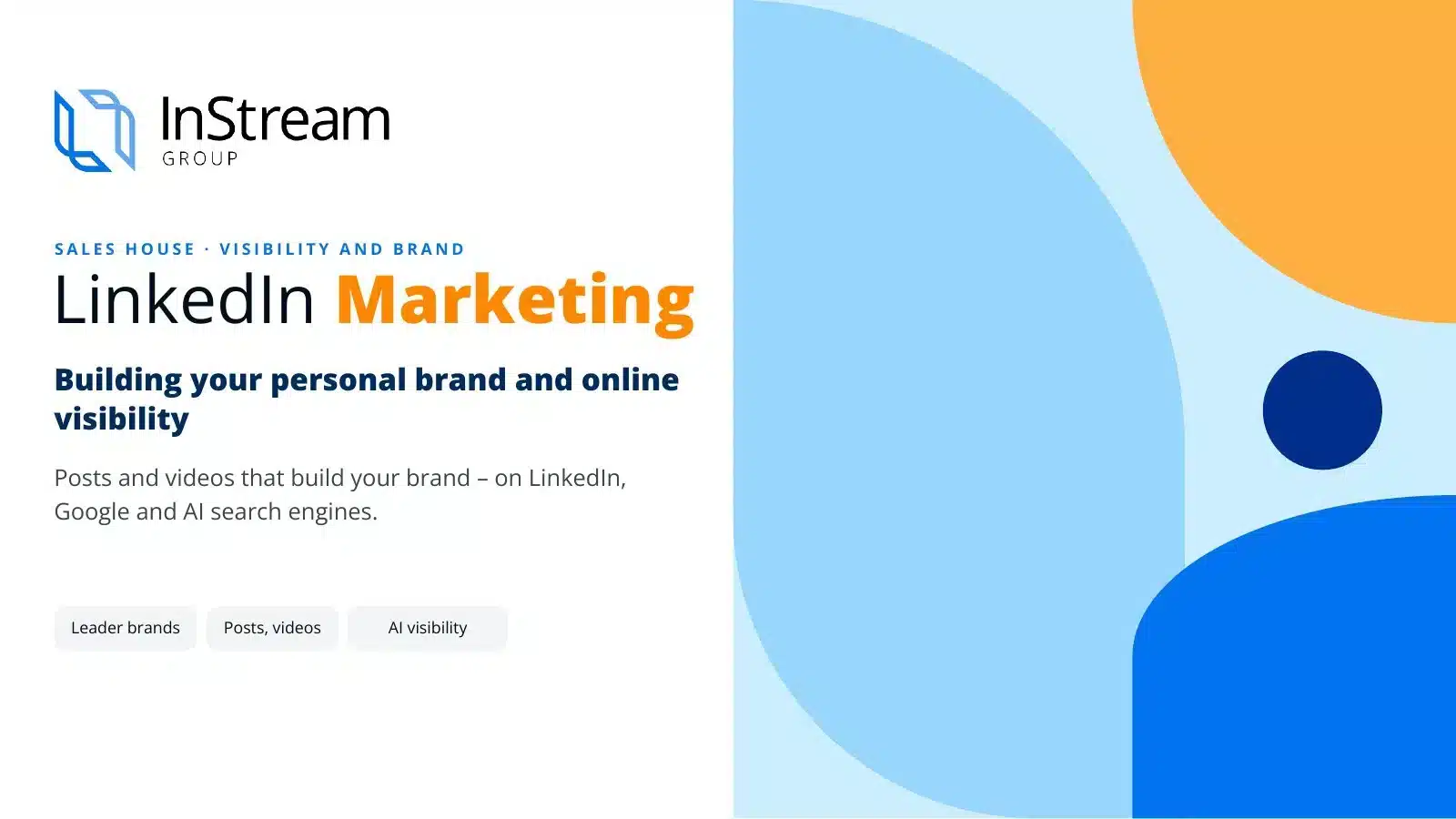
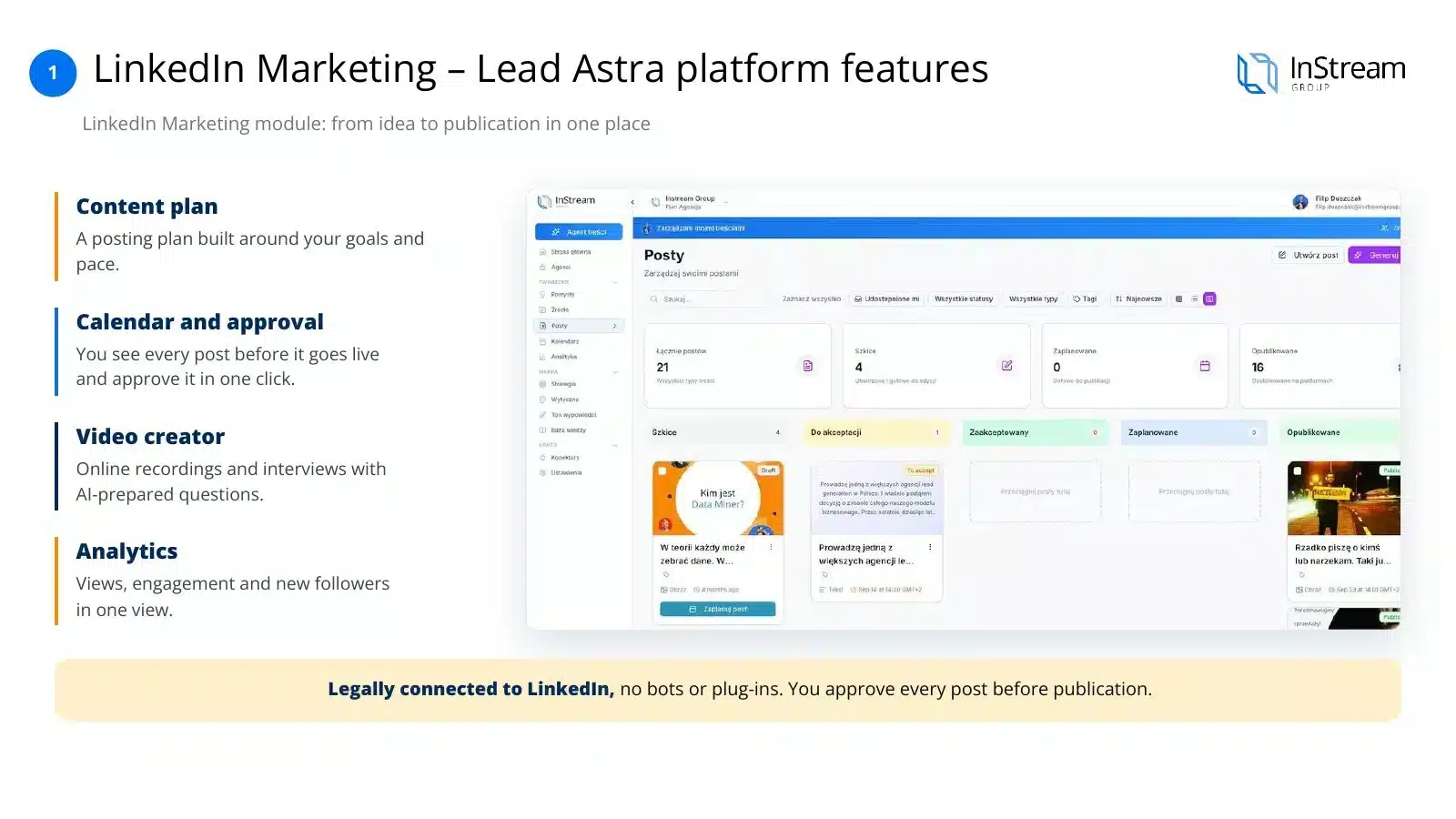
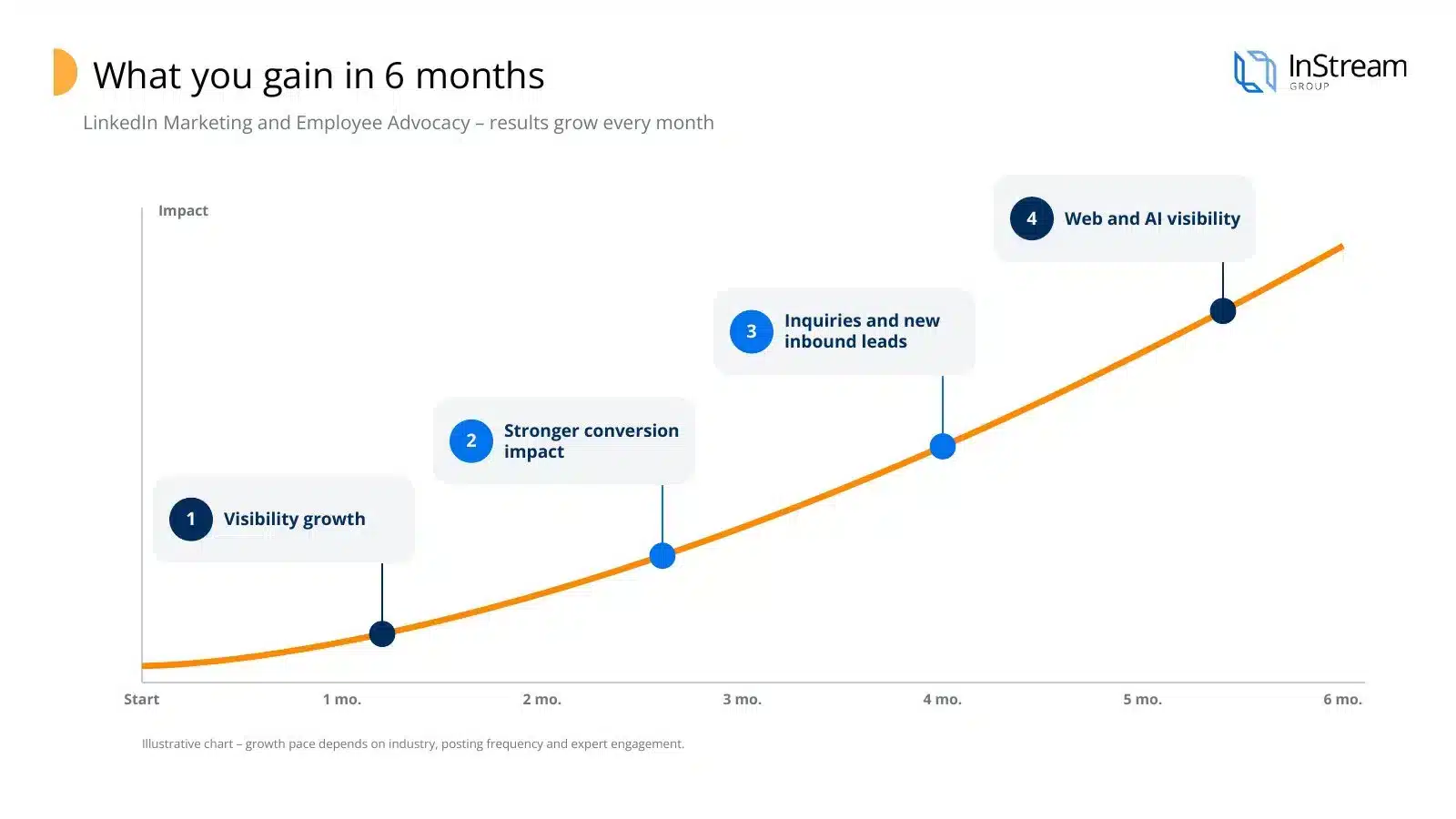
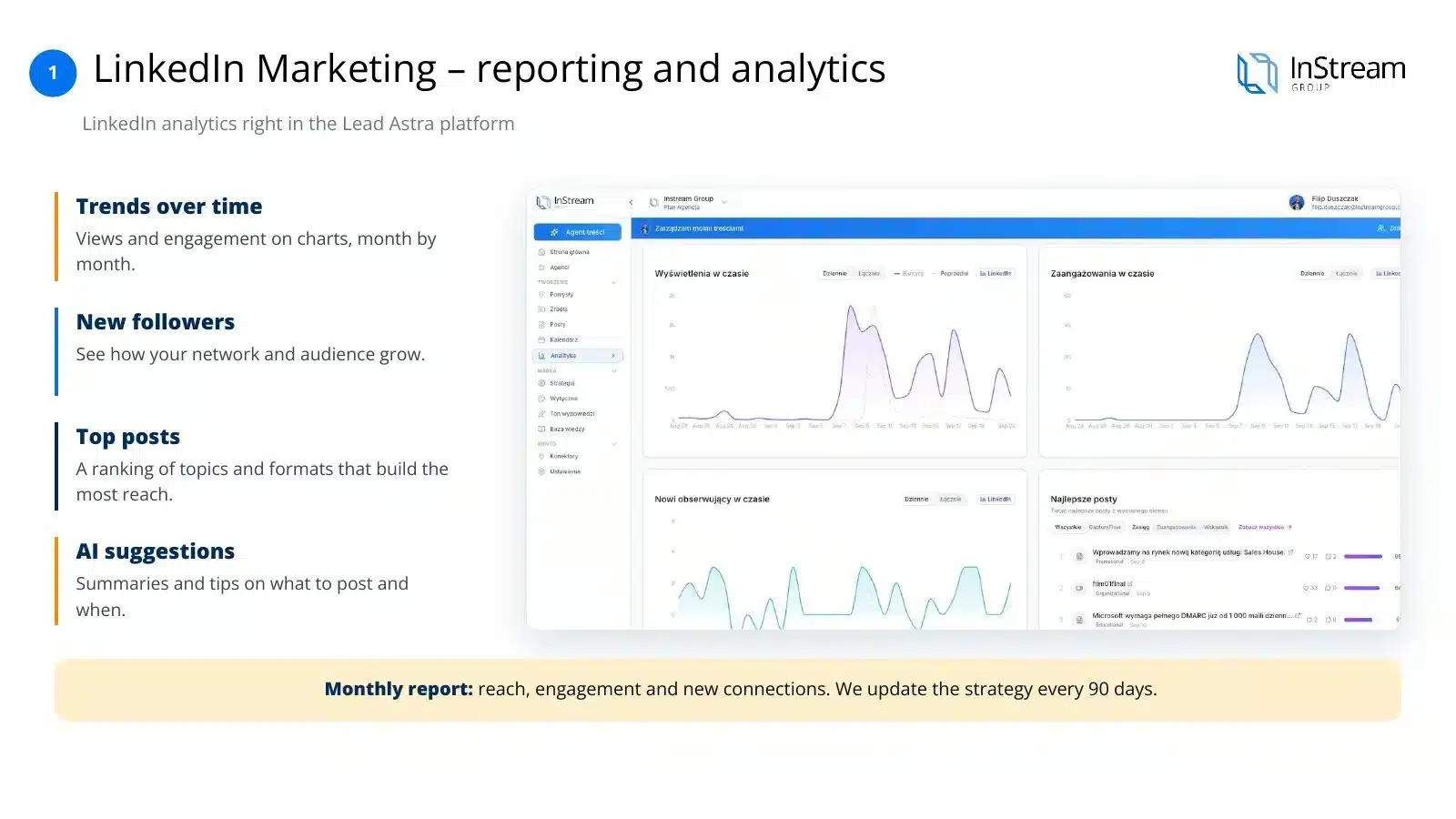
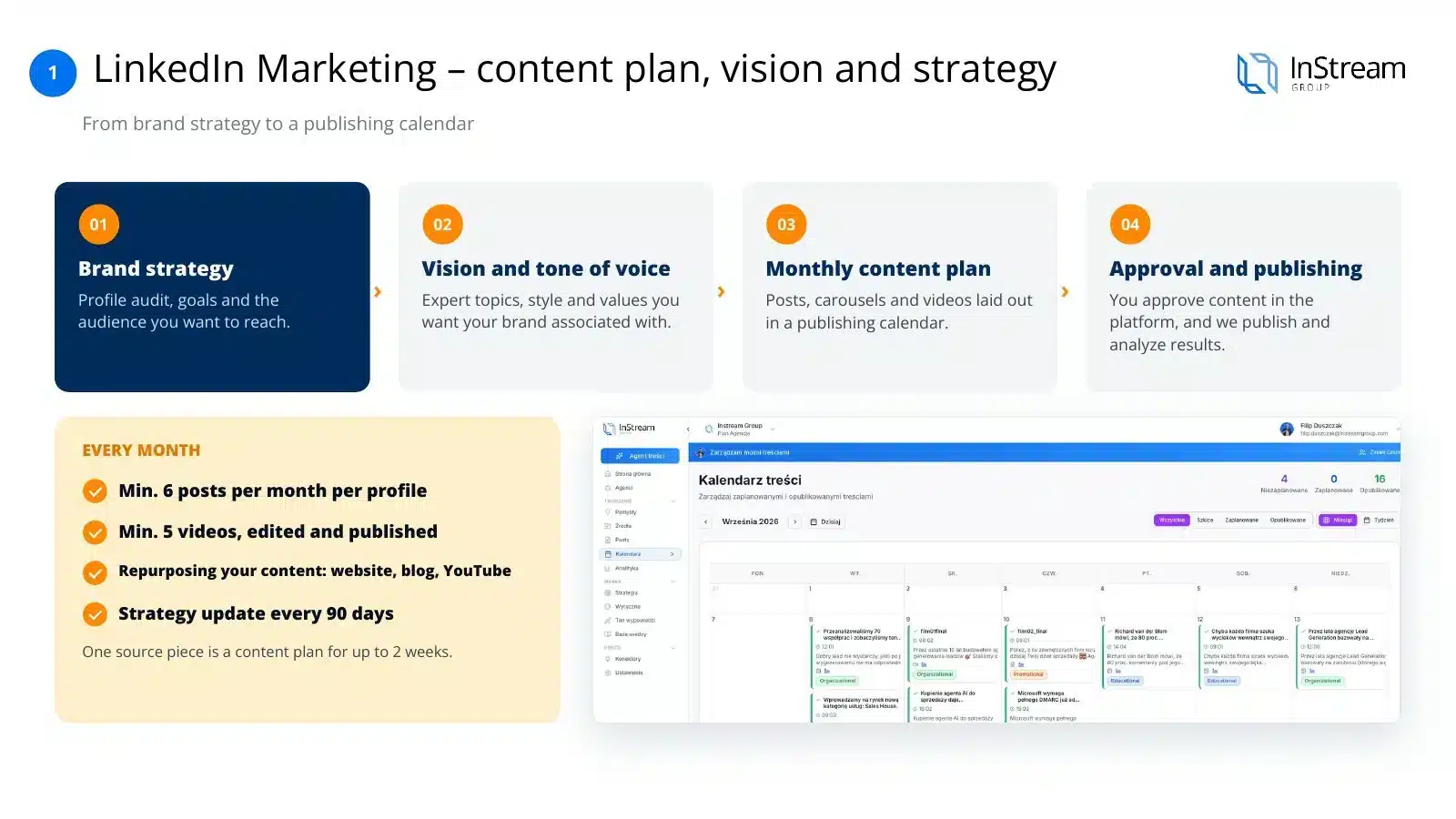
Twelve slides with voice-over: profile audit and changes, the Lead Astra platform, reporting, content plan, case study and LinkedIn Marketing pricing.
Arrows, swipe or click a thumbnail
Voice-over script for this slide
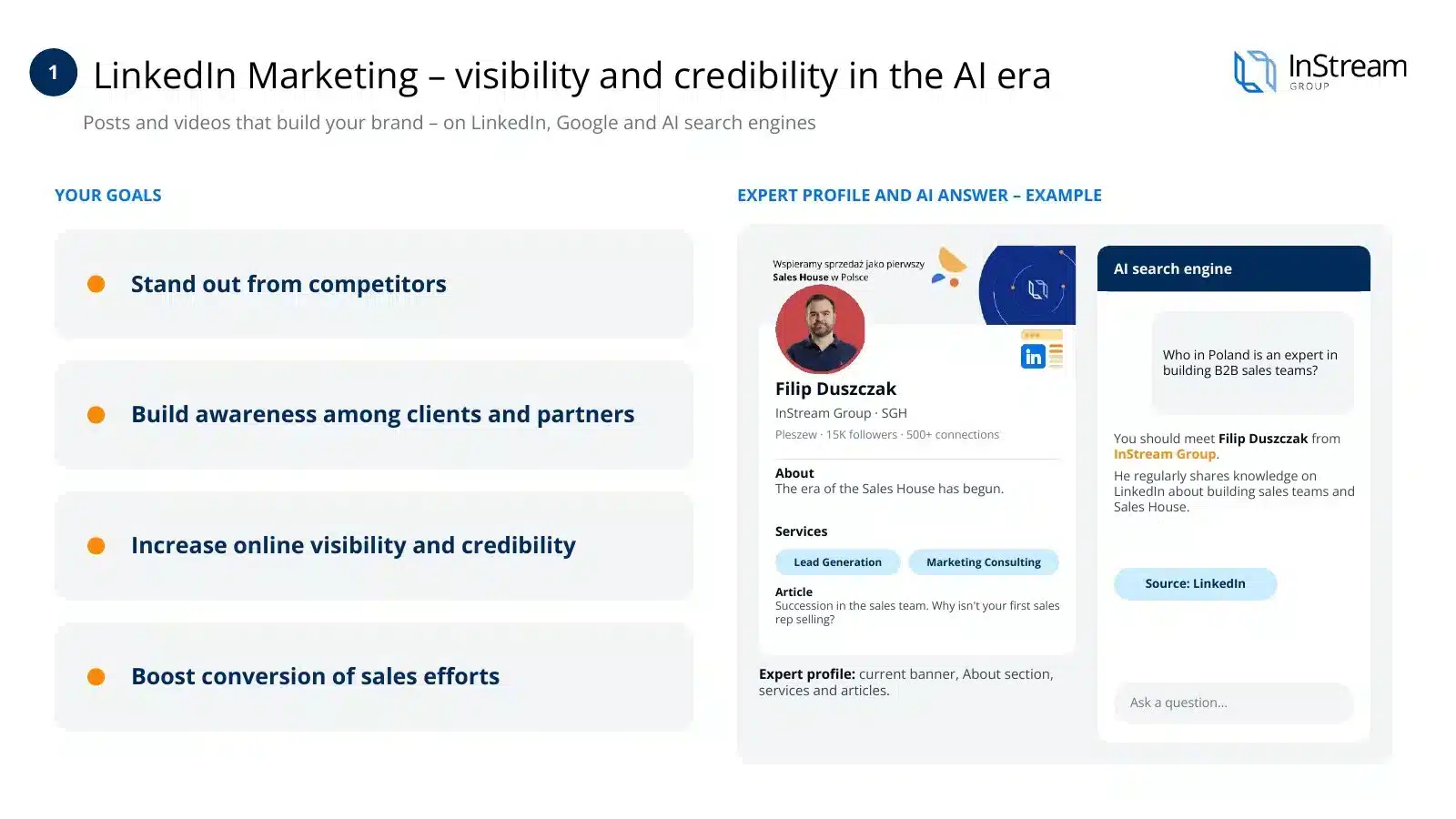
LinkedIn Marketing builds your brand and your company's brand where B2B clients look for partners. Regular content makes you a recognised expert in your industry.
More and more clients ask AI search engines about experts. A well-run LinkedIn profile means the answer may point to you. It's a new channel worth being present in today.
Your profile is your business card, which a client looks at before replying to a salesperson's message. At the start we organise it so that it's clear at first glance who you help and how. After a few months we check the results and refine the details.
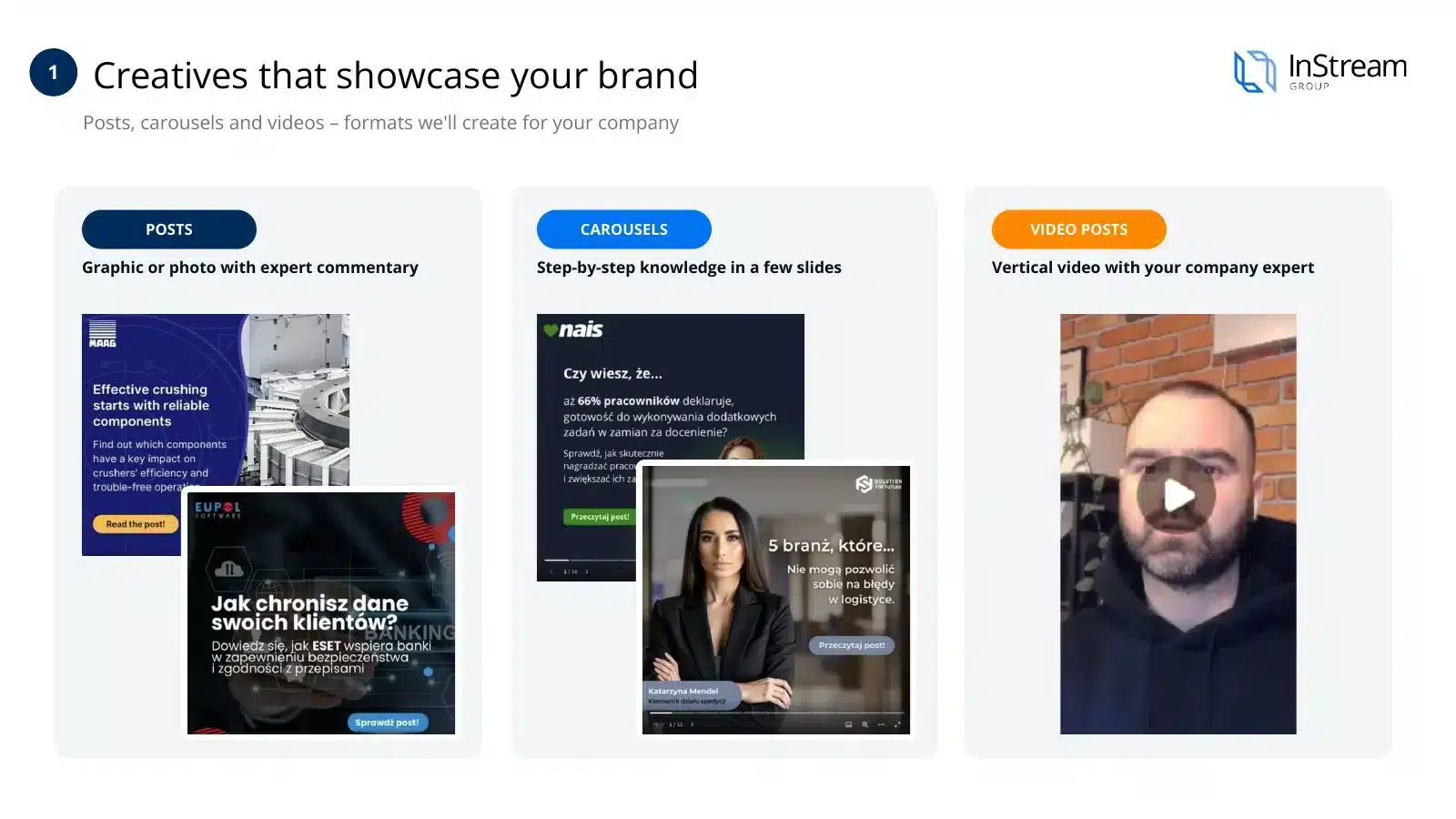
We create many types of content: from expert posts, through carousels, to video. We agree styles and formats with you at a creative meeting. We prepare every creative in line with your company's brand book, so communication is consistent with the whole brand.
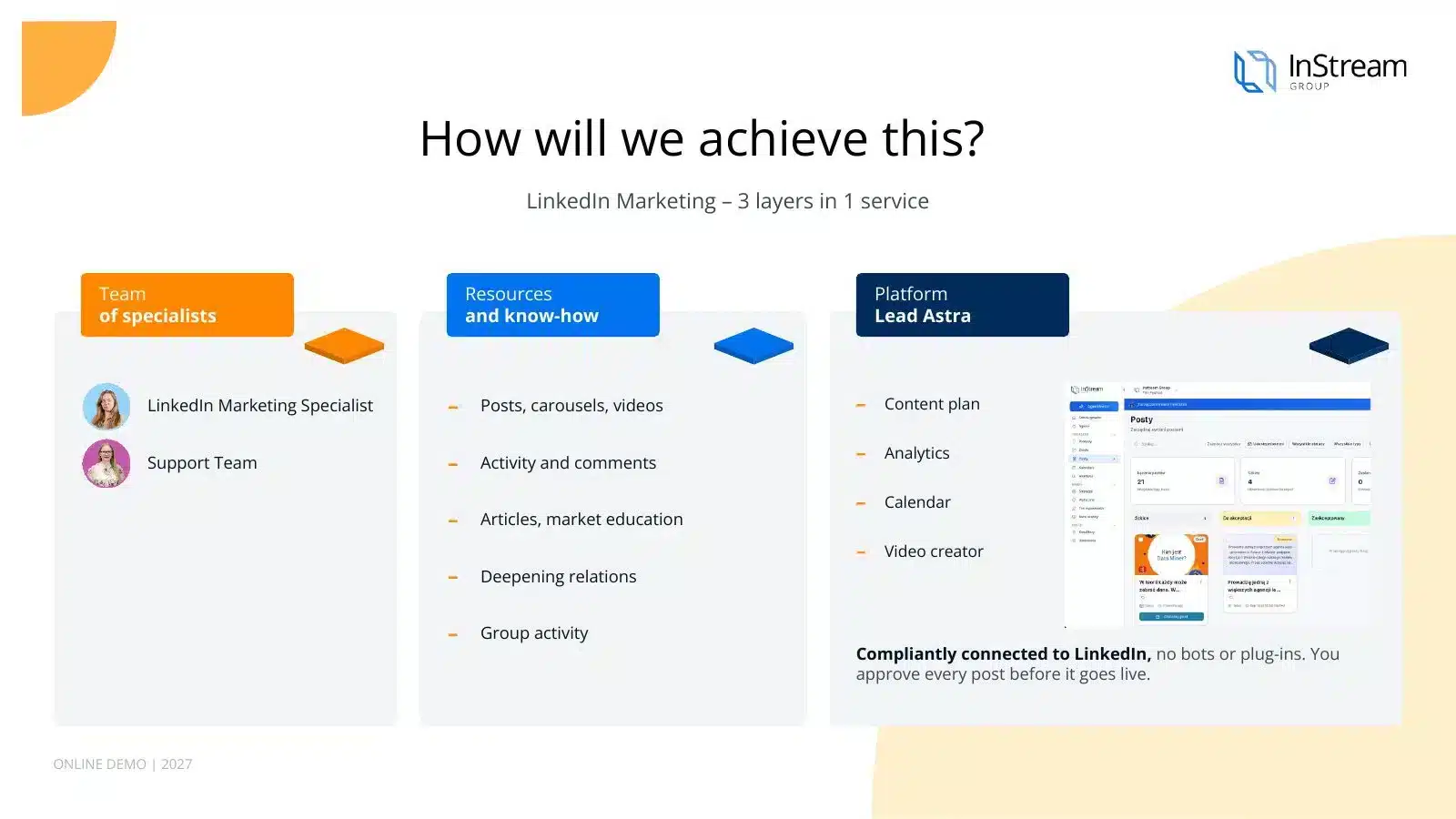
A dedicated specialist and a support team work on your brand. They use our know-how about which content works in B2B. We run everything in the Lead Astra platform and publish nothing without your approval.
You don't have to remember about publications or keep track of deadlines. In the platform you see the content plan for the coming weeks and approve posts with one click. You come to recordings prepared, because we draft the questions in advance with the help of AI.
A personal brand is an investment whose results grow over time. In the first months recognition grows, then sales conversations get easier. Over time clients start coming to you on their own.
We base every content decision on data. You see which topics and formats reach your audience best. Based on this we refine the strategy every quarter.
We start with a strategy, not with individual posts. Together we decide who you are talking to and what you want to be associated with. From a single recording with you we prepare content for up to two weeks, so we make the most of your time.
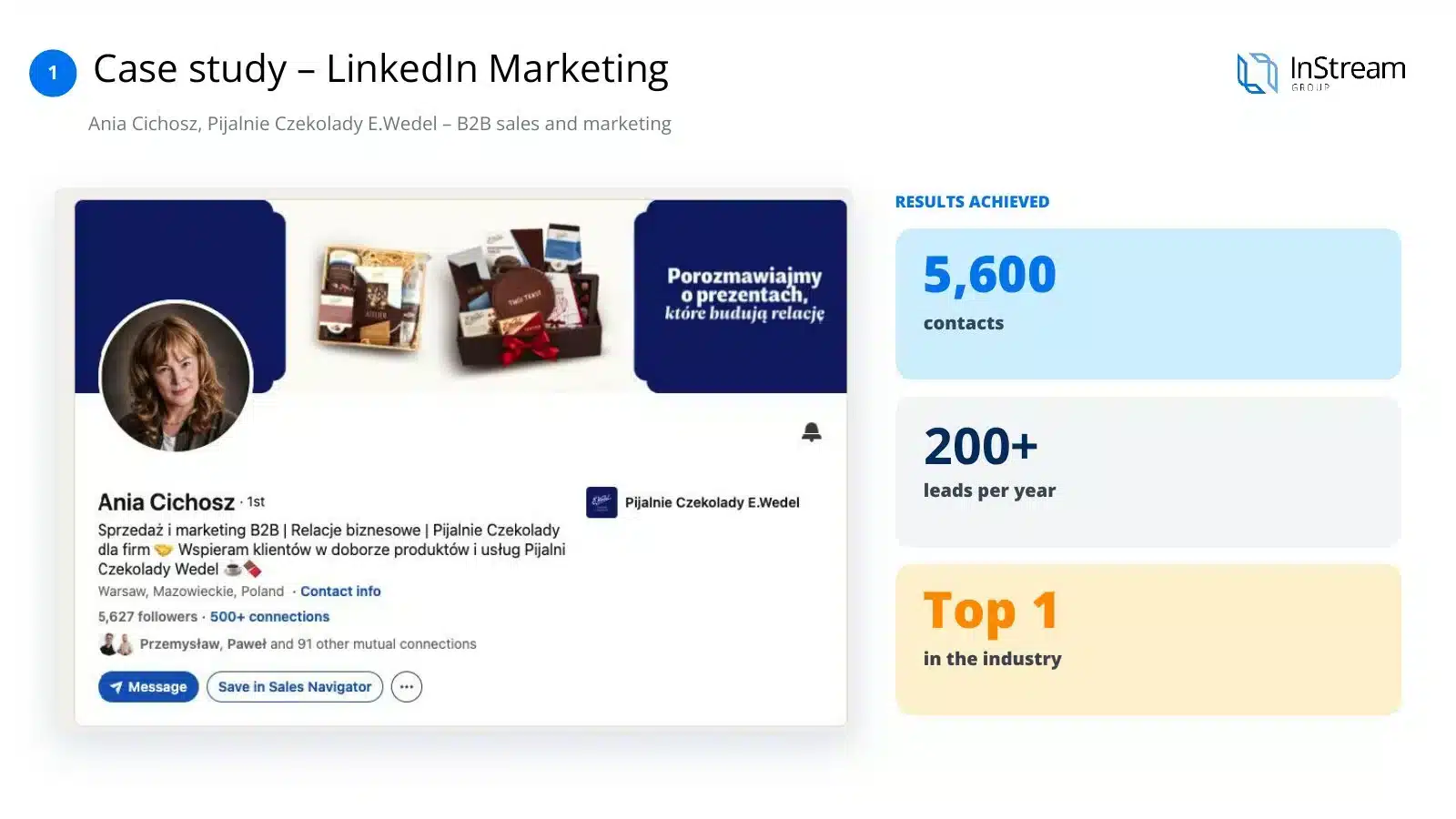
We expand the network, build the position of brand leaders and achieve the best results in the industry. Some of our clients are number one in their segments for LinkedIn recognition. This is how we work for, among others, E.Wedel Chocolate Lounges.
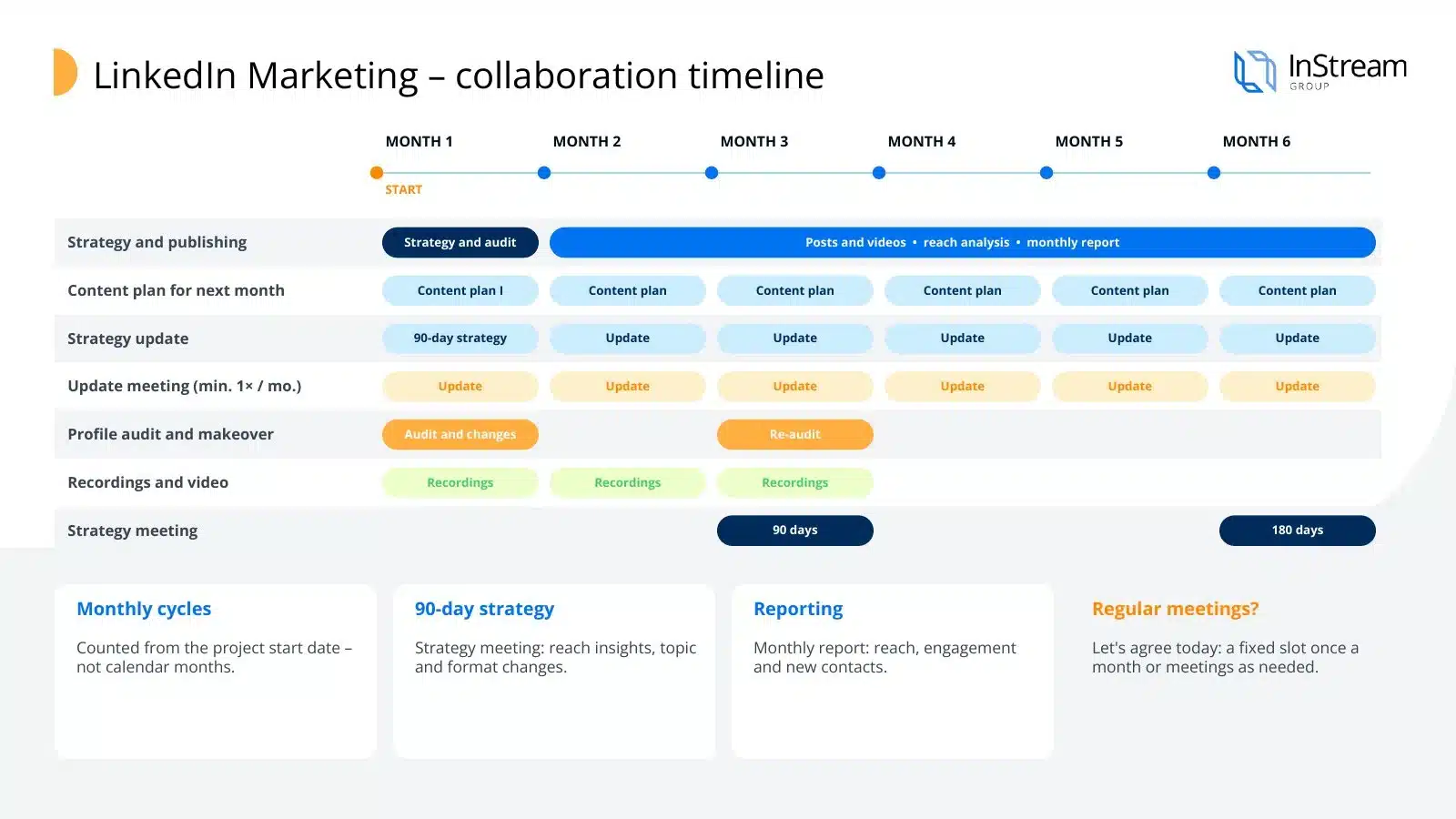
Our cooperation has a steady monthly rhythm. At the start we set up the strategy and profiles, then every month we publish, record and report. Every 90 days we meet to sum up the results and plan the next steps.
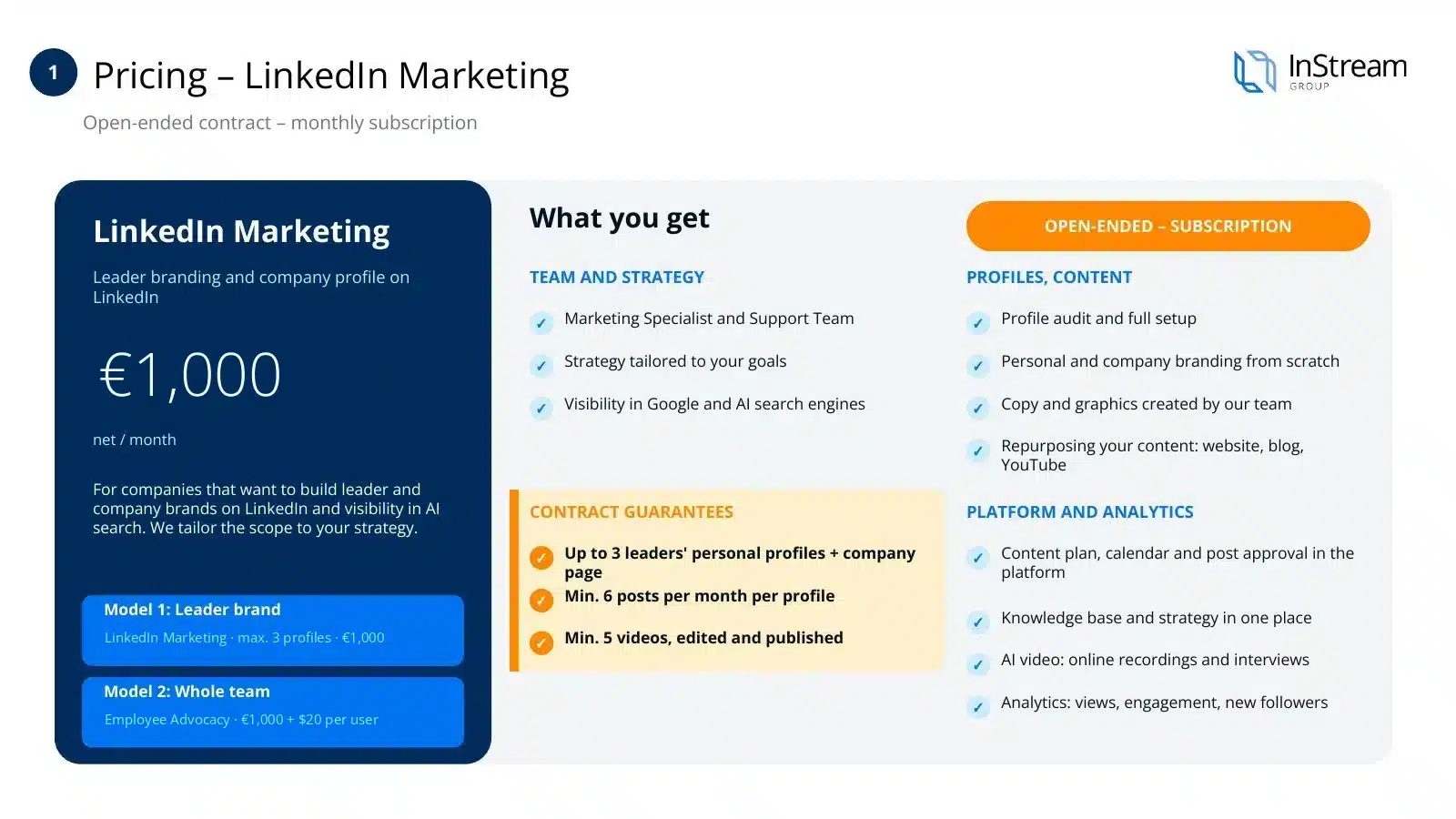
LinkedIn Marketing is a subscription from €1,000 net per month. For this price we build your leaders' brands and your company profile. We guarantee the minimum number of publications in the contract. When you want to involve the whole team, you can extend the cooperation with Employee Advocacy.
Clients and their stories
Our clients' success and satisfaction matter most to us. Join more than 1,700 companies worldwide for which we have generated leads.
Case study
Emitel × InStream
Cold Email campaign: boosting in-building mobile network coverage.
105 hot leads350% of the guarantee deliveredClient testimonial
Mr Staff Support
Recruitment of drivers and workers from Asia. Magdalena talks about working with InStream.
Case study
Studio201 × InStream
Cold Email campaign for a software house: apps and AI implementations.
119 hot leads3 signed contractsClient testimonial
Packon
Cardboard packaging manufacturer. Konrad Wijata talks about working with InStream.
Case study
Personal System × InStream
Cold Email campaign for a permanent and temporary staffing agency.
40 hot leads in 3 months17,000+ messagesClient testimonial
Proexwork
Staffing agency. Maciej Krutul talks about working with InStream.
Case study
StethoMe × InStream
LinkedIn: the CEO's personal brand and US market outreach in 4 months.
607 invitations13.5% acceptance rateCase study
Iguana Group × InStream
Cold Email campaign to schools: sports equipment.
43 hot leads419 repliesClient testimonial
HSK Consulting
Employee hiring services. Jarosław Multan talks about working with InStream.
Client testimonial
MAAG Gear
LinkedIn campaign, 2 years of working together. Krzysztof Orłowski talks about working with InStream.
Client stories
See how we help companies like yours
Testimonials, case studies and campaign results from our clients in Poland and around the world.
See client storiesChannels
Where to build your personal brand
It is best to start with the rule of "one owned channel and one reach channel": for example LinkedIn and a newsletter, or LinkedIn and a podcast. Click a tile to see why it is worth being there and what to publish.
Reach · the B2B hubLinkedIn
B2B decision-makers in one placeWhy there? +
Why: this is where B2B decision-makers are and the algorithm shows posts from people more often than posts from companies. LinkedIn is also one of the sources AI assistants use.
What to publish: expert posts, videos, carousels, articles and comments under your clients' content.
OwnedYouTube and podcast
Longer formats that work for yearsWhy there? +
Why: a recording shows your way of thinking better than text and Google shows YouTube videos in search results and in AI Overviews.
What to publish: conversations with clients, case study breakdowns, answers to questions from sales calls.
OwnedNewsletter
Direct contact without an algorithmWhy there? +
Why: the subscriber list belongs to you and not to the platform. A LinkedIn newsletter notifies readers about every issue.
What to publish: one specific topic a month, conclusions from projects and a comment on market changes.
OwnedAuthor page
Your business card for Google and AIWhy there? +
Why: an expert page on the company website with a bio, photo and links to your profiles helps Google and AI connect your name with the company and the topic.
What to publish: a bio, areas of expertise, articles, interviews and talks.
ReachFacebook
Groups and local communitiesWhy there? +
Why: industry groups and owners of smaller companies who rarely visit LinkedIn. The same image as on LinkedIn strengthens recognition.
What to publish: event coverage, videos, answers in industry groups.
ReachX
A quick comment on the newsWhy there? +
Why: contact with journalists and the tech community, quick reactions to events in your industry.
What to publish: short opinions, threads and comments on reports.
ReachGuest blogs
A new audience and a link to youWhy there? +
Why: an article on a widely read industry blog means new readers and independent confirmation of your expertise that Google and AI can see.
What to publish: guides with your method and conclusions from practice.
ReachMedia and podcasts
An independent source about youWhy there? +
Why: a media mention is external confirmation. AI assistants readily quote such sources when someone asks about an expert.
What to publish: expert comments, interviews, appearances on industry podcasts.
ReachGroups and communities
Where clients ask questionsWhy there? +
Why: in groups, clients ask about problems before they start looking for a supplier.
What to publish: substantive answers under your own name, without pushy selling.
ReachSpeaking
Conferences, webinars, trainingWhy there? +
Why: an hour on stage builds trust faster than dozens of posts and the recording then keeps working online.
What to publish: talks, panels and excerpts from your talks as videos on LinkedIn.
Employees' personal brands
Employees' personal brands: the whole company speaks with one voice
Employee advocacy is a brand ambassador programme: employees deliberately build their own and the company's visibility on LinkedIn, using a shared strategy and ready-made content. Instead of three leaders' profiles, dozens of experts are at work, each with their own network.
The reach of the whole team
Every active employee adds their own network to the company's reach: clients, partners and industry people the company page does not reach.
One style and one narrative
Consistent profiles, banners and descriptions. Employees speak in the same tone and represent the same values.
A benefit for employees
Developing a personal brand, training and team support are real value for people, not just for the company.
Employee Advocacy in practice: 5 videos about the rollout
Five short videos about how we build employees' personal brands: the cooperation model, publishing plan, video, analytics and brand strategy. Under each title you will find a short description of the video.
Personal Branding or Employee Advocacy
The brand of selected leaders or the voice of the whole company: which model to choose.
Platform and publishing plan
A knowledge base, a calendar for the whole month and approval of every post before publication.
Video on LinkedIn
Recording at your desk, and several vertical videos a month from one session.
Analytics and results
Data tells you what to publish and when, and every 90 days we update the strategy.
Profile and brand strategy
A profile audit, content strategy and a team that creates posts consistent with the company brand.
Personal brand vs company brand
Personal brand vs company brand: how to connect them
The company page and a personal profile do two different jobs on LinkedIn. The company page is a source of information, the personal profile is a source of trust, because people trust people, not logos. They work best together when they speak the same language.
Company page and website
- Role
- Information and institutional credibility
- Who publishes
- Marketing
- Type of content
- Offer, events, reports, recruitment
- What it gives sales
- Confirms that the company exists and operates
The profile of an expert, salesperson, board member
- Role
- Trust, opinion, relationship
- Who publishes
- An expert, a salesperson, a board member
- Type of content
- Experience, conclusions from projects, a voice in the discussion
- What it gives sales
- Opens the conversation and shortens the path to a meeting
Do you need a personal brand if the company already has a strong one?
Yes, because they work at different levels. The company brand confirms that the organisation is credible. A personal brand makes the client want to talk to you specifically. A strong company brand without a face looks like a catalogue.
What if the expert leaves the company?
A personal brand stays with the person and companies often raise this risk. Practice shows something else, though: a team nobody sees costs more, because it starts every conversation from scratch. The solution is a programme for several people instead of one face of the company.
Leader, team and company
Let's connect your leaders', employees' and company brands into one message
LinkedIn Marketing builds your leaders' brands and the company page. Employee Advocacy brings in the whole team. In 30 minutes we will match the model to your organisation.
- LinkedIn Marketing for leaders
- Employee Advocacy for the team
- LinkedIn Sales for salespeople
Online visibility: SEO and GEO
Online visibility and your personal brand: Google and AI search engines
GEO (Generative Engine Optimization) means visibility in the answers of ChatGPT, Gemini, Perplexity or Google AI Overviews. AI assistants build answers from public sources and LinkedIn is one of the most frequently cited sources for professional and business questions.
- 1
You publish on LinkedIn
Your profile, posts, articles and videos are public, so search engines and AI models can read them.
- 2
AI connects the facts about you
Your name, role, company and the topics you write about form a clear picture: who you are and what you know.
- 3
Your brand becomes a source
The more consistent your profile and the more regular your content, the better the chance that AI treats you as a credible source.
- 4
The client asks, AI points to you
When someone asks about your industry or service, the answer may mention you and your company.
Google AI Overviews cited LinkedIn Pulse articles in answer to a question about personal branding on LinkedIn. A longer article under your name is a source AI can bring up.
In answers about building a personal brand, Google included YouTube videos. A recording of your talk or interview works in search results and in AI.
The cited sources included university pages and guides signed with an expert's name. What counts is the author, the update date and specific knowledge.
Based on a review of Google AI Overviews answers for five Polish-language phrases about personal branding, 19 November 2026. The sources AI cites change over time.
Brand consistency
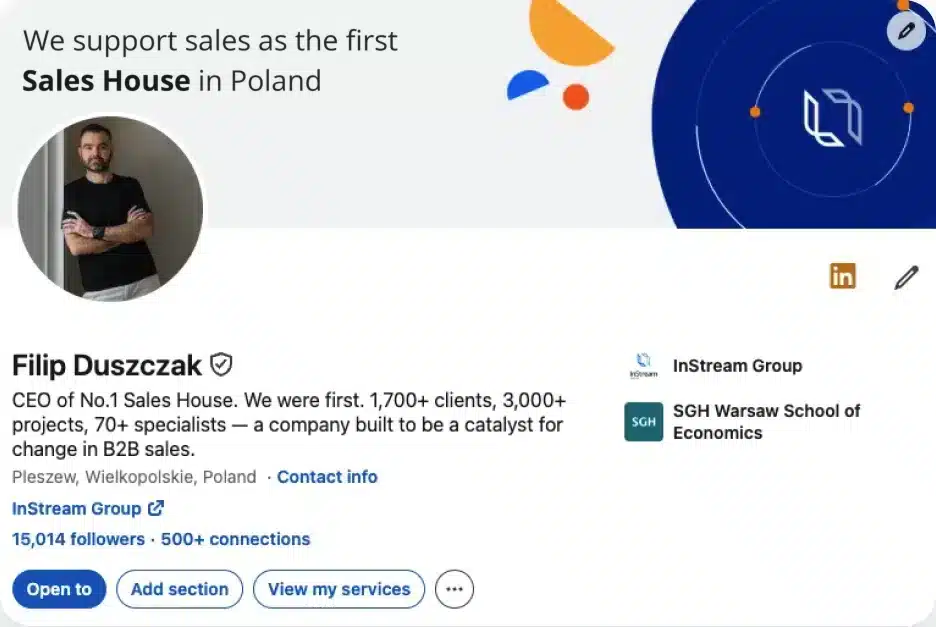
A consistent personal brand: the example of Filip Duszczak
Consistency is a quality the client sees at every touchpoint. The LinkedIn profile of InStream Group's CEO shows what one brand looks like: the same photo, the same promise and the same company colours, repeated in every channel.
Where you repeat the same image
- LinkedIn: photo, banner, headline and About section.
- Facebook and other social media: the same photo, the same tagline and a link to the company website.
- E-mail signature: name, role, logo and a link to your LinkedIn profile in the company colours.
- Author page on the company website: bio, photo and links to your profiles.
- Talks and materials: the same promise on slides, in interviews and podcasts.
The same photo
One portrait in all channels. The client recognises you in a second, wherever they meet you.
The same promise
One sentence about who you help and with what: in your headline, on your banner, in your bio and in your signature.
The same colours and link
The company colours and a link to your profile or expert page. Every channel leads to the next one.
How we build brands
How we build a personal brand: 6 steps of cooperation
This is what work on a personal brand looks like in LinkedIn Marketing. At the start we set up the strategy and profiles, then every month we plan, record, publish and report. The first results usually show after several months of systematic work, not after a few weeks.
- 1Month 1
Strategy and audit
A profile audit and brand strategy: who you are talking to and what you want to be associated with.
- 2Months 1 and 3
Profiles
Profile changes: banner, headline, About, Featured. A re-audit in month 3.
- 3Every month
Content plan
A content plan for the next month. You approve every post in the Lead Astra platform.
- 4Every month
Recordings and publications
Online interviews and recordings. Min. 6 posts per profile and min. 5 edited videos.
- 5Every month
Analytics and AI
A report: reach, engagement, new followers and AI recommendations.
- 6Every 90 days
Strategy
Strategy meetings after 90 and 180 days: conclusions, new topics and formats.
Where to start: the first 30, 60 and 90 days
30days
Foundations
- One topic you want to be associated with
- Target group: industry, roles, problem
- Profile audit and rebuild
- First posts at a rhythm of twice a week
60days
Rhythm
- A steady publishing rhythm without breaks
- Comments under posts by clients and your industry
- Your first video or online interview
- Manually growing your network around the target group
90days
First conversations
- Conversations moved from comments to messages
- First report: profile visits, accepted invitations, conversations from content
- Adjusting topics and formats
- Deciding on a second channel
Client videos
See how our clients build their brand with video on LinkedIn
Examples of video posts recorded with leaders and brands. Scroll sideways and play any video.
LinkedIn video post
An expert on AI in the sales team
Expert video post · PL
LinkedIn video post
Christmas has its own taste
E.Wedel · Chocolate Lounges
LinkedIn video post
Product feature launch
Leader video post · EN
LinkedIn video post
A report straight from the construction site
On-site video post · PL
LinkedIn video post
StethoMe on the way to New York
Product brand video post
Calculator
Reach your goal: how many followers do you want to gain?
Set your goal on the slider. The calculator will show the package and the monthly cost from our price list.
5,000followers
What the LinkedIn Marketing package includes
- A team of 3 specialists and a brand strategy
- Up to 3 leaders' profiles and the company page
- Min. 6 posts per month per profile
- Min. 5 videos with editing and publication
- The Lead Astra platform and monthly analytics
Assumptions: LinkedIn Marketing subscription at €1,000 net per month (up to 3 leaders' profiles and the company page, min. 6 posts per month per profile, min. 5 videos). The result is indicative.
Your plan
- Goal
- 5,000 followers
- Package
- LinkedIn Marketing
- Monthly cost
- €1,000 net
The number of followers is not everything: who they are matters. See how to measure the results of a personal brand below.
Measuring results
How to measure the results of a personal brand
A personal brand can be measured; it is just counted in different units than an ad campaign. Likes and follower numbers show that something is happening, but they do not tell you whether it is happening with the right people.
Profile views
Profile visits and searches for your name. They show whether your recognition is growing.
MonthlyAccepted invitations
The share of people from your target group who accept your invitation to connect.
MonthlyConversations started by content
How many messages and replies came after a specific post or comment.
MonthlyInbound enquiries
Clients who write to you on their own and meetings booked with LinkedIn contacts. This is the real impact on the funnel.
QuarterlySSI
The Social Selling Index rates four areas at 25 points each. Since 8 September 2026 only accounts with a Sales Navigator licence see the full report.
QuarterlyAI citations
Ask ChatGPT, Gemini and Perplexity "Who is…?" and check whether the answer describes you correctly and which sources it uses.
Quarterly
You will find more about the SSI in our guide to LinkedIn Sales Navigator.
Most common mistakes
5 mistakes that set your personal brand back by six months
These are the mistakes we see most often when we take over clients' profiles. Each of them can be fixed in a few weeks.
A profile like a CV
A list of job titles instead of an answer to who you help and with what. The visitor leaves without knowing why they should write to you.
Instead: a headline and "About" written from the angle of the client's problem.Publishing in bursts
Five posts in a week, then two months of silence. The algorithm and your audience respond to rhythm, not bursts.
Instead: two posts a week all year round.Writing for everyone
Content meant to suit everyone sticks in nobody's memory.
Instead: one topic and one target group.Bots and mass messages
They quickly produce numbers and just as quickly burn a brand that took a year to build.
Instead: manual invitations and messages that relate to the recipient's situation.Measuring likes
One comment from a sales director in your target group is worth more than a hundred reactions from outside it.
Instead: measure conversations, enquiries and meetings.
Pricing 2027
LinkedIn personal branding pricing 2027
Three packages you can combine: your leaders' brands, the whole team's brand and sales conversations on LinkedIn. Monthly subscription, net prices.
- Leaders' personal brands
LinkedIn Marketing
Leaders' personal brands and the company page on LinkedIn
€1,000
net / month
- A team of 3 specialists and a brand strategy
- Up to 3 leaders' profiles and the company page
- Audit and full profile setup
- Min. 6 posts per month per profile
- Min. 5 videos with editing and publication
- The Lead Astra platform and analytics
- The whole team
Employee Advocacy
A brand ambassador programme for the whole organisation
€1,000
net / month + licences by number of people
- A communication strategy for each user
- Audit and setup of 2–3 key accounts
- Employee profiles in one style
- A pool of posts for the whole organisation
- Online interviews and recordings with employees
- Analytics for the company and each employee
- Social selling
LinkedIn Sales
Conversations with decision-makers run by salespeople
€1,000
net / month
- A team of 3 experienced salespeople
- Up to 3 profiles
- Min. 200 new contacts per month
- Min. 5 hot leads per month in the contract
- Voice messages and manual e-mails
- Pilot: 4 months, price on request
Net prices. We agree details and terms on a call. LinkedIn marketing has no lead guarantee: we guarantee the publishing scope. LinkedIn Sales comes with a hot lead guarantee.
Personal brand ranking
Personal brand ranking on LinkedIn: top B2B profiles worldwide 2027
Examples of personal brands worth learning from. Below are 11 B2B profiles from a public global creator ranking and what each of them is known for. Follower numbers are approximate, as reported in the ranking.
| # | Person | Followers (approx.) | Known for |
|---|---|---|---|
| 1 | Allie K. Miller | 1.6M | AI: speaking, education and advisory for business |
| 2 | Josh Bersin | 994K | HR and workforce research, The Josh Bersin Company |
| 3 | Cassie Kozyrkov | 705K | Decision intelligence, former Chief Decision Scientist at Google |
| 4 | Ann Handley | 523K | Marketing writing, MarketingProfs and the Total Annarchy newsletter |
| 5 | Ethan Mollick | 427K | Wharton research on AI and the One Useful Thing newsletter |
| 6 | Lenny Rachitsky | 402K | Product and growth: Lenny's Newsletter and podcast |
| 7 | Jason Lemkin | 313K | SaaS growth and sales, SaaStr |
| 8 | Dave Gerhardt | 207K | B2B marketing, the Exit Five podcast and newsletter |
| 9 | Devin Reed | 102K | B2B content strategy, The Reeder |
| 10 | Jason Bay | 100K | Outbound sales training, Outbound Squad |
| 11 | Katelyn Bourgoin | 98K | Buyer psychology, Why We Buy |
5 headline patterns we check in an audit
- Role + brand
- Niche + benefit
- Proof + client problem
- Hook + services
- Headline as a CTA
Method: approximate LinkedIn follower counts as reported in a public ranking of B2B creators (rounded snapshots, source updated 16 October 2026) and presence in that ranking. Excluding people who run LinkedIn agencies. Ranking source: Favikon, Top B2B Influencers.
Frequently asked questions about personal branding
What is a personal brand?
A personal brand (personal branding) is the picture of your expertise that forms in other people's minds before they talk to you: what you are an authority on, who you help and why it is worth asking your opinion. In B2B sales it is created by what a client finds about you on LinkedIn, in Google and in AI assistants' answers.
Are personal brand and personal branding the same thing?
In practice yes, they are synonyms. To be precise: a personal brand is the result, the picture of you in your audience's minds. Personal branding is the method you use to build that picture deliberately: you choose a topic, channels, formats and proof of expertise.
How do you build a personal brand step by step?
In six steps: choose one topic you want to be associated with; define your target group; organise your LinkedIn profile; build a network of the right people, manually and without bots; publish regularly, ideally twice a week; move conversations from comments to private messages. Measure the results every month.
Where do you start building a personal brand?
With your profile. Publishing with a messy profile is like inviting guests to a flat under renovation: people come, see the mess and leave. First the photo, the banner, a headline that says who you help and with what, and the About section. Then a steady publishing rhythm.
How long does it take to build a personal brand?
The profile itself can be fixed in a week, but recognition is built over quarters. The first conversations that come from content usually appear after several months of regular work. The biggest enemy of a personal brand is not weak content, but a break after a few posts.
What are examples of personal brands in B2B?
Good examples are the B2B leaders from the personal brand ranking in this guide, including Ann Handley, Jason Lemkin and Dave Gerhardt. What they have in common is a clear focus, regular content and a personal brand consistent with their company brand. We also show consistency across channels using the example of Filip Duszczak, CEO of InStream Group.
What types (archetypes) of personal brand are there?
In B2B we see five types: the leader or CEO who is the face of the company; the hands-on expert sharing knowledge from projects; the salesperson-advisor whose content turns into conversations; the creator or educator building a community around a topic; and the company ambassador, an employee in an employee advocacy programme.
How does a personal brand help in B2B sales?
It shortens the distance before the first conversation. According to Gartner, B2B buyers spend only 17% of their buying time meeting suppliers and 67% prefer a process without a sales rep. The rest of the time is filled with their own research, in which only what you have left online works for you: your profile, posts, interviews and client reviews.
How does a personal brand differ from personal selling?
Personal selling is the direct contact between a salesperson and a client: a conversation, a presentation, negotiations. A personal brand is the picture of that salesperson the client already has before the conversation starts. The brand prepares the ground, personal selling turns it into a contract.
Do you need a personal brand if the company already has a strong one?
Yes, because they work at different levels. The company brand confirms that the organisation is credible. A personal brand makes the client want to talk to you specifically. The best setup is one where the company has its own page and several people from the team publish under their own names.
How do you build a personal brand on LinkedIn and how often should you post?
Start with your profile, then choose a few content pillars and publish at a steady rhythm. Two posts a week is a rhythm most people can keep up for a year. It is better to publish twice a week for twelve months than every day for a month. Also comment on posts by clients and people in your industry.
How do you win clients on LinkedIn with a personal brand?
Combine visibility with social selling. Content lets the decision-maker know who you are. Then you reach them directly, with a message that relates to their situation instead of a template. A comment under a post is a signal of interest. A message that refers to that comment is the start of the sales process. No bots and no automation.
Can AI write my LinkedIn posts for me?
It can prepare material, but it should not publish without your decision. The order is always the same: technology prepares, a human approves. Readers recognise text published without editing and stop trusting the author.
How do you measure the results of a personal brand and what is the SSI?
Measure profile views, the share of accepted invitations, conversations started by content, inbound enquiries and how AI assistants describe you. The SSI (Social Selling Index) is a LinkedIn indicator that rates four areas at 25 points each. Since 8 September 2026 only accounts with a Sales Navigator licence see the full SSI report.
How much does it cost to build a personal brand with an agency?
At InStream Group, LinkedIn Marketing costs €1,000 net per month: up to 3 leaders' profiles and the company page, min. 6 posts per month per profile and min. 5 videos. Employee Advocacy for the whole team is €1,000 net per month plus licences by number of people. LinkedIn Sales costs €1,000 net per month.
Personal branding for 2027
Build a personal brand that sells
Start with the brand test or with a call with our team. We will show you what work on your leaders' brands looks like in the Lead Astra platform and how much it costs for your company.
- 446 LinkedIn projects
- 1,700 companies from 40 countries
- over 10 years on the market
Tell us what personal brand you want to build
In a 30-minute call we will review your profile, agree on the goal of your brand and choose the model: LinkedIn Marketing, Employee Advocacy or LinkedIn Sales.
- 30 minutes, no obligation
- 446 projects on LinkedIn
- 1,700 companies supported in sales
About the author
Filip DuszczakCEO and founder of InStream Group, 17 years in B2B sales. He has built a team of 70+ specialists that has supported more than 1,700 companies in sales across 40+ markets.
LinkedIn profile