
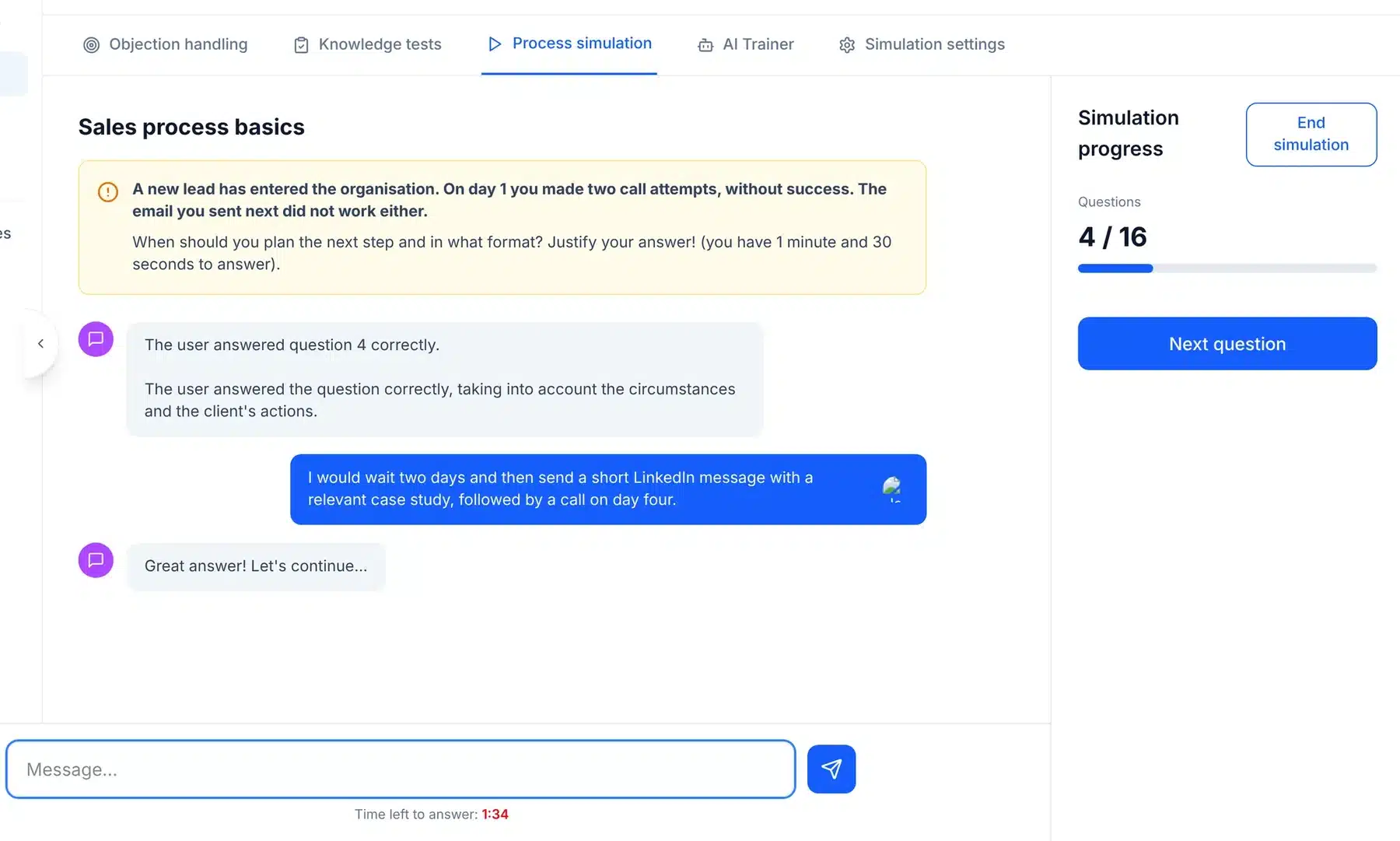
- Marketing assesses an MQL based on fit with your customer profile and behaviour, for example downloading a report or attending a webinar.
- Sales confirms an SQL in a conversation: there is a need, a budget, a decision-maker and a timeline.
- Between them sits the SAL, a lead accepted by sales for contact or rejected with a stated reason.
- MQL → SQL conversion most often depends on the lead handover: a shared definition, response time and feedback.
In this entry: 12 tiles on MQL and SQL
The lead’s path: from first contact to customer
MQL and SQL are two stops on the same road. Each stage has an owner and an event that moves the lead forward. The example shows Nordvell Group, a fictional company selling a production planning system.
The Nordvell Group example is fictional and only illustrates the stages.
MQL, SAL and SQL: the differences in one table
In short: an MQL says “this contact is interested”, an SQL says “this contact wants to buy and can buy”. The SAL is the moment sales takes responsibility for the contact.
| MQL | SAL | SQL | |
|---|---|---|---|
| Who qualifies | marketing | SDR or salesperson | sales |
| Based on | fit with the customer profile and behaviour | lead review against the shared definition | a qualification call, for example using BANT |
| Readiness to talk | interested, not buying yet | worth contacting | ready for a meeting and a proposal |
| Typical signal | content download, webinar, visits to the pricing page | complete data that matches the MQL definition | confirmed need, budget, decision-maker and timeline |
| What you do | pass it to an SDR or run nurturing | contact the lead within the agreed time | book a meeting and create an opportunity in the CRM |
| Place in the funnel | middle of the funnel | the line between marketing and sales | bottom of the funnel |
| Main metric | number of MQLs and cost per MQL | share of accepted leads and response time | SQL to opportunity and customer conversion |
Not every company uses an SAL stage. It is worth having when marketing and sales argue about lead quality, because every rejected lead then gets a reason marketing can learn from.
Criteria: when a lead becomes an MQL and when it becomes an SQL
An MQL definition is built from two kinds of signals: fit (who the contact is) and interest (what they did). An SQL needs something you cannot see in the data: confirmation in a conversation.
A lead becomes an MQL when
- the company matches your ideal customer profile: industry, size, market,
- the person has the right role, for example influences the purchase,
- they took an action that shows intent: downloaded a report, attended a webinar, returned to the pricing page,
- they passed the agreed lead scoring threshold.
An MQL becomes an SQL when you confirm in a conversation
- a need or problem your offer solves,
- a budget or readiness to plan one,
- the decision-maker and how the decision is made,
- a timeline in which the client wants to change something.
Points in lead scoring help you pick MQLs, but they do not replace a conversation. SQL qualification most often uses the BANT method, and complex sales with several decision-makers use MEDDIC.
Score your lead: lead, MQL, SAL or SQL?
Pick one contact from your CRM and, for each criterion, mark how much you really know. The tool will suggest which stage the lead is at and what to do next.
Profile: the company matches your ideal customer profile
Interest: the contact downloaded content, attended a webinar or replied to a message
Request: the contact asks for a call, a proposal or a quote
Need: the problem has been confirmed in a conversation
Budget and decision: you know the budget and who decides
Timeline: you know when the client wants to decide
The thresholds are a practical InStream Group guide, not an official standard. The tool does not save your answers.
SAL and handing a lead over to sales: 5 steps
The handover is where MQLs most often get lost. A simple agreement between marketing and sales, often called an SLA, helps. Write it down in one document and review it once a month.
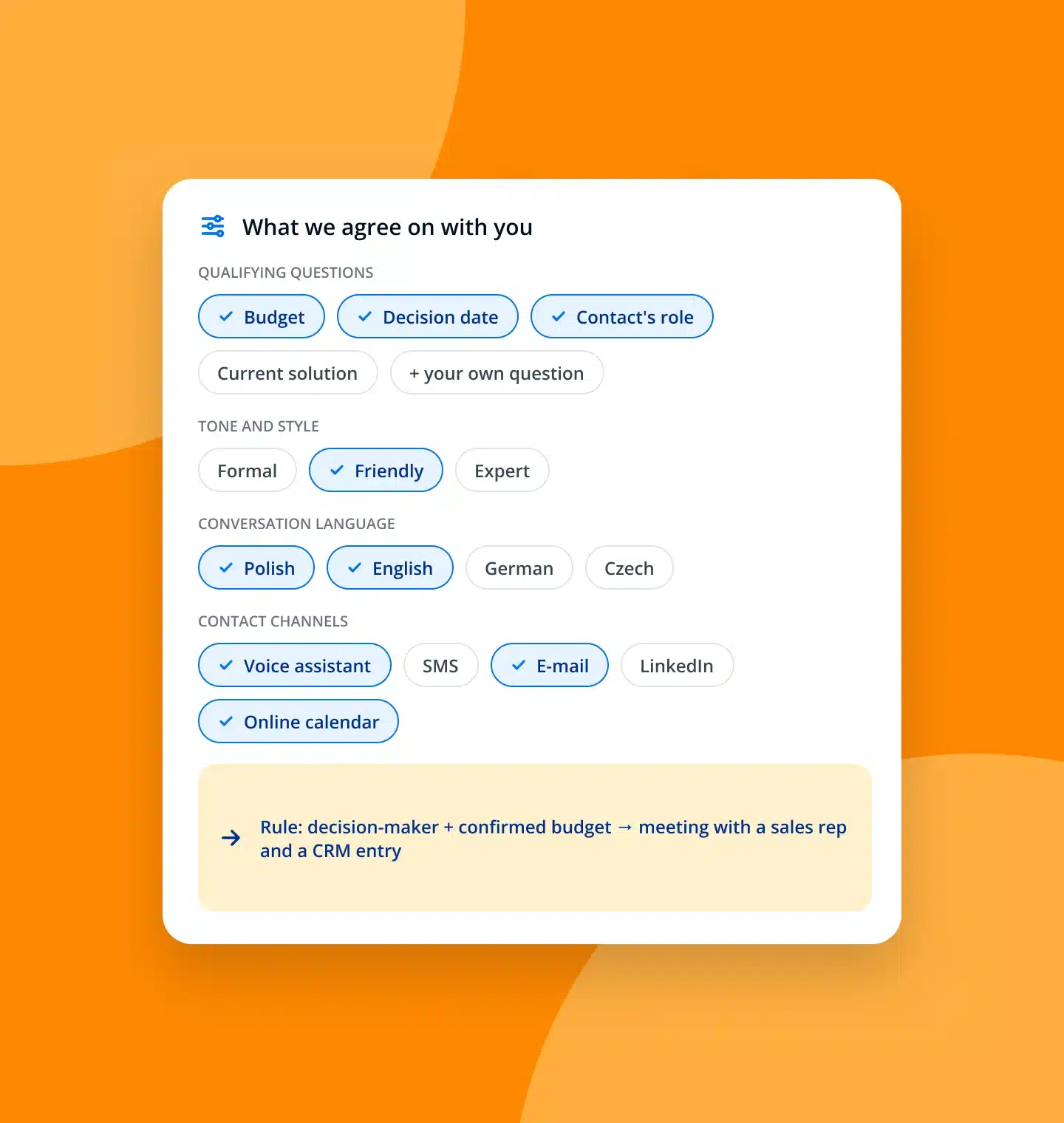
In our lead handling service we agree the first-contact time and qualification criteria with the client before launch, and the meeting goes into the salesperson’s calendar together with the call summary.
Calculator: how many SQLs and MQLs you need to hit your sales target
Work the funnel backwards. Enter how many customers you want to win each month and the conversion rates you see in your CRM today. The calculator shows how many SQLs and MQLs you need every month.
The starting values are an example, not a benchmark. The tool does not save your data.
Why don’t we give a “good” MQL → SQL conversion rate? Published benchmarks differ several times over, because every company defines an MQL differently. A loose definition lowers the conversion rate and a strict one raises it, even though sales has not changed at all. So compare your result with previous months and look at the number of SQLs together with SQL-to-customer conversion.
MQL and SQL in your CRM: stages, statuses and fields
| CRM status | Set by | When |
|---|---|---|
| New lead | form or integration | after the enquiry or reply |
| MQL | marketing or a scoring rule | after passing the threshold |
| SAL (accepted) | SDR or salesperson | within the agreed response time |
| Rejected + reason | SDR or salesperson | when the lead does not meet the definition |
| SQL | SDR or salesperson | after the qualification call |
| Opportunity | salesperson | after a meeting is booked |
For every lead, also record the source, handover date, owner and a follow-up date if the contact asks to talk in a few months. Without these fields you cannot calculate conversion or response time. In Pipedrive, leads land in the Leads Inbox and only SQLs are converted into deals in the pipeline.
Inbound vs outbound: where is the MQL at all?
The MQL → SQL model was born in inbound marketing. In outbound campaigns, for example cold email, the MQL stage often disappears, because the recipient’s reply does the qualifying.
Inbound: forms, content, webinars
The lead leaves their details, scoring picks the MQL, an SDR accepts it as an SAL and confirms the SQL in a call. MQL criteria and a fast response matter most here.Outbound: cold email and LinkedIn
The contact comes from a database built for your customer profile. A reply asking for a meeting or a proposal is a hot lead straight away, and it becomes an SQL after a short call.There is also a third model: the PQL (product qualified lead), a lead qualified by the product. You will mainly find it in SaaS companies, where the customer first uses a trial and the readiness signal is their activity in the app.
7 reasons an MQL does not turn into an SQL
A ranking from the causes that hurt conversion most to the ones that are easy to fix. We based it on our work with our clients’ sales funnels.
- No shared definition of MQL and SQL. Marketing counts one thing, sales expects another and both sides are right.
- Responding to the lead too slowly. Interest drops with every hour, especially for form leads.
- MQLs counted from clicks alone. Downloads and opens without fit to the customer profile produce many MQLs and few SQLs.
- Lead handed over without context. The salesperson does not know where the contact came from or what they asked about, so they start the conversation from scratch.
- Rejections without a reason. Marketing does not know what to improve in the campaign and the criteria.
- “Not now” leads disappear. Instead of going into lead nurturing with a follow-up date, they stay in the inbox.
- Nobody measures the stages every month. Without MQL → SAL → SQL numbers, the argument about lead quality never ends.
Clients on working with us: 4 short videos
Emitel: Cold Email campaign
Studio201: leads for a software house
Personal System: leads for a recruitment agency
Packon: a packaging manufacturer’s review
In each of these projects we worked on the same principle: first a shared definition of a good lead, then the campaign and handing hot contacts over to the client’s salespeople.
What lead handling and qualification cost with us
Lead Handling (SDR)
Individual quotemonthly subscription priced by the number of leads you hand over: from the Mini package (up to 20 leads a month) to Enterprise (over 150)See the service →Virtual Lead Qualification
Individual quotemonthly subscription, the AI assistant replies to leads 24/7 and proposes a meeting timeSee the service →Sales Booster
€8,000net for 4 months (€2,000 / month) + platform licence: process, qualification criteria and CRMSee the programme →KPIs we track in lead handling: first response time, share of leads we reached, lead to SQL and meeting conversion, and SQL to opportunity conversion. Net prices, 2026 price list.
Send us MQLs, get SQLs back in your calendar
We will turn your leads into booked meetings
We will take over leads from forms, campaigns and trade fairs, qualify them against criteria agreed with you and hand them to your salespeople as SQLs with a call summary.
See the demoExplore Lead Handling →Common MQL and SQL mistakes
- Passing every contact who downloaded content to salespeople.
- Scoring leads with points only, without a qualification call.
- No SAL stage and no rejection reasons, so the argument about lead quality drags on for months.
- No agreed response time for new leads.
- Measuring only the number of MQLs instead of conversion into SQLs and customers.
Frequently asked questions
MQL – what is it?
An MQL (marketing qualified lead) is a lead qualified by marketing. It fits the customer profile and has shown interest, for example by downloading a report or attending a webinar, but is not yet ready for a sales conversation.
SQL – what is it?
An SQL (sales qualified lead) is a contact for whom sales has confirmed the need, budget, decision-maker and timeline. A salesperson can move on to a meeting and a proposal.
What is the difference between an MQL and an SQL?
Marketing identifies an MQL from data and the contact’s behaviour. Sales confirms an SQL in a conversation. An MQL is interested, an SQL wants to buy and can buy.
What is an SAL?
An SAL (sales accepted lead) is a lead accepted by sales for contact. It is the stage between MQL and SQL: sales reviews the MQL and either accepts it or rejects it with a stated reason.
Who decides that a lead is an MQL and who decides it is an SQL?
Marketing decides on MQLs, usually through lead scoring rules. Sales, meaning an SDR or a salesperson, decides on SQLs after a qualification call. It is worth writing down the criteria for both stages together.
When does an MQL become an SQL?
When you confirm the need, budget, decision-maker and timeline in a conversation. This assessment most often uses the BANT method, and complex sales use MEDDIC.
What is a good MQL to SQL conversion rate?
There is no single norm. Published benchmarks differ several times over, because companies define MQLs differently. Compare your result with previous months and also look at SQL-to-customer conversion.
Is there an MQL in cold email?
Usually not. In cold email the recipient’s reply does the qualifying: a request for a meeting or a proposal is a hot lead straight away, and it becomes an SQL after a short call.
How quickly should sales contact a lead?
As quickly as you write into the agreement between marketing and sales. Handle form leads fastest, because interest drops with every hour. It is worth measuring response time every month.
What should you do with an MQL that is not ready to talk?
Do not delete it. Record the reason and a follow-up date in the CRM and pass the contact to lead nurturing. Come back on the agreed date with a new reason to talk.
How should you mark MQLs and SQLs in a CRM?
Use statuses or stages: new lead, MQL, SAL, rejected with a reason, SQL and opportunity. For every lead, record the source, handover date and owner.
Does “SQL lead” have anything to do with the SQL language?
No. In sales, SQL stands for sales qualified lead. The SQL database language has a LEAD function, which is why search engines sometimes mix the two topics.
Related terms
Sources
- InStream Group data and price list 2026: Lead Handling (SDR), Virtual Lead Qualification and Sales Booster services, and the contractual hot lead definition in Cold Email.
- PipeChamp data: sales processes with an SQL stage and qualification methods, as of 19 November 2026.
- The Nordvell Group example is fictional and illustrates the stages.
