
In this entry: 12 tiles on lead scoring
The two axes of scoring: fit and engagement
A good scoring model rates a lead on two axes. The first tells you whether this is your client at all. The second tells you whether they are ready to talk now. On top of that come negative points and score decay, which protect salespeople from false alarms.
Fit with the ICP
Company and contact data: industry, size, market, job title and influence on the decision. It tells you whether the lead can buy at all.
Engagement
What the lead did: replied, asked about the price, requested a meeting or a proposal. It tells you whether they are ready to talk now.
Negative points
You subtract points for signs that this is not a client: a personal email address, no influence, a competitor, a clear no.
Score decay
Activity points lose value over time. A lead that has been silent for several weeks drops down the ranking and goes back to nurturing.
Lead scoring calculator
Tick what you know about one lead on your list. The calculator adds up the points on both axes, subtracts negative points and suggests what to do with the lead.
The points and thresholds are an InStream Group example to calibrate on your own data, not a standard of the method. The tool does not store your answers.
How to build a lead scoring model in 6 steps
A scoring model is not built in a marketing spreadsheet. You build it from data on won and lost deals, together with the salespeople who will then use it.
Manual qualification, rule-based or predictive (AI) scoring
| Manual qualification | Rule-based scoring | Predictive scoring (AI) | |
|---|---|---|---|
| How it works | a salesperson or SDR assesses the lead in a conversation, e.g. with BANT | points for criteria and actions according to set rules | a model learns from the history of won and lost deals |
| Data you need | call notes | an ICP and basic data in your CRM | several hundred closed deals and clean data |
| Who it suits | few leads, complex sales | dozens of leads a month or more | high lead volume and a mature CRM |
| Main risk | everyone scores differently | the model ages without calibration | hard to explain where the score comes from |
In practice these methods work together: scoring sets the order and a qualification call confirms whether the lead really is an opportunity.
A sample points table for a B2B company
An example for the fictional company Nordvell Group, which sells a production planning system to mid-sized manufacturing plants. Scale 0–100: 50 points for fit and 50 for engagement.
| Criterion | Points | Why |
|---|---|---|
| Production or operations director, or board | +15 | the person who has the problem and the budget |
| Manufacturing plant with 50–500 staff | +10 | the size at which the system pays off |
| Industry from the ICP (e.g. metal, plastics) | +10 | where Nordvell has the most rollouts |
| Poland or a DACH country | +5 | markets the company serves |
| Company email address | +5 | easier to confirm the company and the person |
| Planning in a spreadsheet | +5 | a clear problem to solve |
| Request for a meeting or a proposal | +20 | the strongest readiness signal |
| Question about price or rollout date | +10 | the lead is already thinking about buying |
| Reply to a message | +10 | there is contact and a conversation |
| Personal email address | −10 | hard to confirm the company |
| Student, intern, person with no influence | −15 | will not buy or persuade their managers |
| No activity for 30 days | −10 | engagement fades |
Thresholds in this example: from 40 points the lead is an MQL and goes to qualification, from 55 points with at least 25 for fit and 20 for engagement it goes straight to a salesperson.
The numbers in the example are fictional and only illustrate the method.
Lead scoring in InStream Group numbers
Scoring only works when it combines data from campaigns, the CRM and salespeople’s conversations. That is why we roll it out together with the process, not as a separate module in a tool.
Scoring replies in outbound: how we count cold email leads
In outbound a lead does not click on your content, it either replies or stays silent. That is why we score the content of the reply. This is the rule we use in our Cold Mailing contracts.
HHot lead
A person from the approved database clearly asks for a meeting, a proposal or a call and has a phone number and an email. It counts as 1 hot lead.
WWarm lead
“Please get back to me in three months” or “please write to my colleague”. Three such replies count as one hot lead.
CCold lead
Fits the ICP but has not replied yet. It stays in the message sequence.
×No
A clear “we are not interested”. We unsubscribe the contact and it does not return to the campaign.
Test yourself: how would you score this reply?
“Please suggest a meeting time next week. My number: 600 000 000.”
This is a hot lead: a meeting request and a phone number.
“Interesting topic, but we plan budgets in March. Please get back to me in three months.”
This is a warm lead: there is interest but no readiness right now.
“I am not the right person, please write to our operations director.”
This is a warm lead: you get the decision-maker’s name, but no conversation yet.
“Thank you, we are not interested. Please do not write again.”
This is a no: unsubscribe the contact and remove it from the sequence.
Lead scoring vs MQL, SQL, BANT, MEDDIC and lead nurturing
Scoring is the first filter on a lead’s way to sales. Each next stage has its own tool and its own glossary entry.
Leads with high fit and low engagement do not go to the bin but to lead nurturing. We explain the difference between the MQL and SQL stages in the MQL and SQL entry. Qualification in a conversation uses BANT or, in complex sales, MEDDIC. Every stage rests on the ICP.
How we score Cold Mailing leads: 2 videos
Targeting and databases
Results and the client panel in the CRM
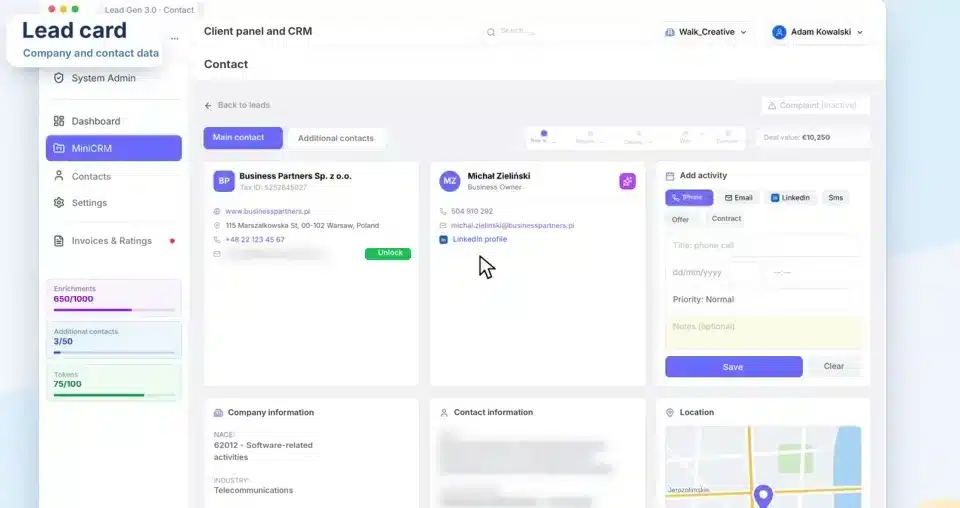
We set fit with the ICP before launch, when we build and approve the database. We score engagement by the replies: every hot lead lands in the client panel and in your CRM with its stage and contact history.
7 B2B buying signals: from strongest to weakest
Ranked by how well the signal predicts a sales conversation. When you build your model, give the most points to signals at the top of the list.
- A request for a meeting, a proposal or a call. The lead says it wants to talk.
- A question about price, rollout date or contract terms. The lead is already comparing buying options.
- A reply from a decision-maker. You are talking to someone with budget or influence on the decision.
- Several people from one company react. The topic lives across the company, not just with one person.
- A return visit to the offer or pricing page. A sign of interest, but without a commitment.
- A content download or webinar attendance. The lead is learning and is usually at the start of the journey.
- An email open. The weakest signal, because some email clients open messages automatically.
What rolling out scoring with us costs
Cold Mailing 2.0
€1,700net / month, min. 5 hot leads per month in the contract, a hot lead definition and the 3:1 ratioSee the service →CPL – pay for results
€700one-off net setup fee plus a fixed price per hot lead, you pay only for leads that meet the definitionSee the service →CRM rollout with scoring
quote after analysisfields, points, thresholds and lead handover rules in Pipedrive, Livespace, HubSpot and other systemsSee CRM implementation →KPIs we track after rolling out scoring: MQL → SQL conversion, time from a hot lead appearing to a salesperson’s contact, share of leads rejected by salespeople and SQL → client conversion. Net prices, 2026 price list.
We will score your leads
We will build a scoring model for your process
We will show how lead scoring looks in the client panel and in PipeChamp. We will also suggest criteria and thresholds for your ICP.
Watch the demoDiscover Cold Mailing →Common lead scoring mistakes
- A model built by marketing without the salespeople who are supposed to use it.
- Points for email opens and website visits instead of replies and contact requests.
- No negative points, so students and competitors get high scores.
- No SLA: a hot lead waits in the CRM for several days for the first call.
- A model set once and never compared with sales results.
Frequently asked questions
What is lead scoring?
Lead scoring is rating leads with points for fit with the ideal customer profile and for engagement. The total decides which leads salespeople handle first and which go back to marketing.
What is the difference between lead scoring and lead grading?
Lead grading usually describes fit with the ideal customer profile, often as a letter from A to D. Lead scoring adds engagement and gives one number. Many teams combine both, for example A1 or B2.
How does a points-based lead scoring model work?
Each criterion gets a number of points, for example 15 for a decision-making role and 20 for a meeting request. The points add up and once the lead passes a threshold it changes status, for example to MQL or SQL.
What criteria should you use for B2B lead scoring?
On the fit axis: industry, company size, market and job title. On the engagement axis: a reply, a meeting or proposal request, a price question. Plus negative points, for example for a personal email address.
What score threshold should you set for an MQL?
There is no universal threshold. Start with a value that roughly one in five leads passes. After a quarter, check in your CRM whether leads above the threshold end in a meeting more often.
What are negative points in lead scoring?
Points subtracted for signs that the lead is not a client: a personal email address, no influence on the purchase, a company outside your market, a competitor or a clear no. They protect salespeople from working on false leads.
How is lead scoring different from BANT?
Lead scoring rates many leads automatically, based on data and behaviour. BANT is qualification in a conversation: budget, authority, need and timing. Scoring shows who to talk to first and BANT confirms whether it is a real opportunity.
How does lead scoring connect with MQL and SQL?
A lead that passes the marketing threshold becomes an MQL. After SDR qualification and acceptance by a salesperson it becomes an SQL. Scoring is the filter between capturing a lead and a sales conversation.
What is predictive lead scoring?
Scoring in which a statistical or AI model calculates the points itself from the history of won and lost deals. It needs a large number of closed deals and clean CRM data.
Can you set up lead scoring in a CRM?
Yes. Systems such as HubSpot have a built-in scoring module, while in Pipedrive or Livespace you build scoring from fields, rules and automations. Good criteria and handover rules matter more than the tool.
How often should you calibrate a scoring model?
Every quarter, compare scores with sales results and with salespeople’s feedback. After a change of offer, market or ICP, recalculate the model straight away.
What does lead scoring look like in cold email?
In cold email you score the content of the reply. At InStream Group a hot lead is a person who clearly asks for a meeting, a proposal or a call and has a phone number and an email. Three weaker replies count as one hot lead.
Related terms
Sources
- InStream Group contracts: the hot lead definition and the 3:1 ratio for warm replies, 2026 price list.
- InStream Group data: number of projects and CRM rollouts, as of 30 Jul 2026.
- PipeChamp data: qualification methods, as of 15 Nov 2026.
- The Nordvell Group example is fictional and only illustrates the method.
