
In this entry: 12 tiles on SPIN Selling
The SPIN model: from situation to value
Each question type has a different goal. The conversation moves from facts to what the change will give the client. At the end it is the client who says why they need a solution.
The client says: “This is how we do it today.”
The client says: “This is a problem for us.”
The client says: “It costs us more than I thought.”
The client says: “If we solved this, we would gain…”
40 SPIN questions: 10 of each type
The questions use a fictional company, Nordvell Group, that sells a production planning system. Adapt them to your industry and do not ask them all at once.
S – Situation questions (10)
- How do you plan production today?
- How many people work on planning?
- Which systems do you use?
- How often does the plan change in a week?
- Who approves changes to the plan?
- How many production lines do you run?
- How does the plan reach the shop floor?
- How do you measure plan delivery?
- How long has the current planning approach been in place?
- What changes are you planning in the company this year?
P – Problem questions (10)
- What makes planning hardest today?
- How often does the plan drift from reality?
- Where do you lose the most time?
- Do you ever deliver late to clients?
- What happens when an urgent order arrives mid-week?
- How easy is it to see where an order stands?
- Does the plan depend on one or two people?
- What frustrates your shift managers?
- Which data is uncertain or out of date?
- What can your current system not handle?
I – Implication questions (10)
- What does a late delivery mean for your relationship with a key client?
- What does one hour of line downtime cost?
- How do plan changes affect overtime?
- What happens when the planner is on holiday?
- How does uncertain data affect material purchasing?
- How does this show up in the quarterly result?
- Have you turned down orders because of these problems?
- How does the problem affect the team on the floor?
- What happens if volume grows by a fifth?
- How does the board see the current situation?
N – Need-payoff questions (10)
- What would planning without manual fixes give you?
- How would your shift managers' work change?
- How much time would the planning team get back?
- What would on-time deliveries mean for your key client?
- How useful would a real-time view of orders be?
- Which decisions could the board make faster?
- How important would it be if the plan did not depend on one person?
- What would make it easier to accept larger orders?
- What result would be enough for you after six months?
- Who in the company would benefit most from the change?
Example SPIN conversation
Part of a first meeting between a Nordvell Group seller and a production director. Each question shows its type.
Seller · SHow do you build next week's production plan today?
DirectorIn a spreadsheet. Our planner updates it several times a day.
Seller · PWhat happens when an urgent order comes in mid-week?
DirectorWe move other orders and have to redo part of the plan.
Seller · IHow does that affect delivery dates for other clients?
DirectorLast month we were late twice with deliveries to our largest customer.
Seller · IWhat does that mean for that relationship?
DirectorThey have announced a supplier review next year. That is a big risk for us.
Seller · NIf changing the plan took a few minutes and dates were visible straight away, what would that change for you?
DirectorWe could take urgent orders without putting regular clients at risk. That would be a strong argument in the supplier review.
The conversation is fictional and only illustrates the method.
SPIN questions for 4 industries
| Industry | S | P | I | N |
|---|---|---|---|---|
| IT and SaaS | Which tools does the team use? | Where do integrations cause the most trouble? | How much time a week does the team lose moving data by hand? | What would one consistent database give you? |
| Manufacturing | How do you plan line changeovers? | How often does the plan need fixing? | How does downtime affect delivery dates? | What would a live view of line load change? |
| Professional services | How do you assign people to projects? | Where do projects most often slip? | How do hour overruns affect margin? | What would planning capacity in advance give you? |
| Logistics | How do you plan routes and loads? | When do vehicles run part-empty? | What do empty runs cost per month? | What would better fleet use mean for you? |
The research behind SPIN
The key finding: in large deals, closing techniques from small sales stop working. Successful sellers ask more questions about consequences and value, and present product features too early less often.
“SPIN Selling” in brief
Opening
Briefly agree the purpose of the meeting and permission to ask questions. Do not start with a presentation.
Investigating
The most important part of the conversation. This is where S, P, I and N questions work.
Demonstrating capability
Talk about benefits that answer the needs the client named, not about every feature.
Obtaining commitment
End with a concrete step forward, for example a meeting with the board.
Five takeaways from the book, in our own words: in large sales progress matters more than a quick close; the problem must grow in the client's eyes before price comes up; implication questions are the hardest and most valuable; a benefit answers a need the client has named; objections more often come from presenting too early than from price.
SPIN, Challenger, MEDDIC and BANT: how to combine them
| SPIN | Challenger | MEDDIC | BANT | |
|---|---|---|---|---|
| What it is | a conversation method | a way to bring a new perspective | a deal qualification method | quick lead qualification |
| Who leads the talk | the client, the seller asks | the seller, who teaches and provokes | the seller checks what is known about the deal | the SDR or seller |
| Best moment | a discovery meeting | a client sure they know it all | before the proposal and forecast | first contact |
| How to combine | questions in the meeting | an insight before implication questions | conversation findings logged in the CRM | a filter before the meeting |
A practical mix: the SDR qualifies with BANT, the seller runs the meeting with SPIN questions and the CRM scores the deal with MEDDIC.
The 7 most common SPIN mistakes
- Too many situation questions. The client feels interrogated and you ask about things you could check before the meeting.
- Pitching before implication questions. The problem seems small, so the price seems too high.
- Questions read from a list. Without listening to the answers the conversation loses its point.
- Leading questions. The client senses manipulation and pulls back.
- No need-payoff questions. The client never says in their own words why change matters.
- Ending without a next step. The meeting was pleasant, but the sale did not move forward.
- Using SPIN for a simple, quick purchase. A small deal needs a shorter conversation.
SPIN in PipeChamp: practice with an AI client
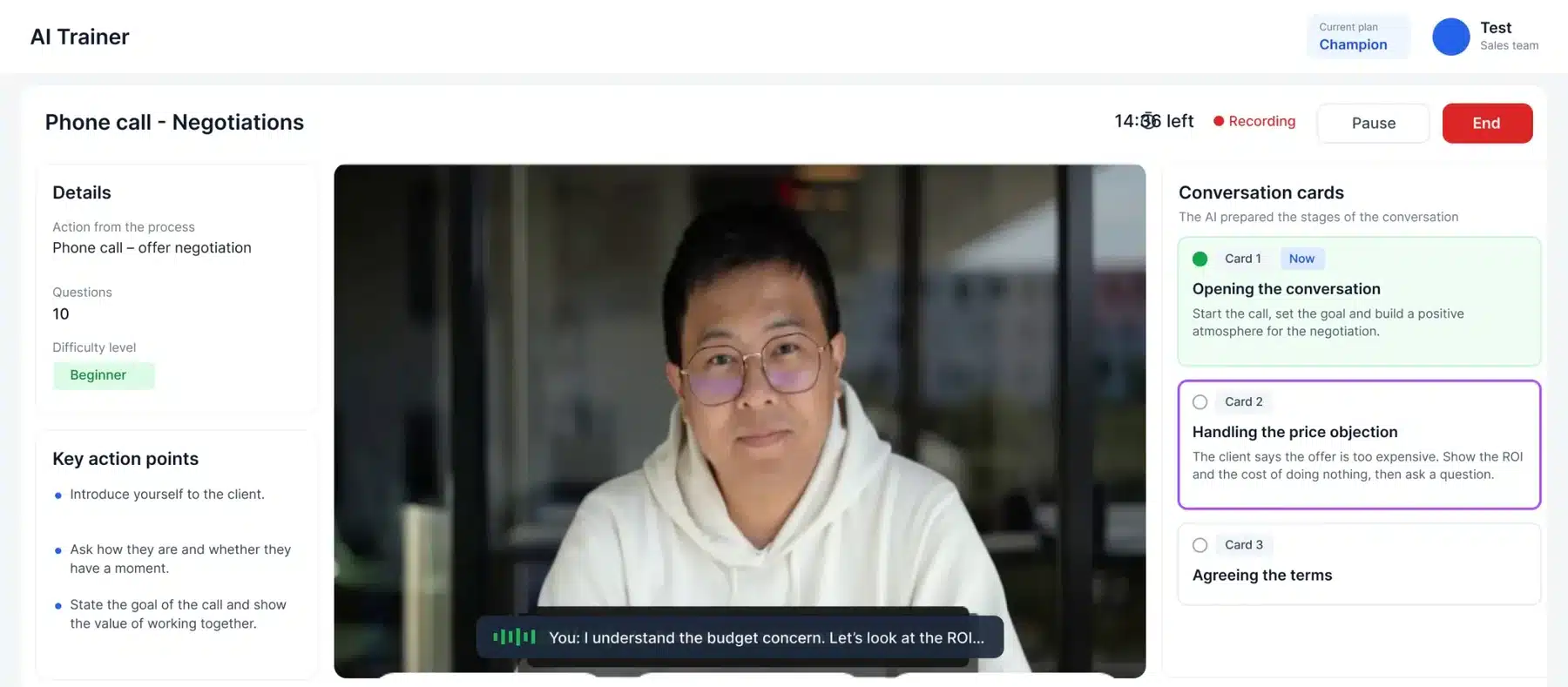
In PipeChamp sellers practise with an AI client before they call a real one. The SPIN first-contact template guides them through S, P, I and N questions, and we rate the outcome the way the book does:
How we practise conversations with teams
PipeChamp · a virtual training ground for salespeople
Sales Booster · Phase 3 · Practice and new habits
Rolling out SPIN in a team: cost and what we measure
SalesBooster
€8,000net for 4 months (€2,000 / month) + platform licence, process, CRM and trainingSee the programme →KPIs we track after a SPIN rollout: share of meetings that end with an advance and a dated next step, number of implication questions in recorded calls, and share of proposals sent after a discovery conversation. Net prices, 2026 price list.
Can you spot the SPIN question types?
“How many people work on production planning today?”
A Situation question: it gathers facts about how things work today.
“What makes planning hardest for you today?”
A Problem question: it looks for difficulties and dissatisfaction.
“How do late deliveries affect the relationship with your largest client?”
An Implication question: it shows what the problem really costs.
“What would planning without manual fixes give you?”
A Need-payoff question: the client describes the value of change.
We will build a SPIN script for your offer
We prepare questions for your industry, build them into your process in PipeChamp and practise them with your team in calls with an AI client.
Watch the demoDiscover PipeChamp →Frequently asked questions
What is SPIN Selling?
SPIN Selling is a method for running sales conversations with four types of questions: Situation, Problem, Implication and Need-payoff. It helps the client name the problem and the value of change themselves.
Who created SPIN Selling?
Neil Rackham described the method in his book “SPIN Selling”, published in 1988. It is based on many years of research into sales calls in large deals.
Does SPIN still work in 2026?
Yes. B2B buyers now have more information before the meeting, so keep situation questions short. Implication and need-payoff questions remain the most effective part of the conversation.
Which deals is SPIN best for?
Complex B2B purchases where the client decides after several meetings. For simple, low-cost products a shorter conversation is enough.
How many questions of each type should I ask?
There is no fixed number. Ask few situation questions and the most problem and implication questions. A few good need-payoff questions usually close the investigation.
What are implication questions?
Questions about the consequences of a problem: costs, delays, risk and impact on other people. They make the problem important enough for the client to act.
What are need-payoff questions?
Questions about the value of a solution that the client answers in their own words, such as “what would it give you…”. They let the client explain why change matters.
Does SPIN work on the phone and on LinkedIn?
Yes, in a shorter form. On the phone ask one or two problem and implication questions. On LinkedIn a problem question is a good opener, while the full SPIN belongs in a meeting.
SPIN or Challenger?
SPIN relies on questions, Challenger on bringing a new perspective. A good mix is a short insight followed by implication questions.
SPIN or MEDDIC?
They do different jobs. SPIN helps run the conversation, MEDDIC helps assess the deal. Findings from a SPIN conversation go into the MEDDIC card in the CRM.
How can a team practise SPIN?
Prepare questions for your industry, practise in pairs or with an AI client in PipeChamp, and review recordings of real meetings.
Is the book “SPIN Selling” worth reading?
Yes, if you sell complex B2B solutions. The book explains well why small-sale techniques fail in large deals.
Related terms
Sources
- Neil Rackham, “SPIN Selling”, McGraw-Hill, 1988: the method and the research, summarised in our own words.
- PipeChamp data (process and script templates, AI trainer), as of 15 Nov 2026.
- InStream Group 2026 price list: Sales Booster.
- The Nordvell Group examples and the conversation are fictional.
