
What is B2B and how do B2B sales work in 2027?

Filip Duszczak
CEO InStream Group
18 min read
Updated: · a guide for 2026 · data from InStream Group projects
B2B (business to business) is a sales model in which a company sells products or services to other companies rather than to consumers. B2B sales stand out for decisions made by a buying group, a longer sales cycle, higher deal values and a relationship that continues after the contract is signed.
In short
- What does B2B mean? The customer is a company and a group makes the buying decision: in complex purchases usually 6–10 people (Gartner).
- B2B sales differ from B2C in the sales cycle, deal value and number of decision-makers, so they need a process, a CRM and several outreach channels.
- You win B2B customers through brand visibility, social selling on LinkedIn and cold email. You measure results with customer acquisition cost (CAC) and LTV.
- B2B vs B2C and other models
- Characteristics and examples
- The B2B customer and their profile
- How to win B2B customers
- Presentation with voice-over
- Brand visibility in B2B
- Social selling on LinkedIn
- Cold email in B2B
- The B2B market in Poland
- What a sales team needs
- Scaling with Sales House
- CAC, LTV and churn: calculator
- Frequently asked questions
- Let’s talk about your sales
Trusted by 1,700 companies from 40 countries
B2B sales with Sales House
Let’s put your company’s B2B sales in order
Lead generation, your brand on LinkedIn, the sales process and CRM in one place. In 30 minutes we will show you which floor of the funnel to start with.
- Cold Mailing for scale
- Social Selling for precision
- CRM implementation for the process
B2B vs B2C
B2B vs B2C: 8 differences in sales
B2C (business to consumer) means selling to consumers, while B2B means selling to companies. We compare both models on the 8 criteria that change the way you sell the most.
- Who buyscustomerB2CA private person, for their own needs.B2BA company or institution, for the needs of its business.
- How many decision-makersdecisionB2CUsually one person, sometimes a family.B2BIn a complex purchase 6–10 decision-makers, each with their own criteria (Gartner).
- Buying cycletime to decideB2CMinutes or days, often driven by emotions and promotions.B2BWeeks or months: research, conversations, a demo, an offer and negotiations.
- Deal valuebasket and contractB2CA low value per purchase. Revenue comes from the number of customers.B2BA high contract value, often a subscription or a multi-year contract.
- Pricingprice listB2CA fixed price list, the same for all customers.B2BA negotiated price, individual discounts and terms of cooperation.
- PaymentsettlementB2CImmediate payment: card, mobile payment or bank transfer at checkout.B2BAn invoice with payment terms, often according to a schedule.
- Outreach channelscommunicationB2CMass advertising, shops, social media.B2BLinkedIn, cold email, referrals, meetings and demos.
- Relationshipafter the purchaseB2CA relationship with the brand. Customers switch shops easily.B2BA relationship with the supplier’s account manager and team that lasts for years.
What a B2C business does
A B2C business sells products and services to consumers, that is private individuals: in a physical shop, in e-commerce or in services. Results depend on scale, price and convenience of purchase.
One company, two models
A company can sell in B2B and B2C at the same time, for example a manufacturer with an online shop and a wholesale department. In that case it pays to separate processes, teams and metrics, because the sales cycle and customer acquisition cost look different.
Sales models
B2C, B2G, B2B2C, D2C, C2C and B2E: other sales models
The abbreviation B2B has a whole family. The first letter tells you who sells and the last one who buys. These are the models you will meet most often alongside B2B.
B2C · business to consumer
A company sells to consumers, that is private individuals. Example: an online clothing shop.
B2G · business to government
A company sells to public administration, most often through tenders. Example: a software supplier for public offices.
B2B2C · business to business to consumer
A company sells through a business partner that serves consumers. Example: a food manufacturer selling through a retail chain.
D2C · direct to consumer
A manufacturer sells directly to consumers, without intermediaries. Example: a cosmetics brand with its own online shop.
C2C · consumer to consumer
Private individuals sell to each other, usually through a classifieds or auction platform. Example: selling a used bike.
B2E · business to employee
A company offers products or services to its employees. Example: an employee benefits platform.
Less often you will also see B2B2B, selling to a company through another business intermediary (component manufacturer → integrator → company), and C2B, when a private individual sells to a company, for example a photographer selling pictures to a stock photo library.
B2B sales characteristics
B2B sales characteristics: examples, markets and process
B2B sales have five constant features: a buying group makes the decision, the cycle takes weeks or months, the decision rests on return on investment, the relationship with the supplier matters and the contract value is high. This is what it looks like in practice.
6 examples of B2B sales
- 01
Manufacturer → distributor
A factory sells machinery, components or raw materials to companies that process or resell them.
- 02
Wholesaler → shop
A wholesaler supplies shops and showrooms that sell the goods on to end customers.
- 03
Software → companies
A software supplier sells licences or subscriptions to companies, for example a CRM or ERP system.
- 04
Professional services
An accounting firm, a law firm or a consultancy serves businesses under an ongoing contract.
- 05
Logistics and transport
A logistics operator transports and stores goods for manufacturers and online shops.
- 06
Agency and sales outsourcing
An agency takes over part of a client’s sales process, for example lead generation or running LinkedIn profiles.
Horizontal and vertical markets
Horizontal market
A product for companies from many industries that share the same need. Example: an invoicing system or a B2B customer acquisition service.
Vertical market
A product for a single industry, tailored to its specifics. Example: software for pharmacies or production lines for the food industry.
A typical B2B sales process in 7 steps
- 1
First contact
email, LinkedIn, phone or a referral
- 2
Qualification
does the company fit your ICP and have a need
- 3
Needs analysis
conversations with the key people
- 4
Presentation or demo
the solution shown on the client’s own case
- 5
Offer
scope, price and terms
- 6
Negotiation and decision
approval of the whole buying group
- 7
Onboarding and service
an account manager, growth and further contracts
What is a B2B system (B2B platform)?
A B2B system is a platform where business customers place orders online: they see individual price lists, credit limits and their purchase history, while the data flows into ERP and CRM. It is used most often by wholesalers and manufacturers.
CRM implementation →The B2B customer
The B2B customer: who they are and how they buy
A B2B customer is a company or institution that buys products or services for the needs of its business, not for private use. Before talking to a salesperson, they do their own research and a whole group decides on the purchase. Four figures from Gartner research show how they buy.
17%
of the buying process is the time B2B buyers spend meeting suppliers. When they compare several, a single salesperson gets about 5% of their attention.
67%
of B2B buyers prefer a buying process without a salesperson. Content, reviews and referrals shape the decision.
77%
of buyers describe their last purchase as complex or difficult. The supplier who makes the decision simpler wins.
6–10
decision-makers make up a typical buying group in a complex B2B purchase. Each has their own criteria and their own materials.
Sources: Gartner, “The B2B Buying Journey” (17%, about 5%, 77%, 6–10 decision-makers) · Gartner, press release of 9 March 2026 (67%).
The B2B customer’s buying group
- Management: approves the budget and direction
- Finance: calculates the cost and return on investment
- Purchasing: compares suppliers and terms
- Users: check whether the solution will work in practice
- IT and quality: assess security and integrations
How does a B2B customer differ from a B2C customer?
A B2C customer buys alone, quickly and for their own needs. A B2B customer buys on behalf of a company, calculates the return on investment and needs arguments for every person in the buying group. That is why you start selling with an ideal customer profile (ICP).
B2B customer profile
How to build a B2B customer profile (ICP) in 4 steps
An ICP (ideal customer profile) describes the company you sell to best. A persona describes the person in that company who makes or influences the decision.
- 1
List your best customers
Take the 10–20 companies that pay the most and stay the longest. Look for what they have in common.
- 2
Describe the ICP in criteria
Industry and industry code, headcount, revenue, country, technology and buying signal.
- 3
Identify the personas
Who signs, who uses, who blocks. In complex B2B usually 6–10 people decide (Gartner).
- 4
Turn the ICP into a database
A list of companies and decision-makers, verified and approved by you before launch.
Segment by need, not only by industry
We will prepare a ready database for your ICP in our B2B company database service.
Sales House demo
See how we win B2B customers
The recording shows what our tools and working with our sales team look like in practice.
Click to play the demo with sound
How to win customers in B2B
How to win customers in B2B: choose your method
You win B2B customers most effectively with several methods at once: your brand on LinkedIn, social selling, cold email and lead handling. Click a tile to see how each service works in practice.
 01 · Visibility and brandLinkedIn MarketingWe build your personal brand on LinkedIn. We plan content, record videos and publish regularly so that customers see you as an expert.→
 01 · Visibility and brandEmployee AdvocacyYour employees speak about the company with one voice. We prepare consistent profiles, a shared content calendar and posts for the whole team.→
 01 · Visibility and brandLinkedIn profile auditWe review your profile element by element. You get recommended changes, a new image and a profile that attracts customers.→
 02 · Lead generationCold MailingWe reach decision-makers with personalised email campaigns. A team, databases and our own sending infrastructure with no risk to your domain.→
 02 · Lead generationSocial SellingA salesperson runs your LinkedIn profile manually. They build relationships, record voice messages and book meetings with your target group.→
 02 · Lead generationB2B company databasesWe build custom company databases from registers, maps and thousands of sources. You get verified contacts that match your target group.→
 03 · Lead managementLead handling (pre-sales)An SDR team qualifies and converts your leads to proven standards. You get a customer who is interested in talking.→
 03 · Lead managementVirtual qualification and meeting bookingAn AI assistant qualifies leads right after they come in. The customer books a meeting themselves or talks to the voice assistant.→
 04 · Sales managementSales department transformationThe 4-month SalesBooster programme rebuilds your team: process, CRM, sales training and new habits.→
 04 · Sales managementRemote sales directorAn experienced director manages your sales department remotely. They bring a process and tools. You focus on scaling.→
 04 · Sales managementOpen consultingYou share your challenges with us. We tailor an individual development path, mentoring and support where you need it.→
 05 · Skills developmentClassic trainingTrainer-led sessions in the training room, reinforced with exercises with a virtual AI client. We check the team’s skills right after the training.→
 05 · Skills developmentTraining on a virtual sales processTogether with you we build a long-term development programme on the PipeChamp platform. Salespeople practise on a virtual version of your company’s process.→
 06 · Tools and CRMCRM implementationWe match the CRM to your process, not the other way round. We map the process, recommend a vendor, implement the system and teach your team to work in it.→
 06 · Tools and CRMAI in sales implementationWe implement an AI layer that supports salespeople: client research, ready-made offers, CRM analysis and automation of everyday work.→

See how it works in practice
Online presentation
How Sales House runs B2B sales
Swipe through the slides like a presentation and see how Sales House works for your sales.
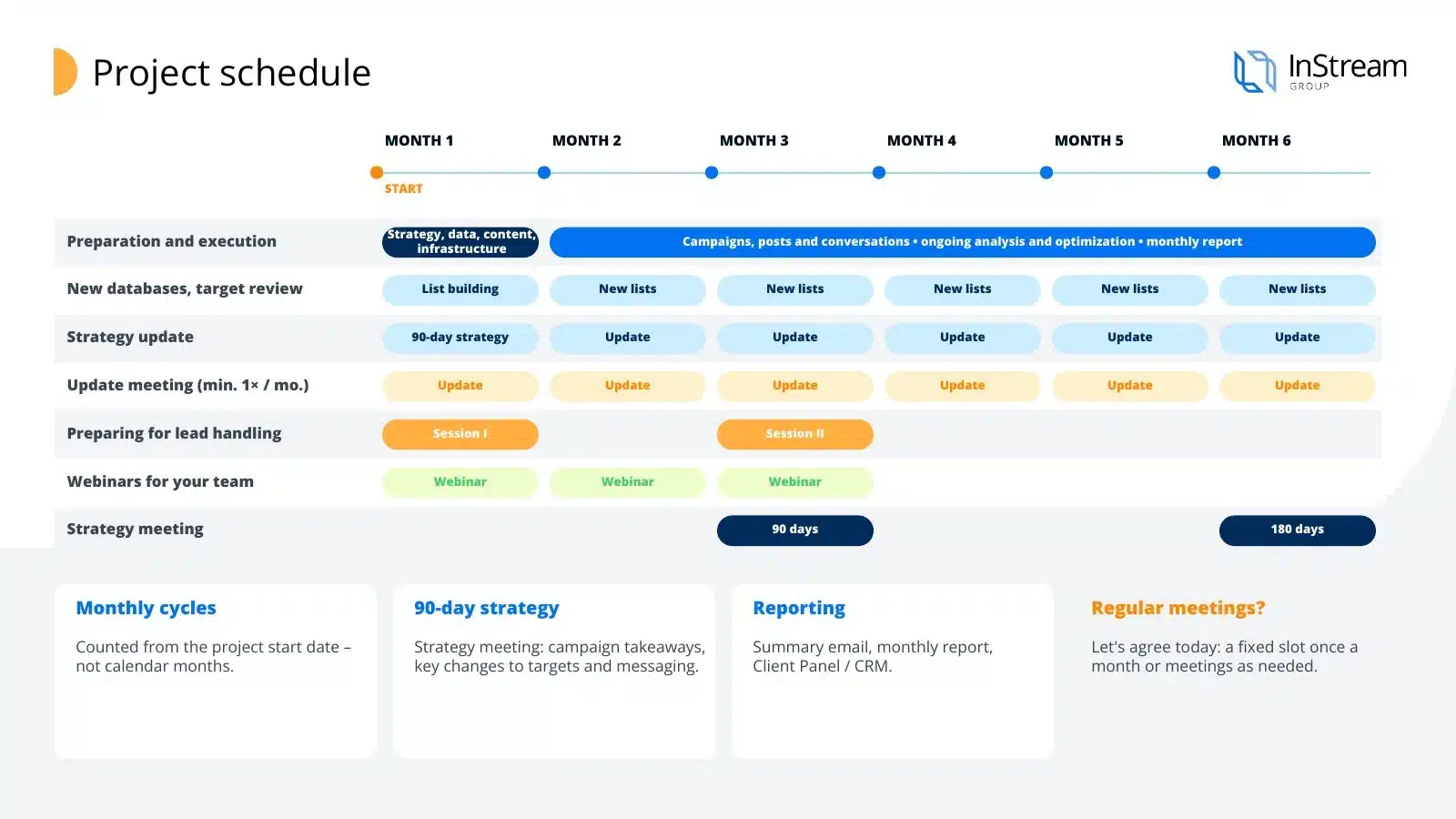
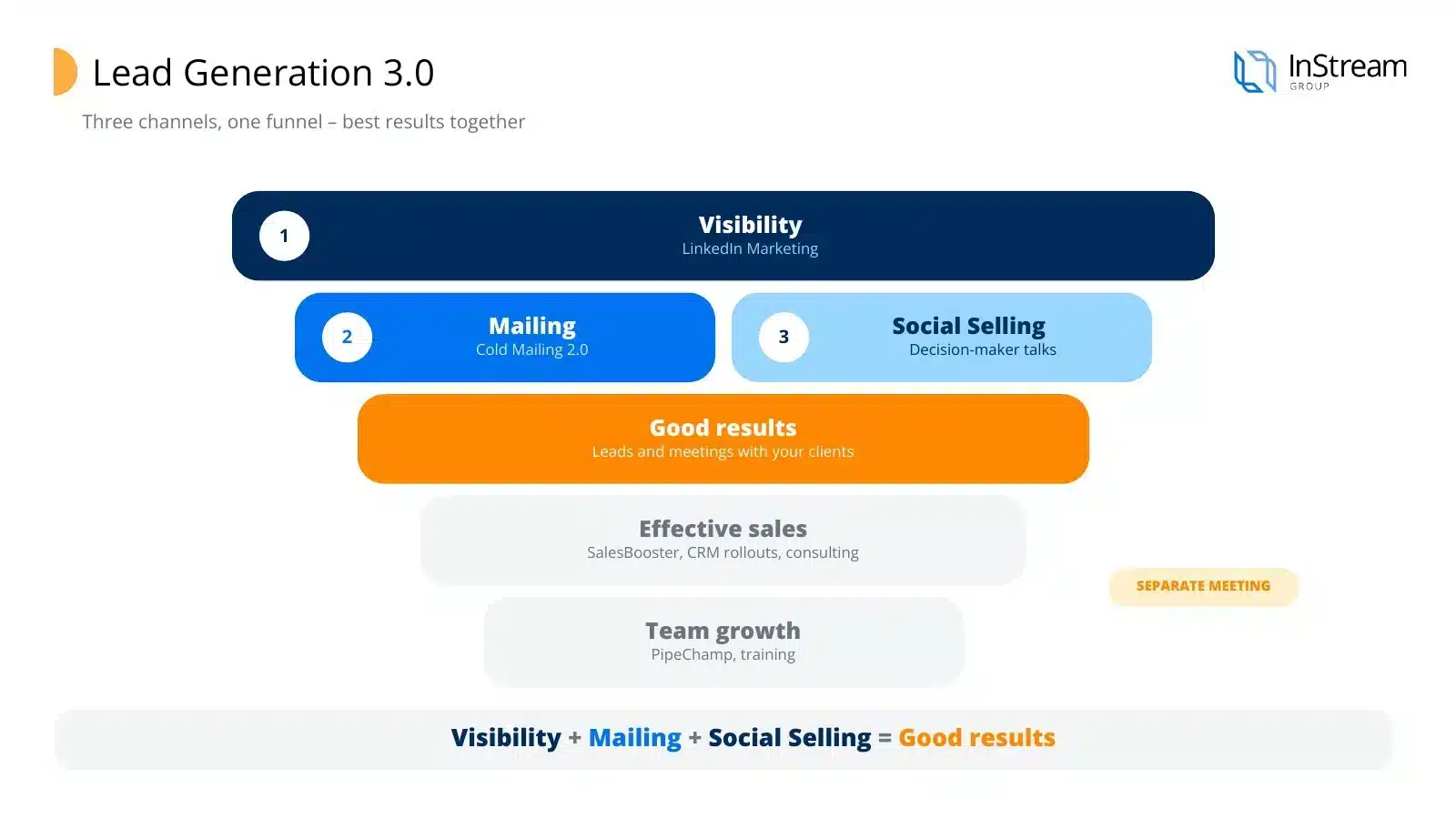
Arrows, swipe or click a thumbnail
Voice-over script for this slide
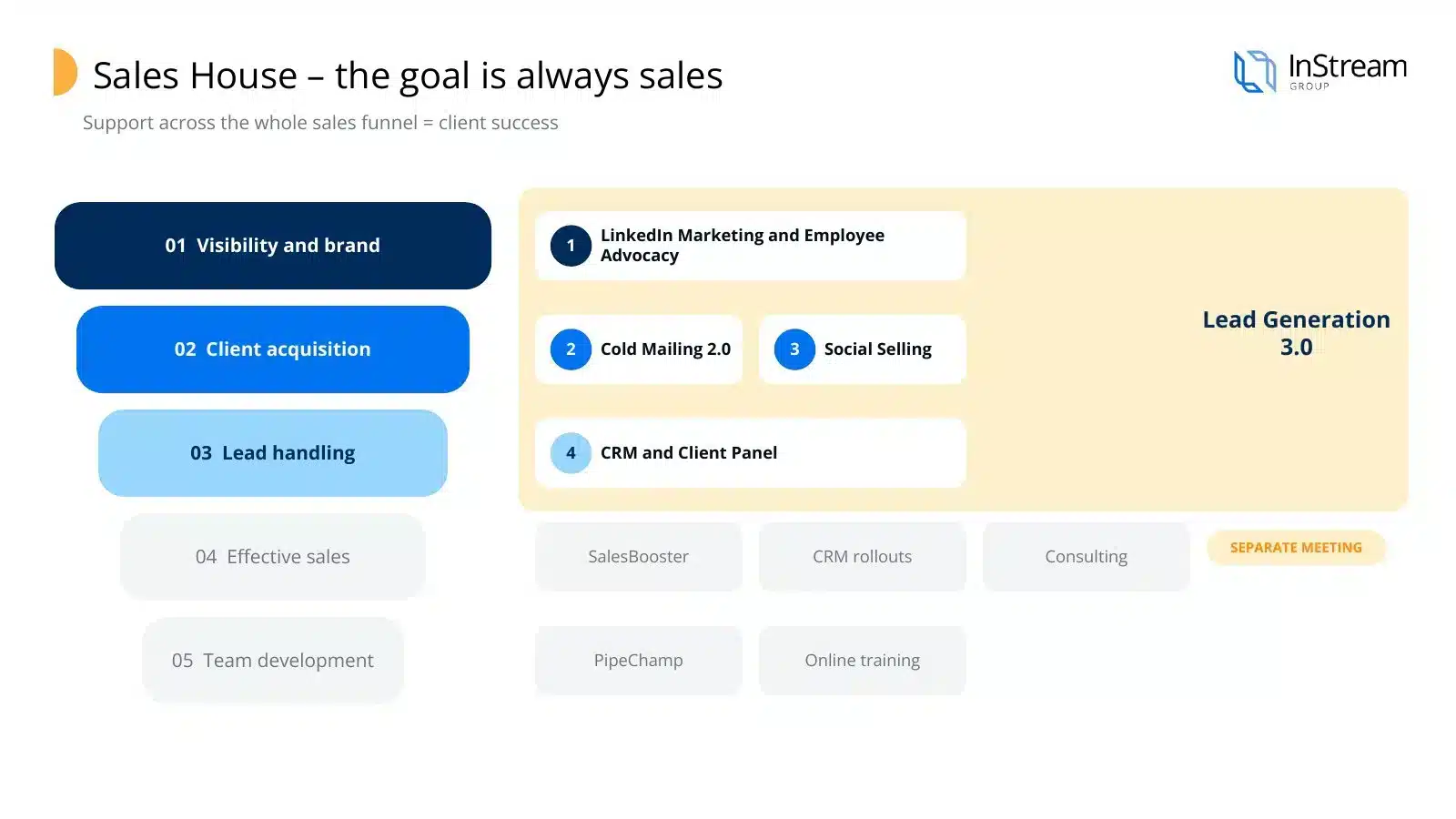
Meet InStream Group, the first Sales House in Poland. In a few minutes we will show you how we can take responsibility for your company's sales. You will also learn why more and more companies choose this model of cooperation.
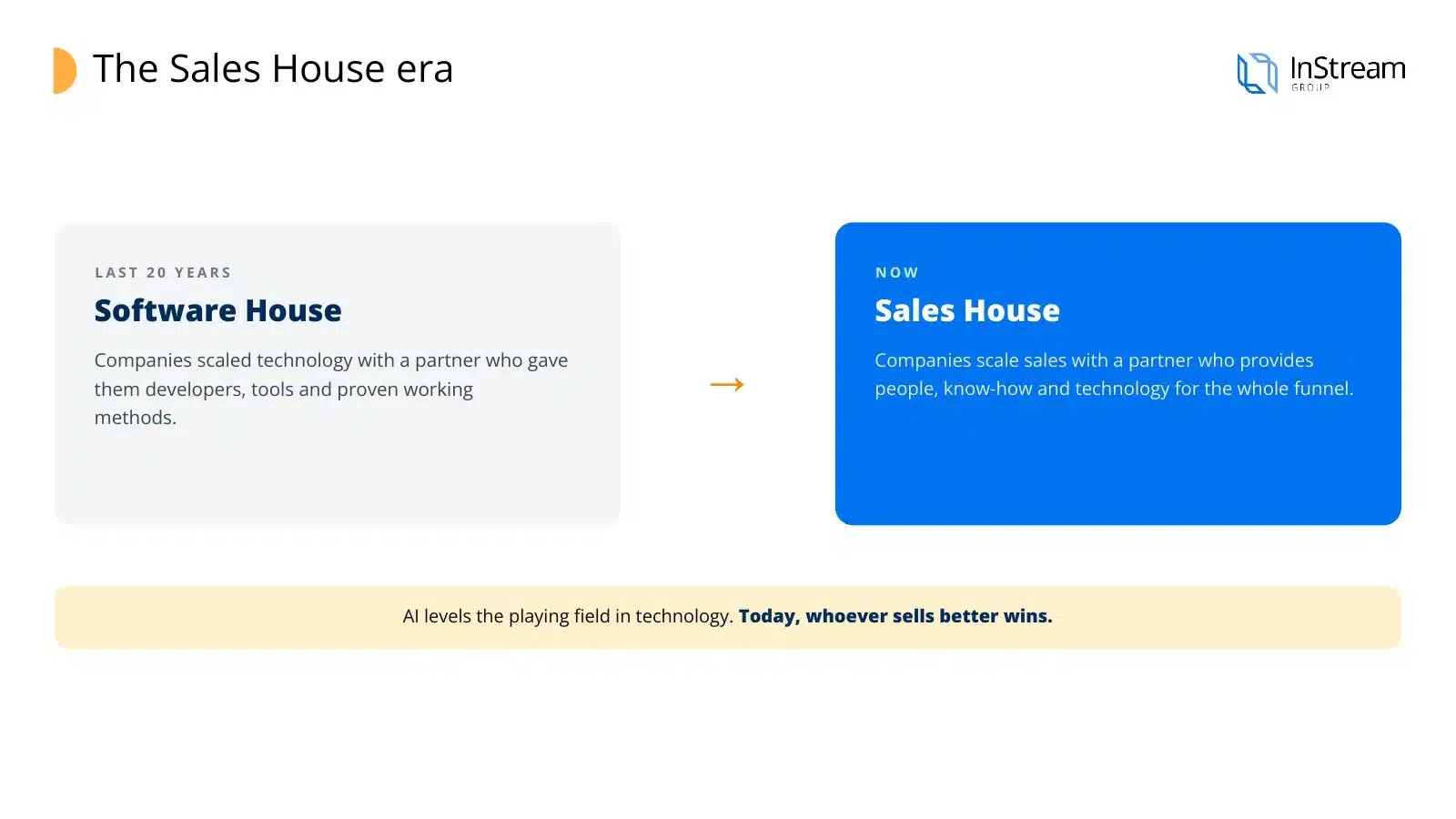
Software houses changed the way companies build technology. Today the same is happening in sales. When artificial intelligence gives everyone similar tools, the advantage goes to whoever sells better. Sales House gives you that advantage from day one.
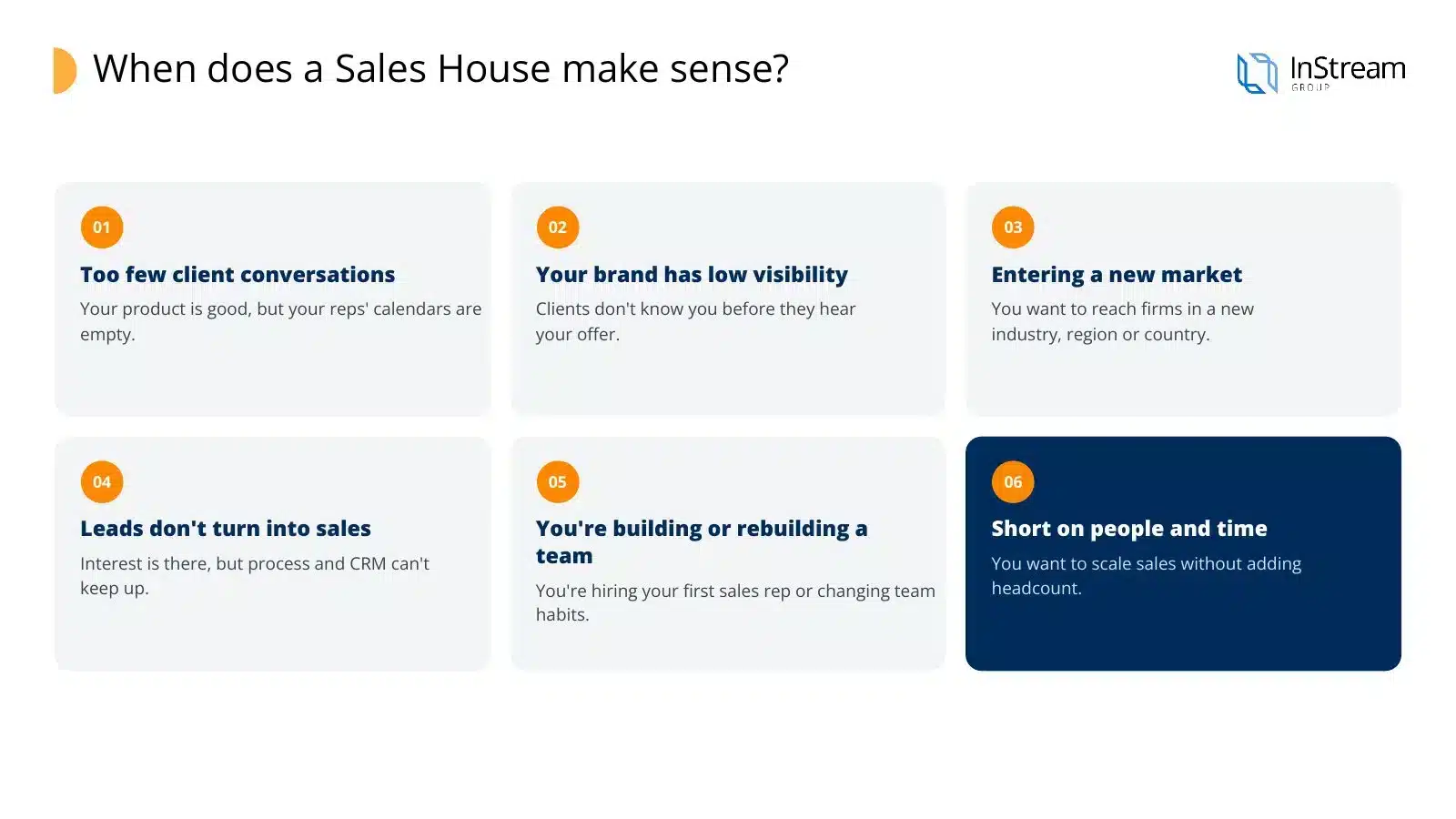
Companies come to us with very different challenges. Some need new conversations with clients, others are entering a new market or building a team from scratch. They all have one thing in common: they want to grow faster without adding headcount.
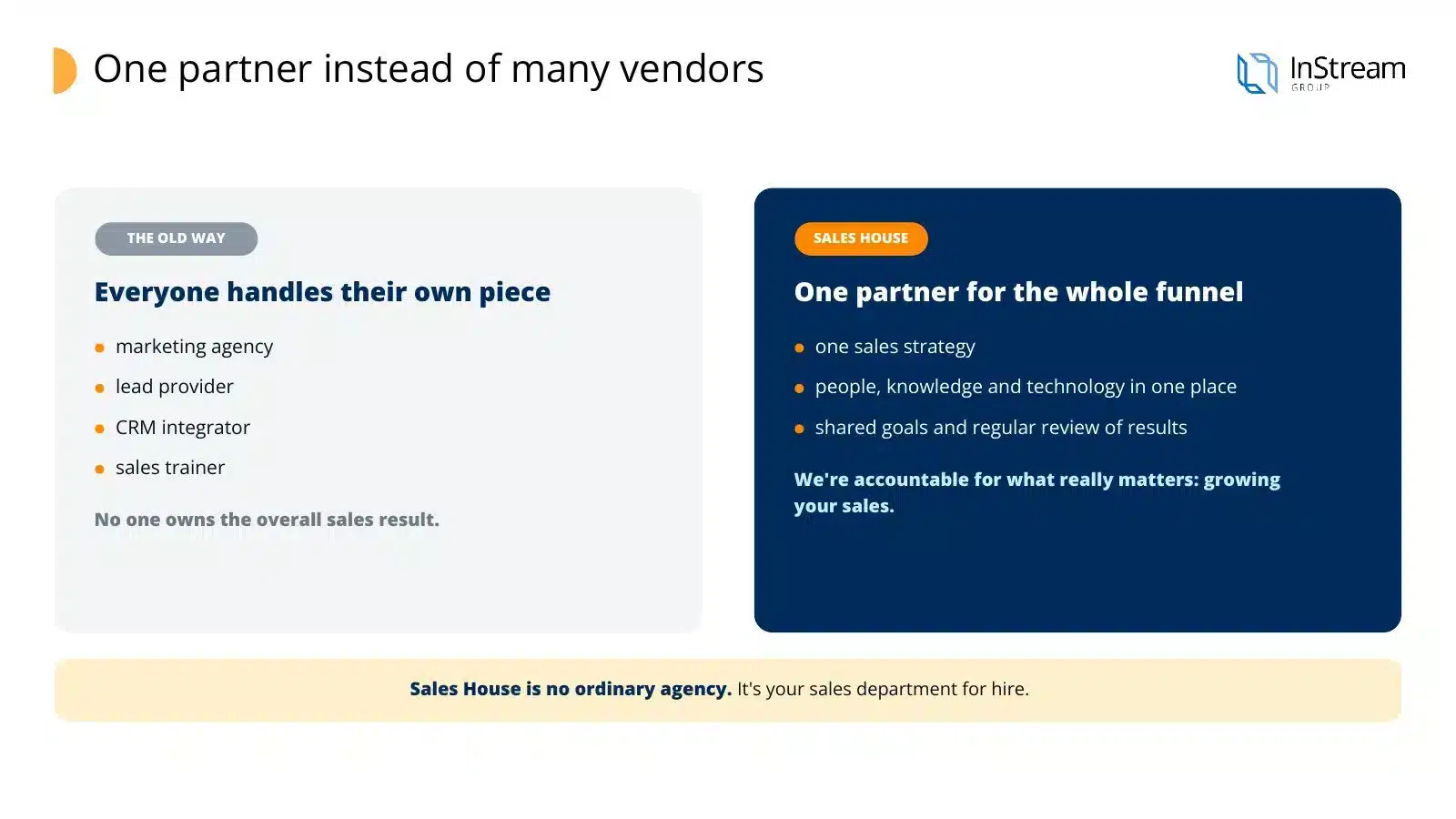
When marketing, leads, CRM and training come from different companies, nobody looks at sales as a whole. At Sales House one team is responsible for the entire funnel. We are accountable to you for one goal: sales growth.
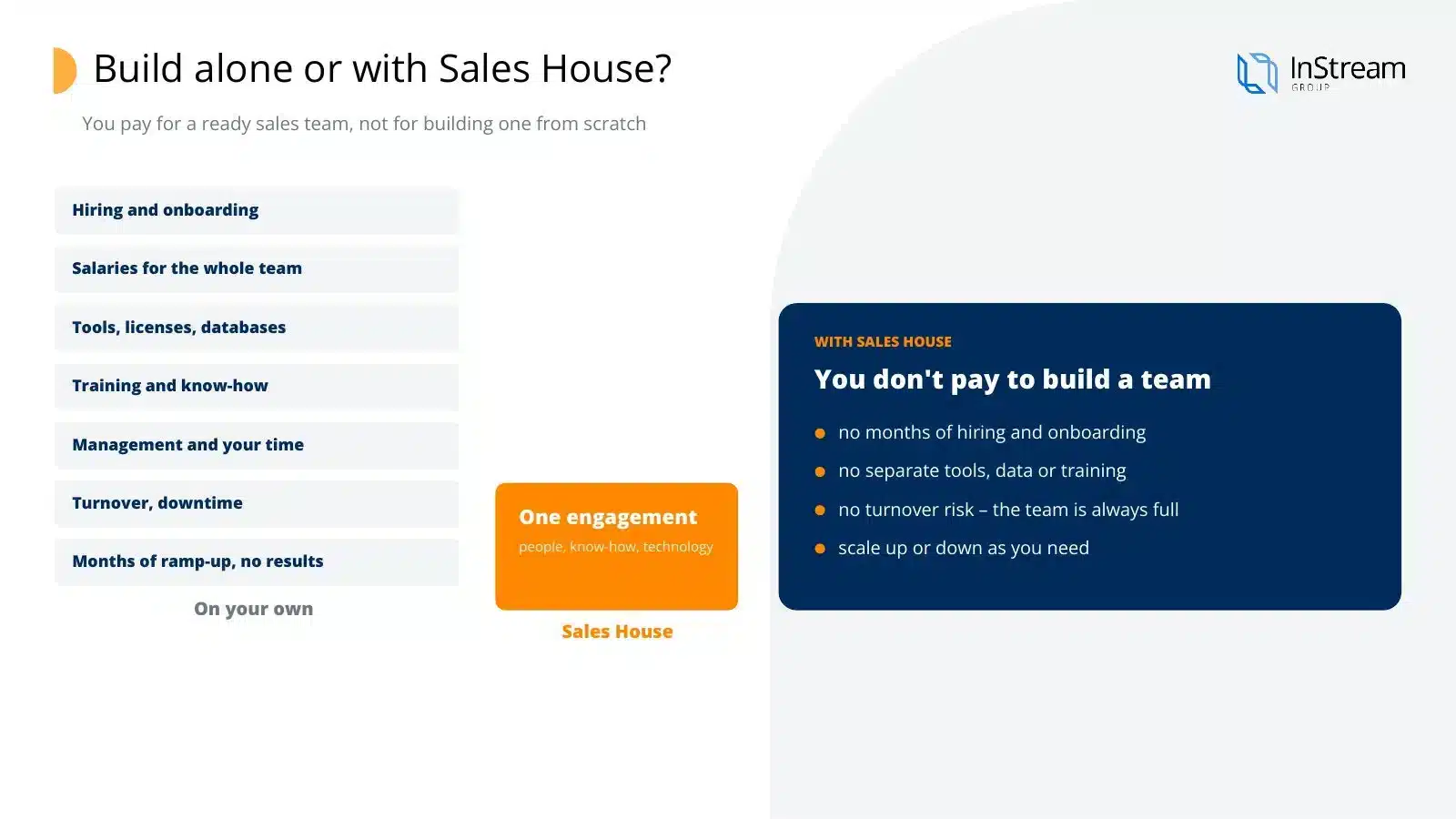
Building a sales department from scratch takes months of recruitment, onboarding and costs before the first results appear. With Sales House you get a team that delivers from the first month. You adjust the scale of cooperation to your company's needs.
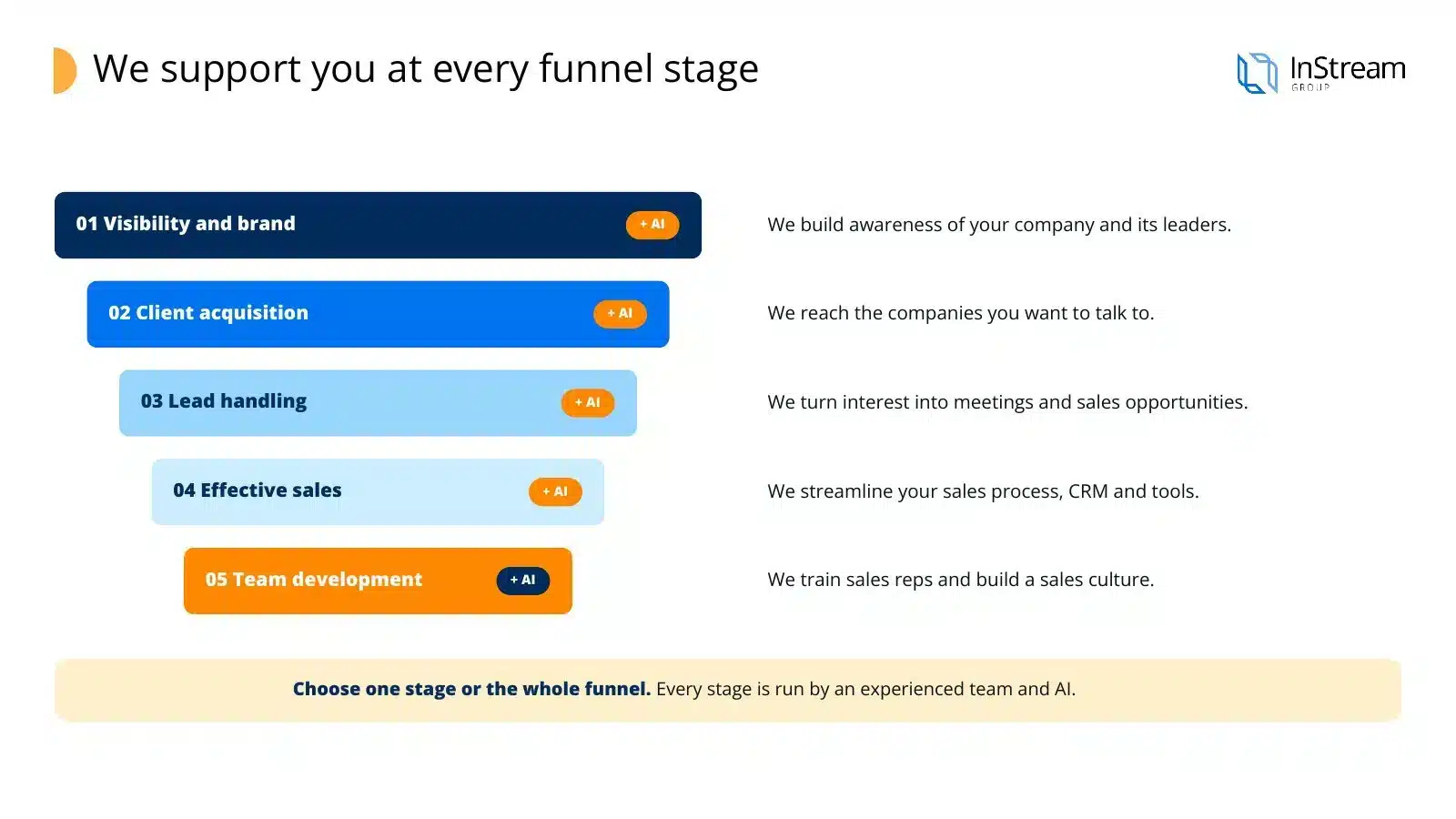
We can step into one stage of your funnel or take over the whole of it. At every stage, experienced specialists supported by artificial intelligence do the work.
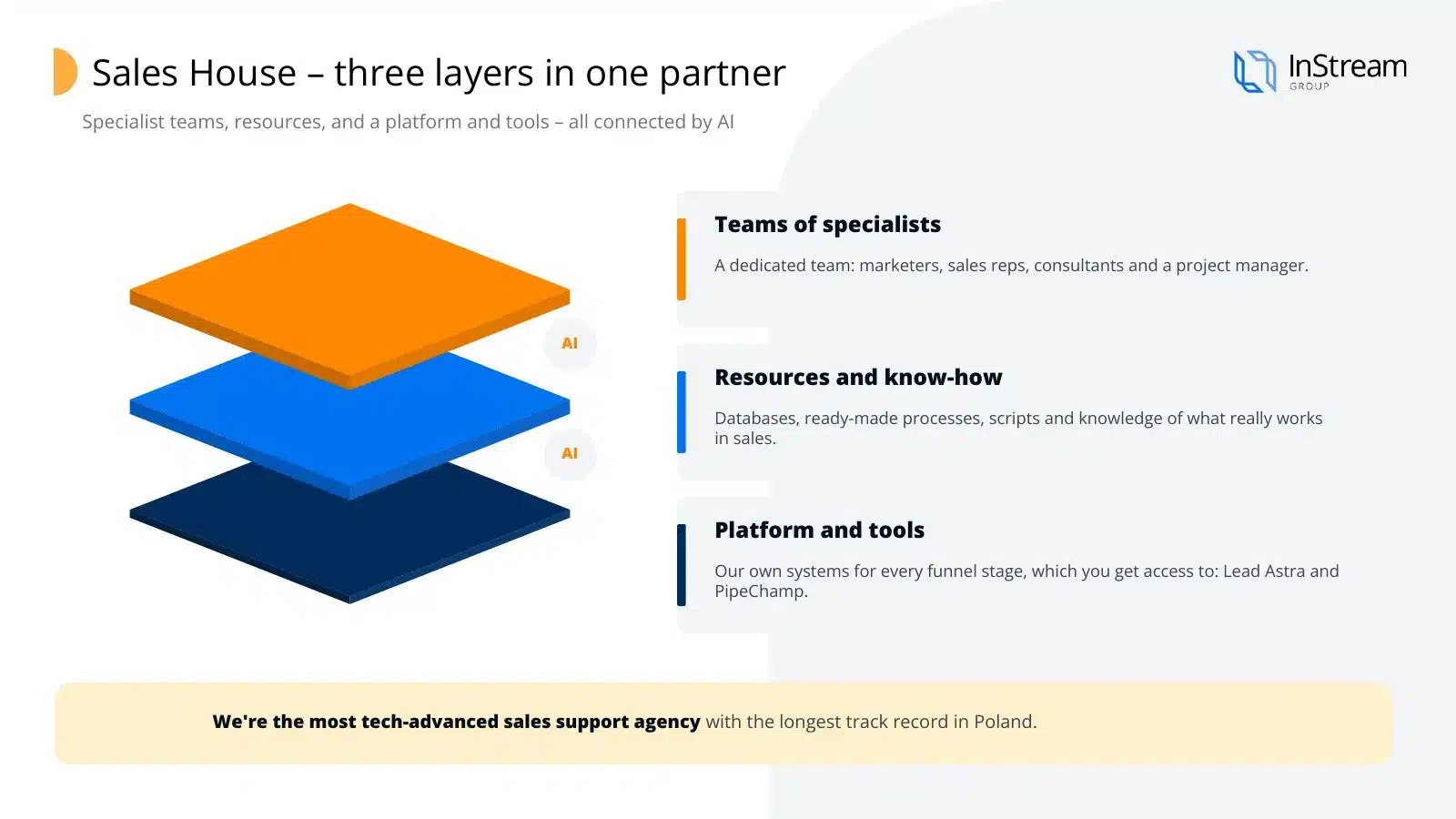
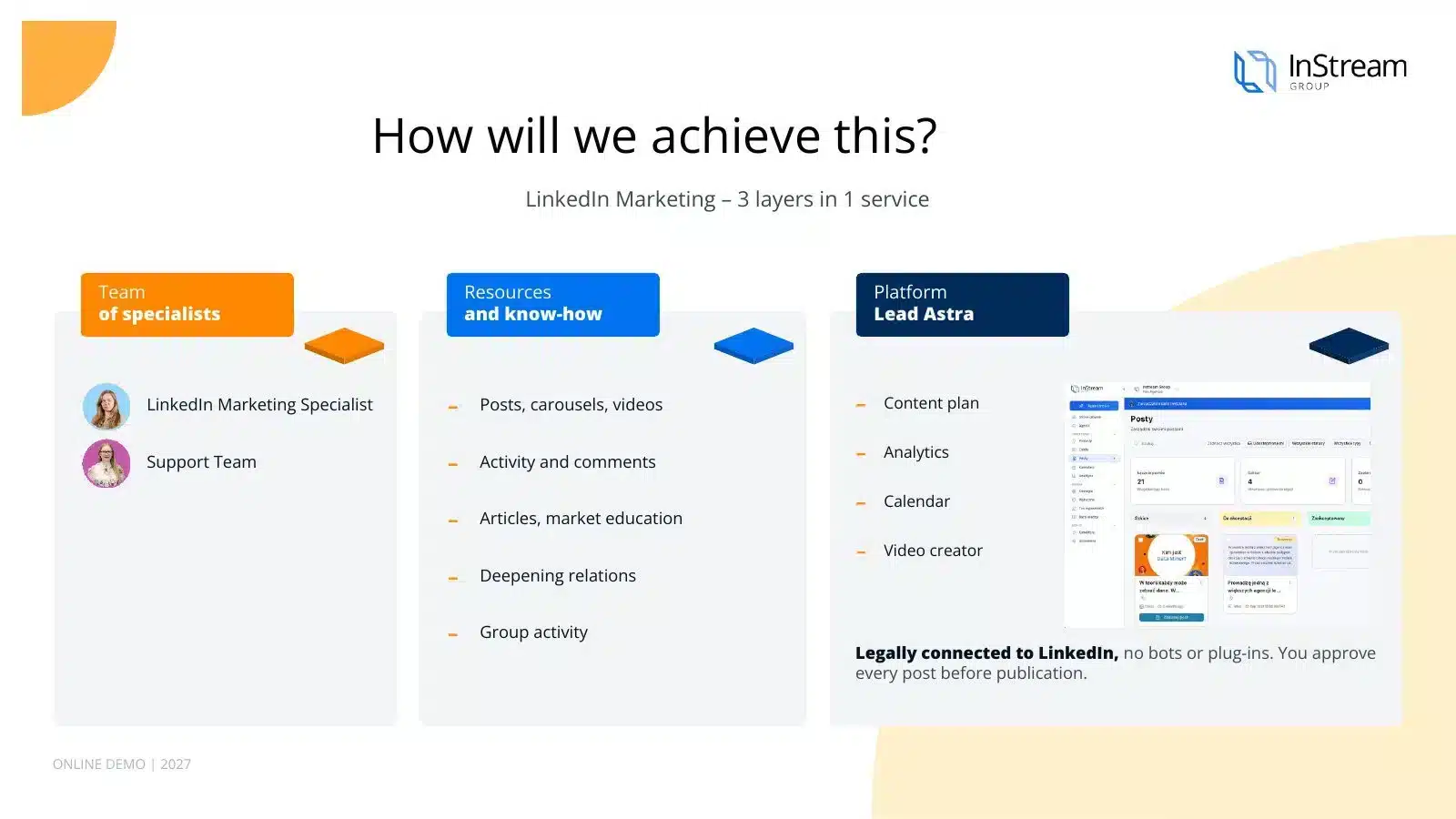
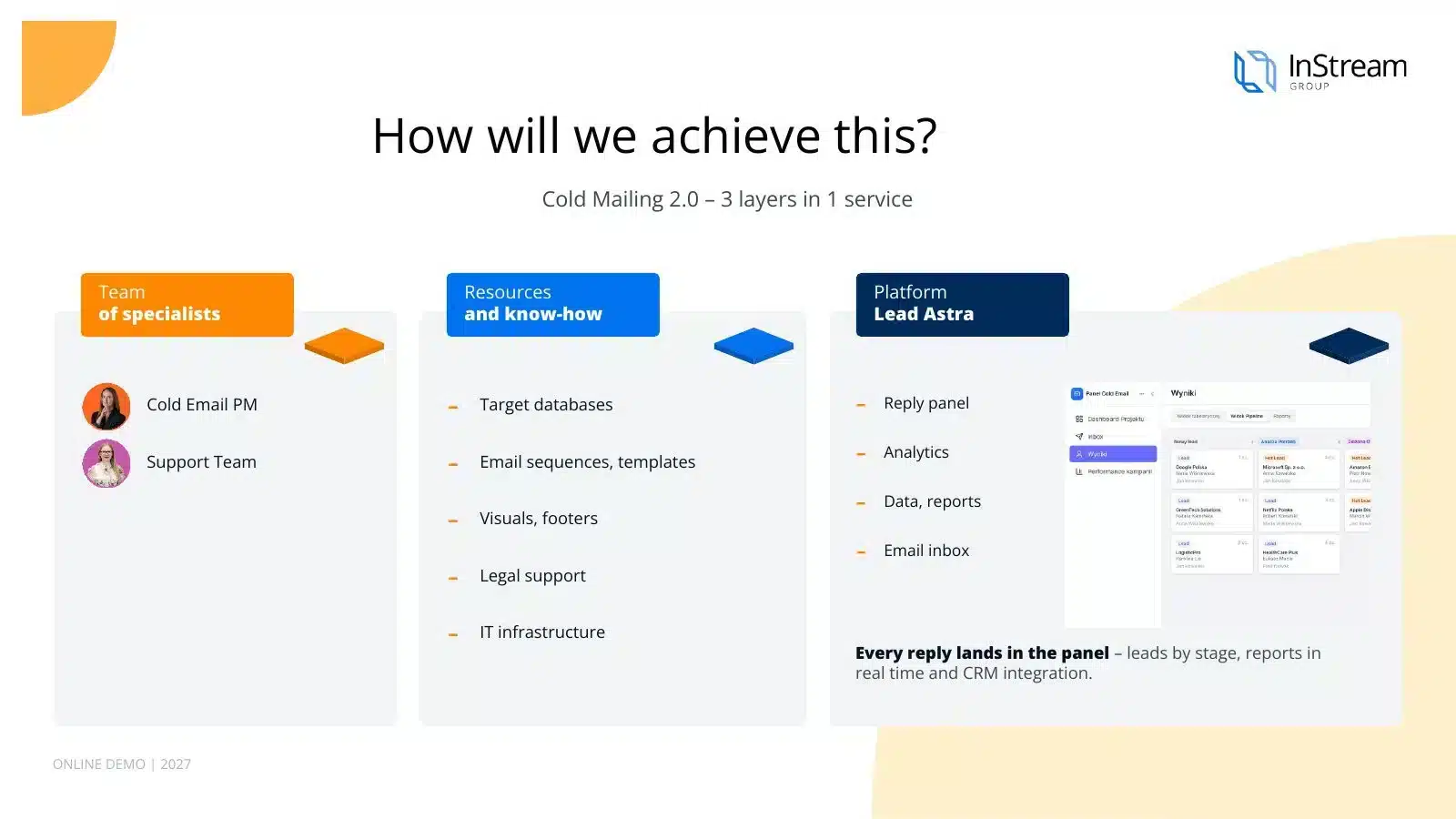
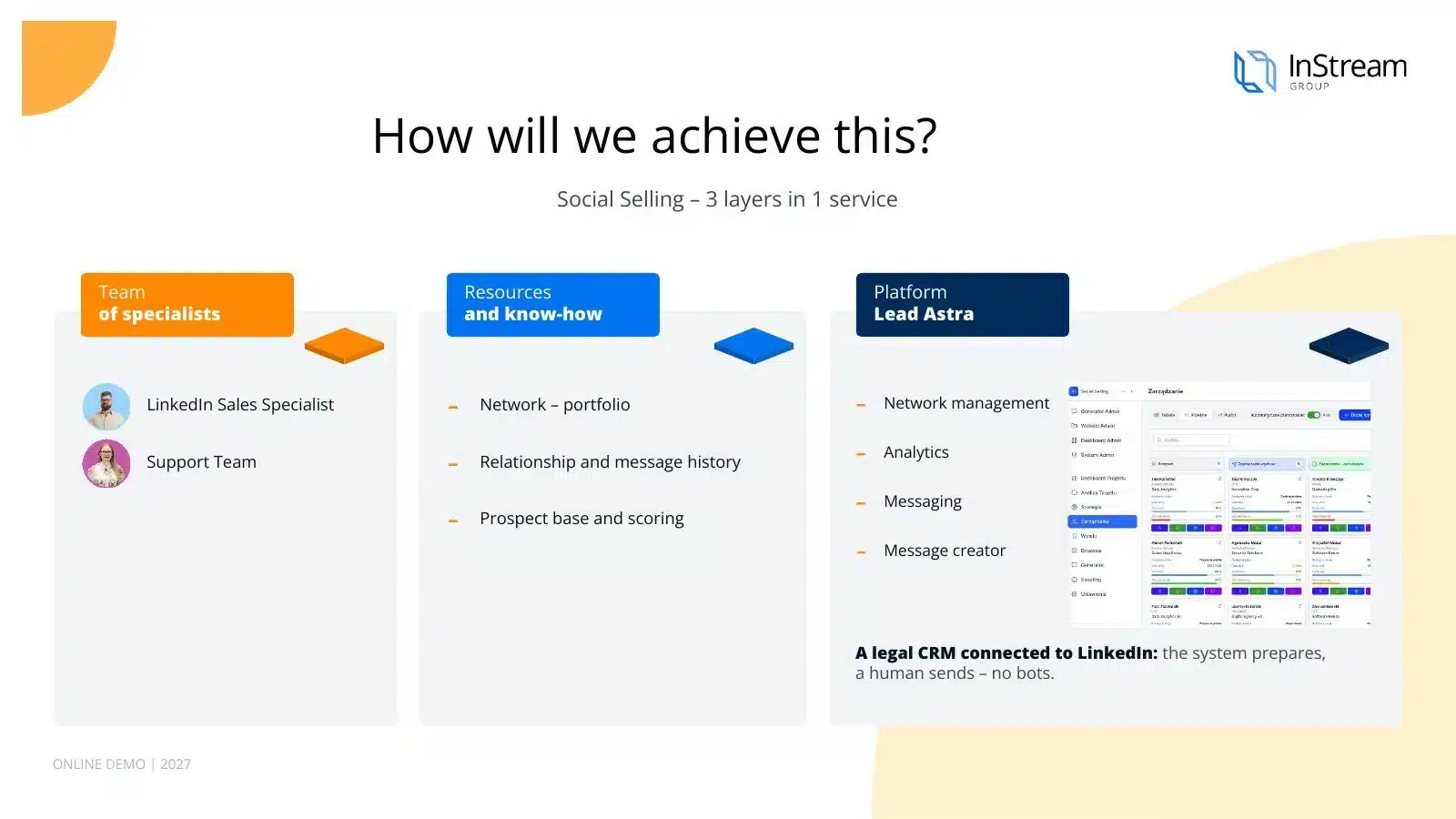
Every service we offer rests on the same foundation. You get people, proven know-how and InStream's own technology. That way you don't pay for experiments – you use solutions proven in our clients' projects.
Everything we do has one goal: the success of your sales. In a moment you will see how we build visibility and win clients. We usually discuss developing the sales process and team at a separate meeting.
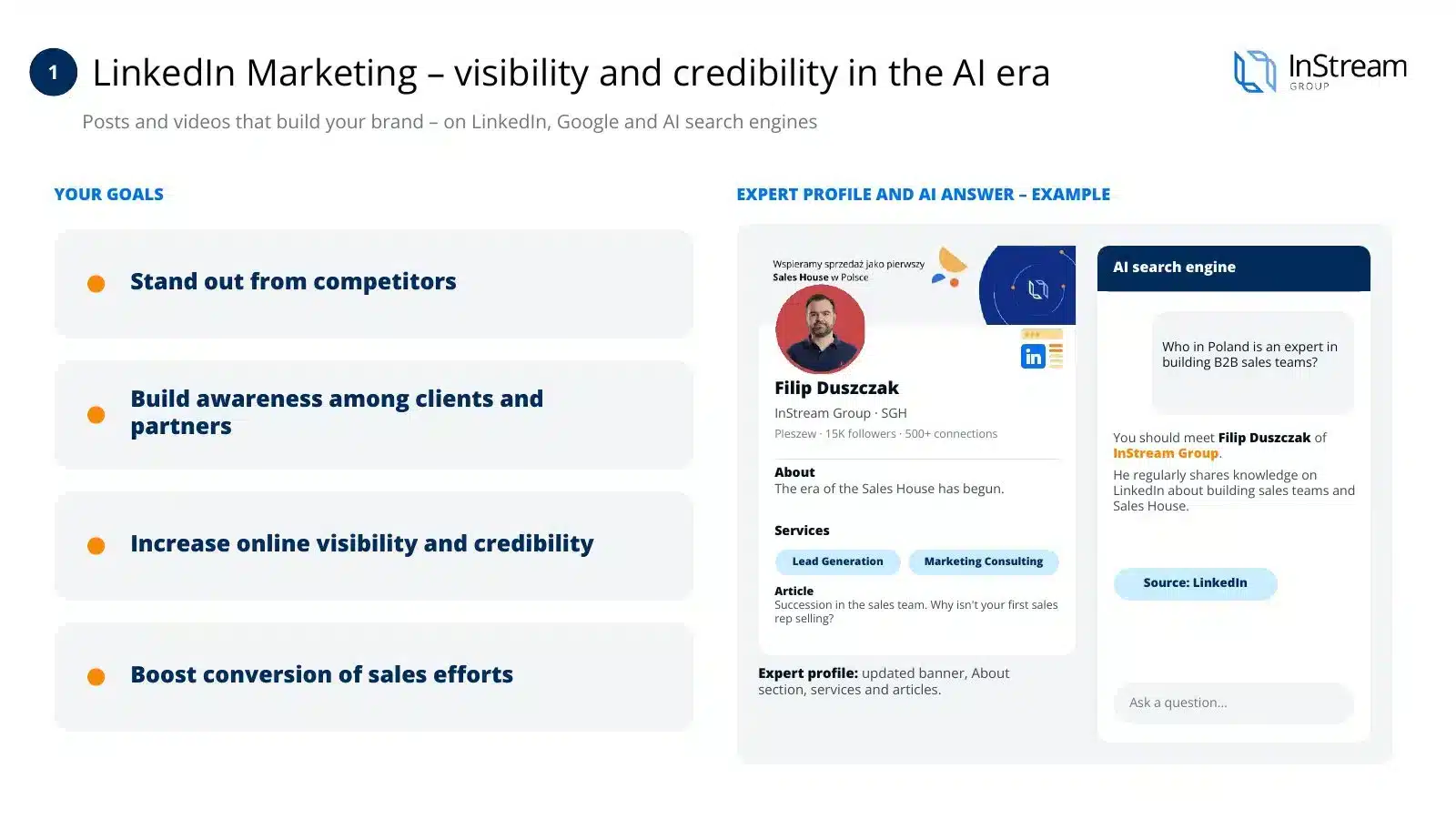
Before a client talks to you, they check you out online. More and more often they also ask artificial intelligence about experts. That is why we build your leaders' brands so they are visible on LinkedIn, in Google and in AI answers.
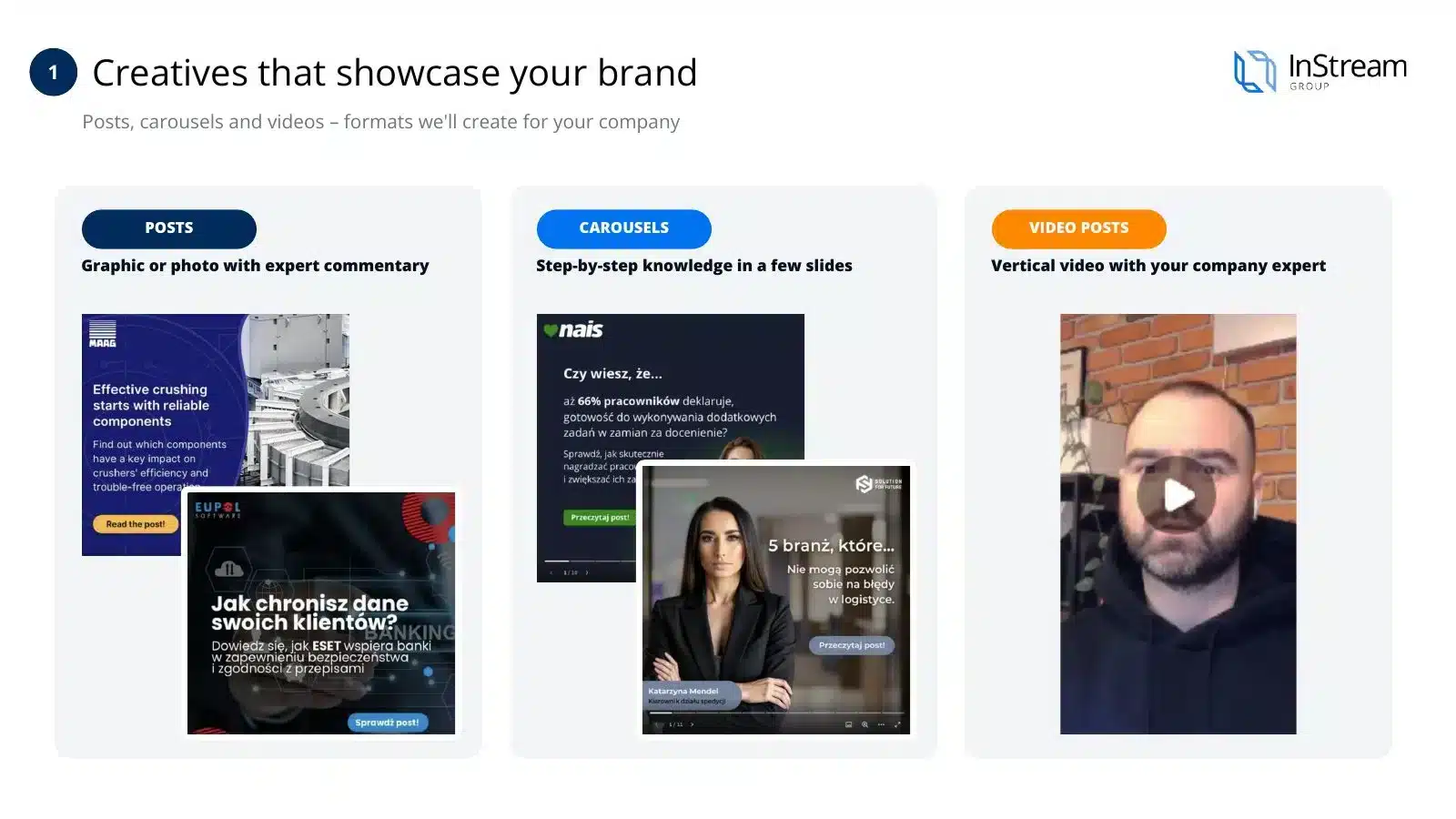
For us, content means many formats: from posts to videos with your experts. We agree the style and formats together at a creative meeting. We prepare every creative in line with your company's brand book.
A dedicated specialist and a support team work on your brand. We plan content, run activity and build relationships on your behalf. You see everything in the Lead Astra platform. Nothing is published without your approval.
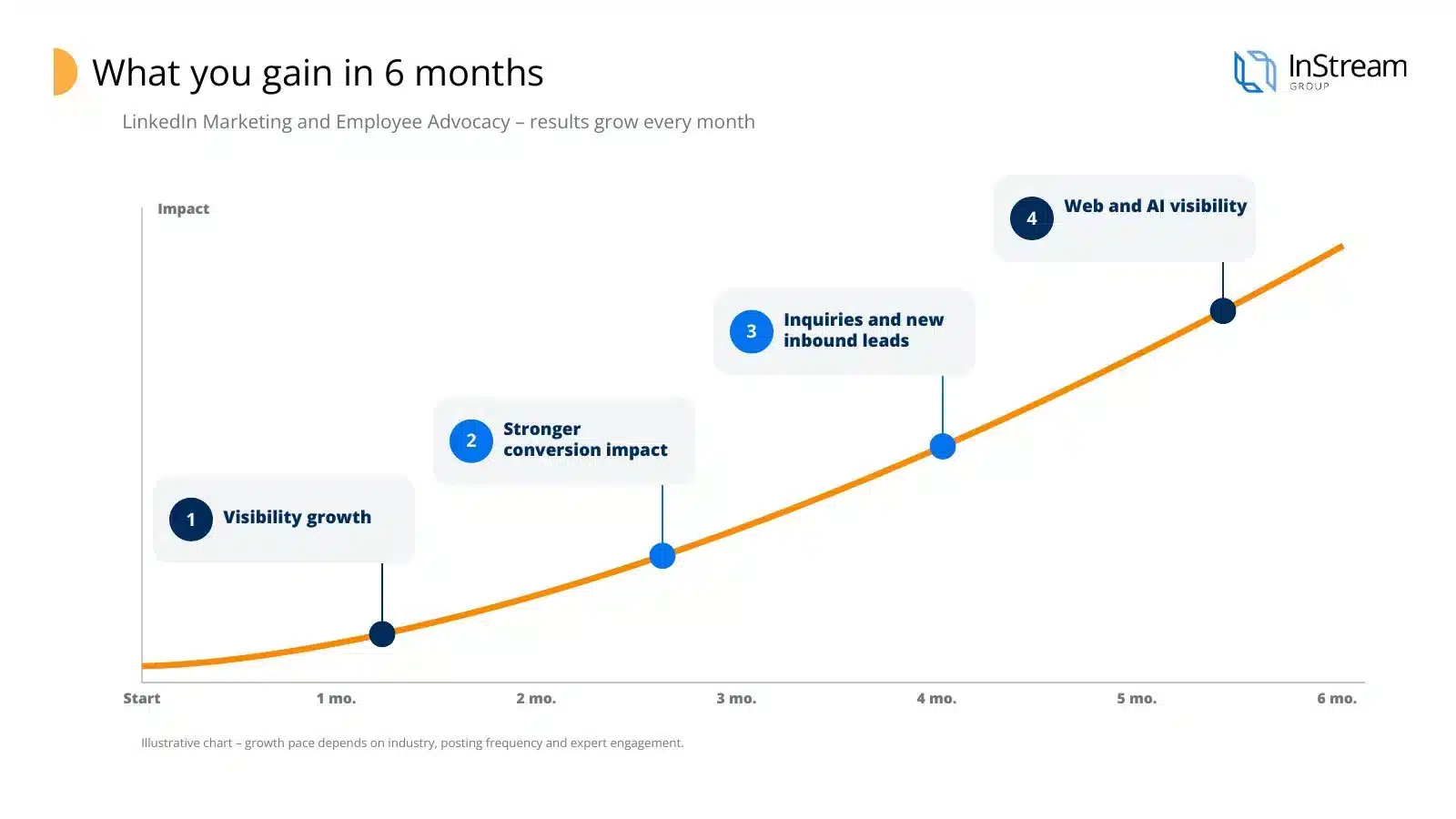
A personal brand is an investment that pays off more every month. First, visibility grows. Over time it translates into better conversion and enquiries from new clients.
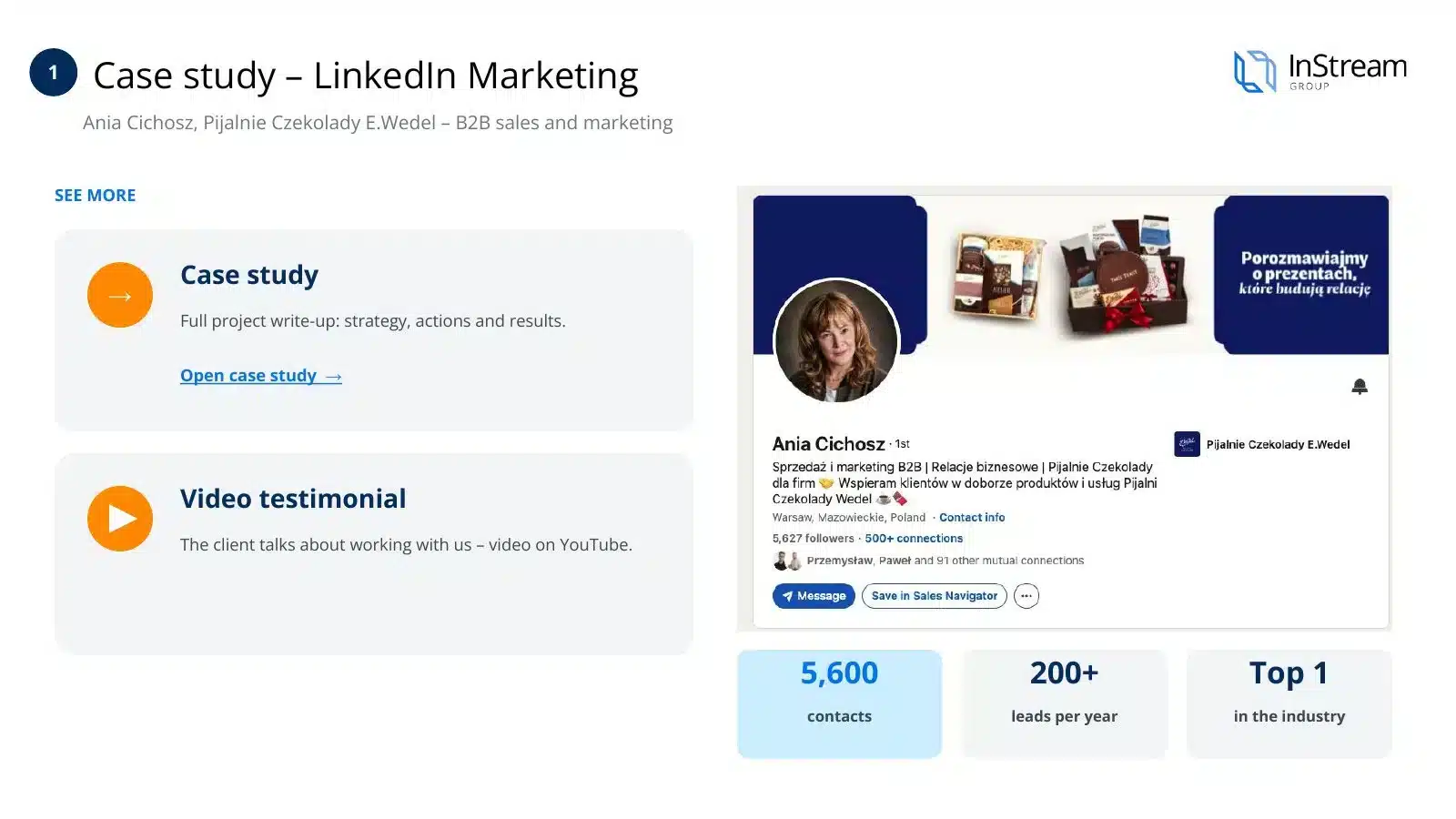
We expand the network, build the position of brand leaders and achieve top results. Some of our clients are number one in their segments for LinkedIn recognition. You will find full case studies and video testimonials on our website.
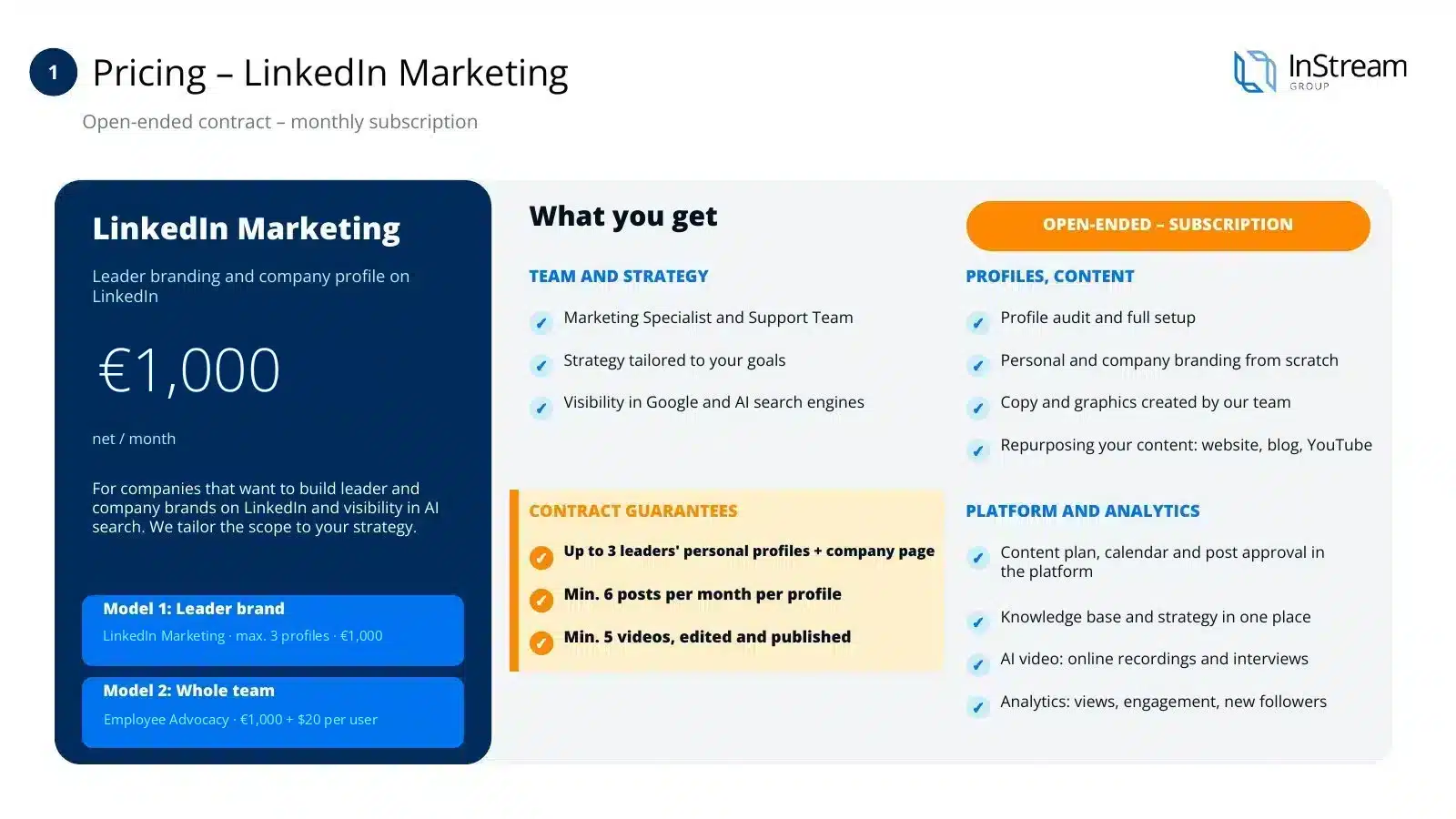
LinkedIn Marketing is a subscription from €1,000 net per month. We write the minimum publishing scope into the contract, so you know exactly what you are paying for. If you want to involve the whole team, we extend the service with Employee Advocacy.
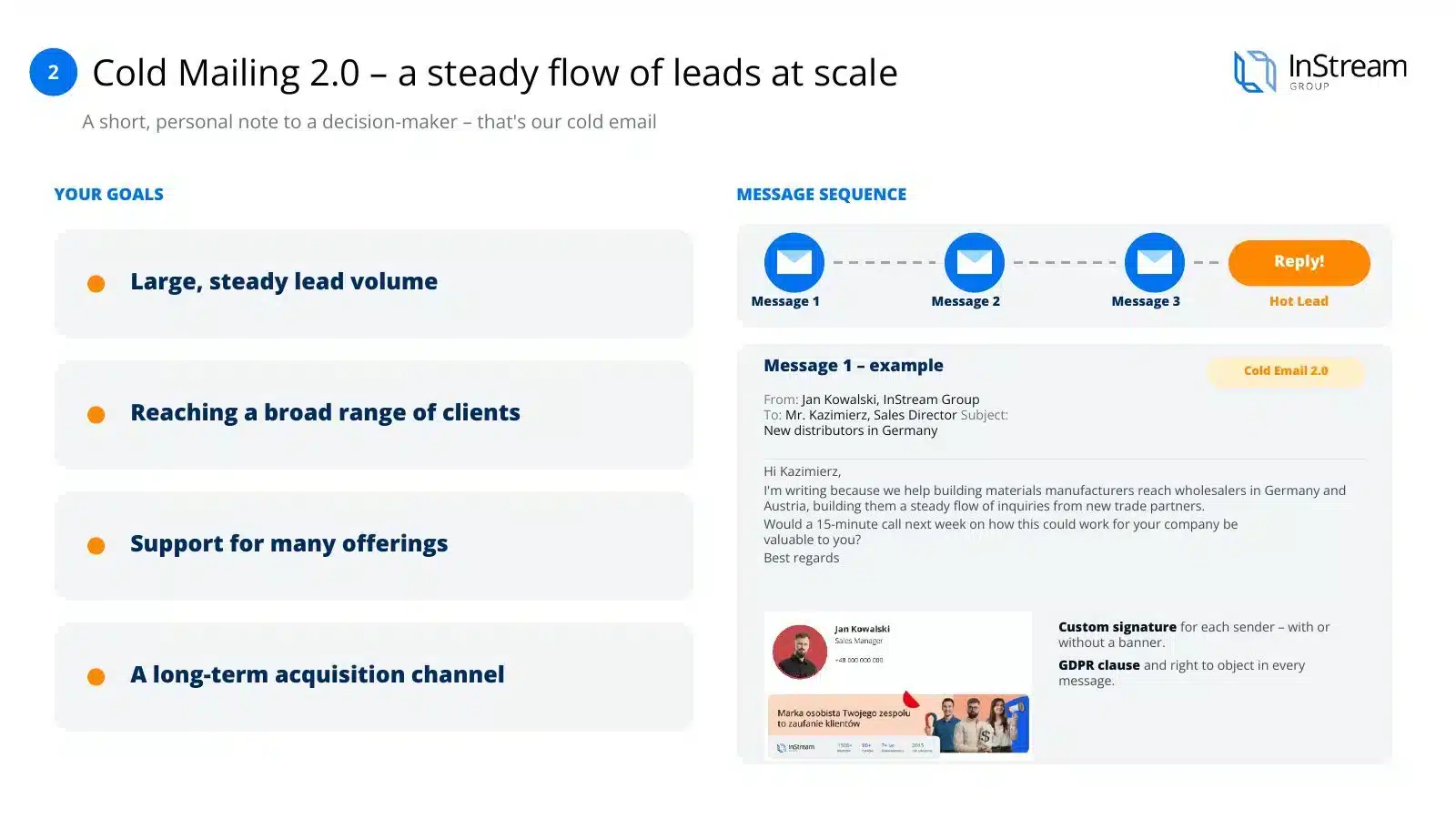
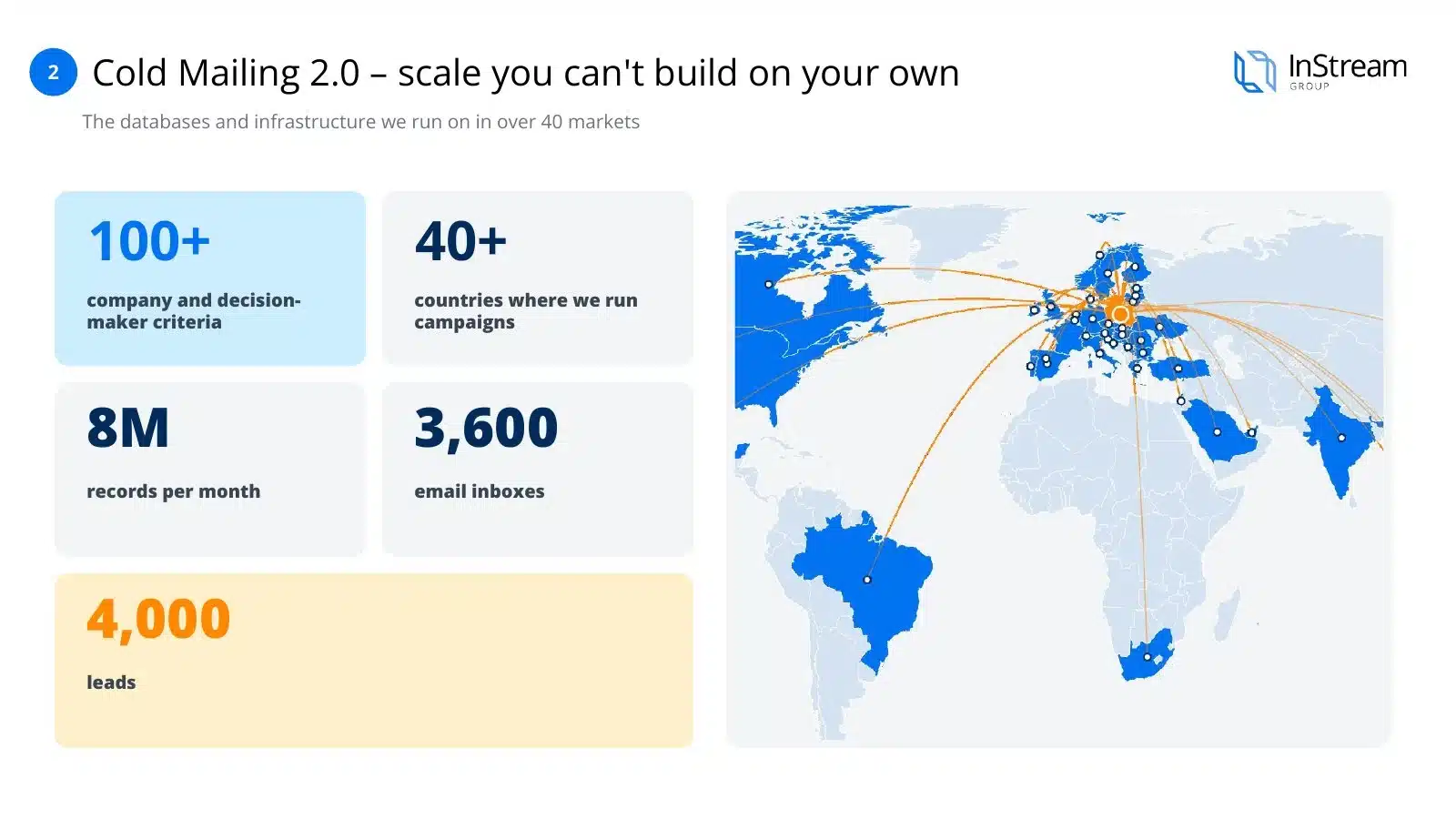
Cold Mailing 2.0 is a way to get a steady stream of new leads at scale. We write short, human messages to the people who really make purchasing decisions. Every campaign is run in compliance with GDPR.
You cannot build this scale on your own. We work in over 40 markets. Our campaigns bring clients 4,000 leads a month. Your campaign uses the same infrastructure and experience.
Your campaign is run by an experienced Project Manager with a support team. We take care of databases, content, infrastructure and the legal side. You receive ready replies in the Lead Astra panel, integrated with your CRM.
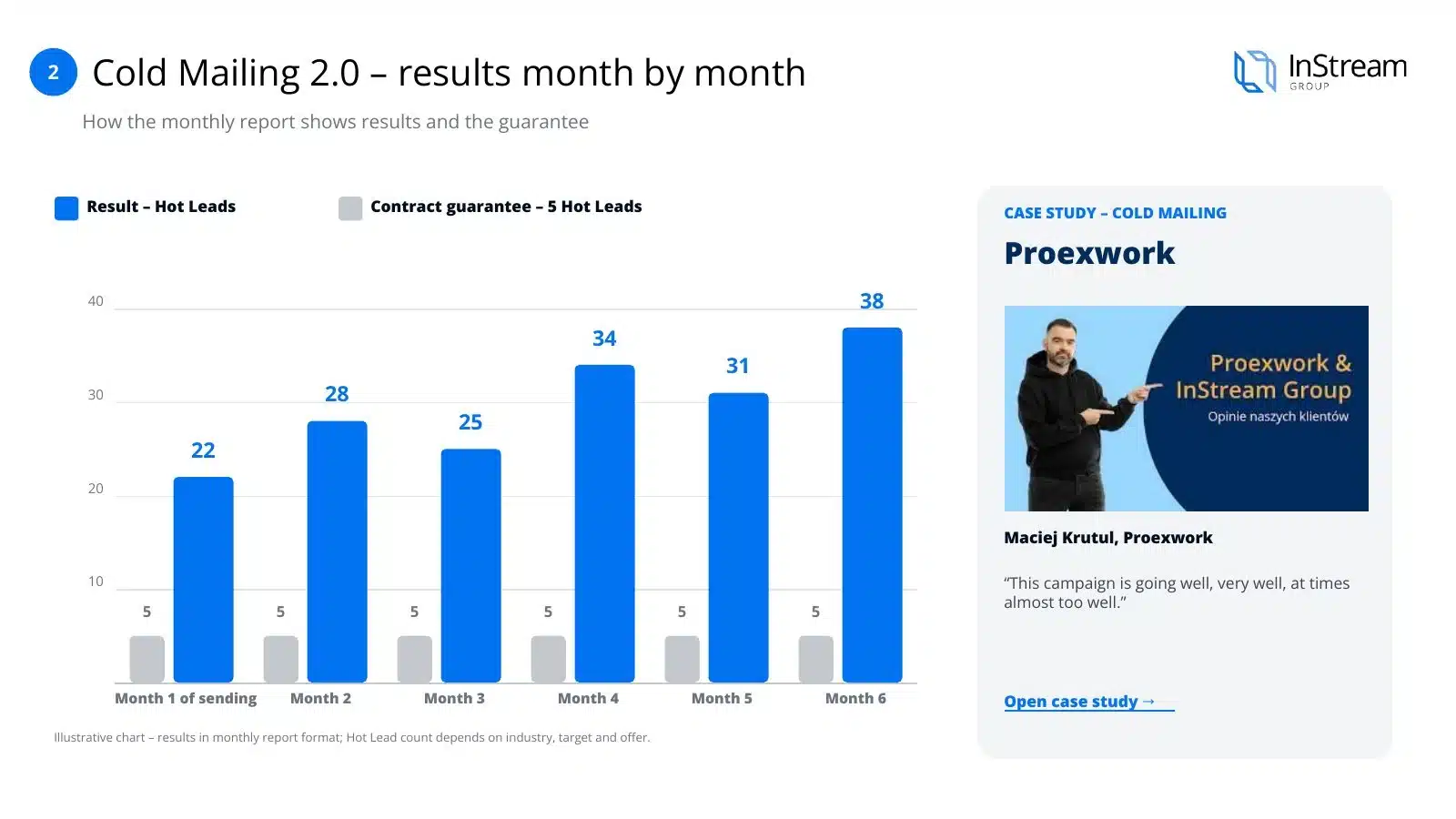
Every month you receive a report comparing the results with the guarantee written into the contract. In a well-set-up campaign the number of Hot Leads grows month after month. You will find case studies from such campaigns on our website.
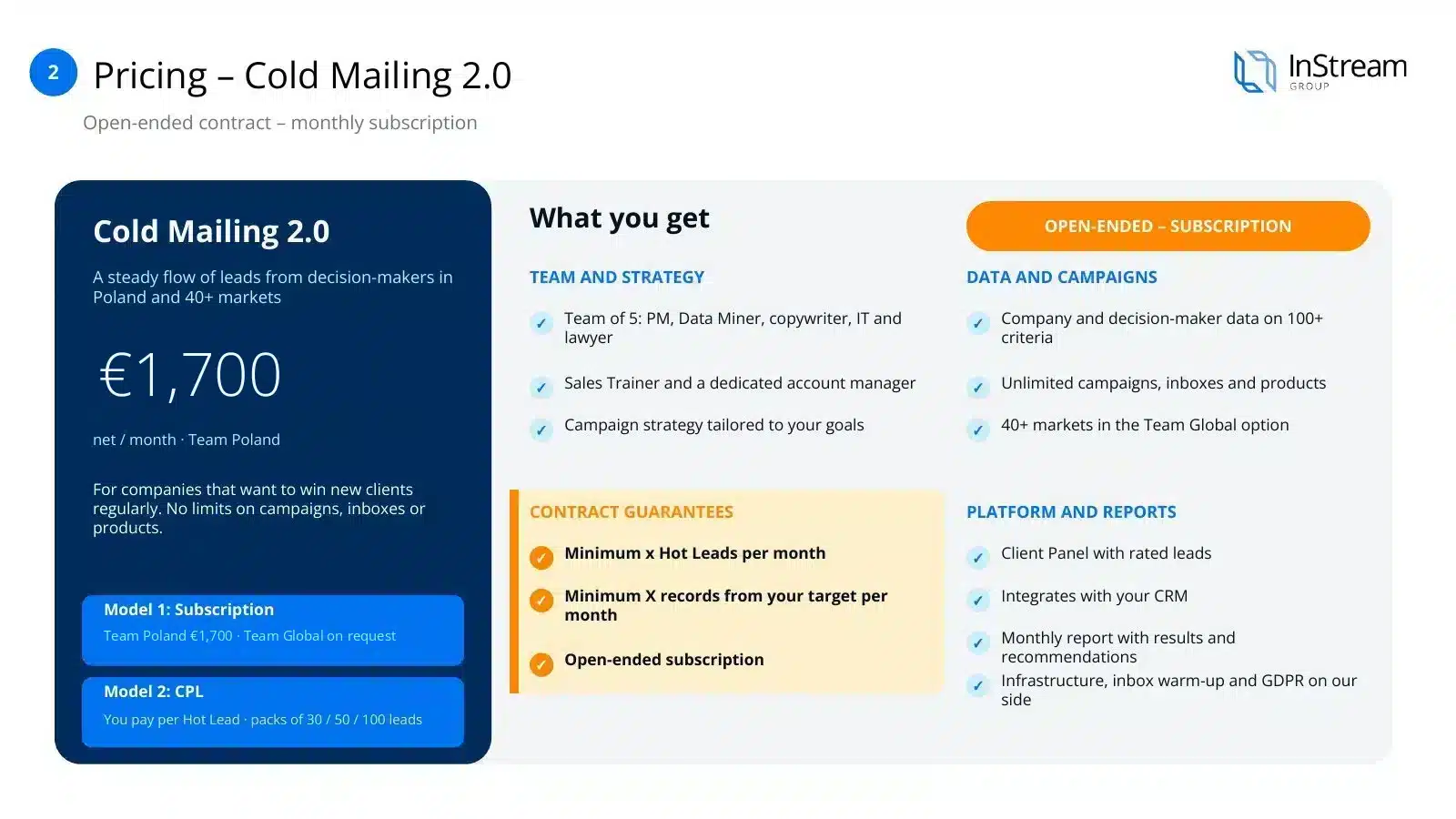
Cold Mailing 2.0 is a subscription from €1,700 net per month, with no limit on campaigns or mailboxes. We guarantee the minimum number of Hot Leads in the contract. You can also choose a model in which you pay only for Hot Leads.
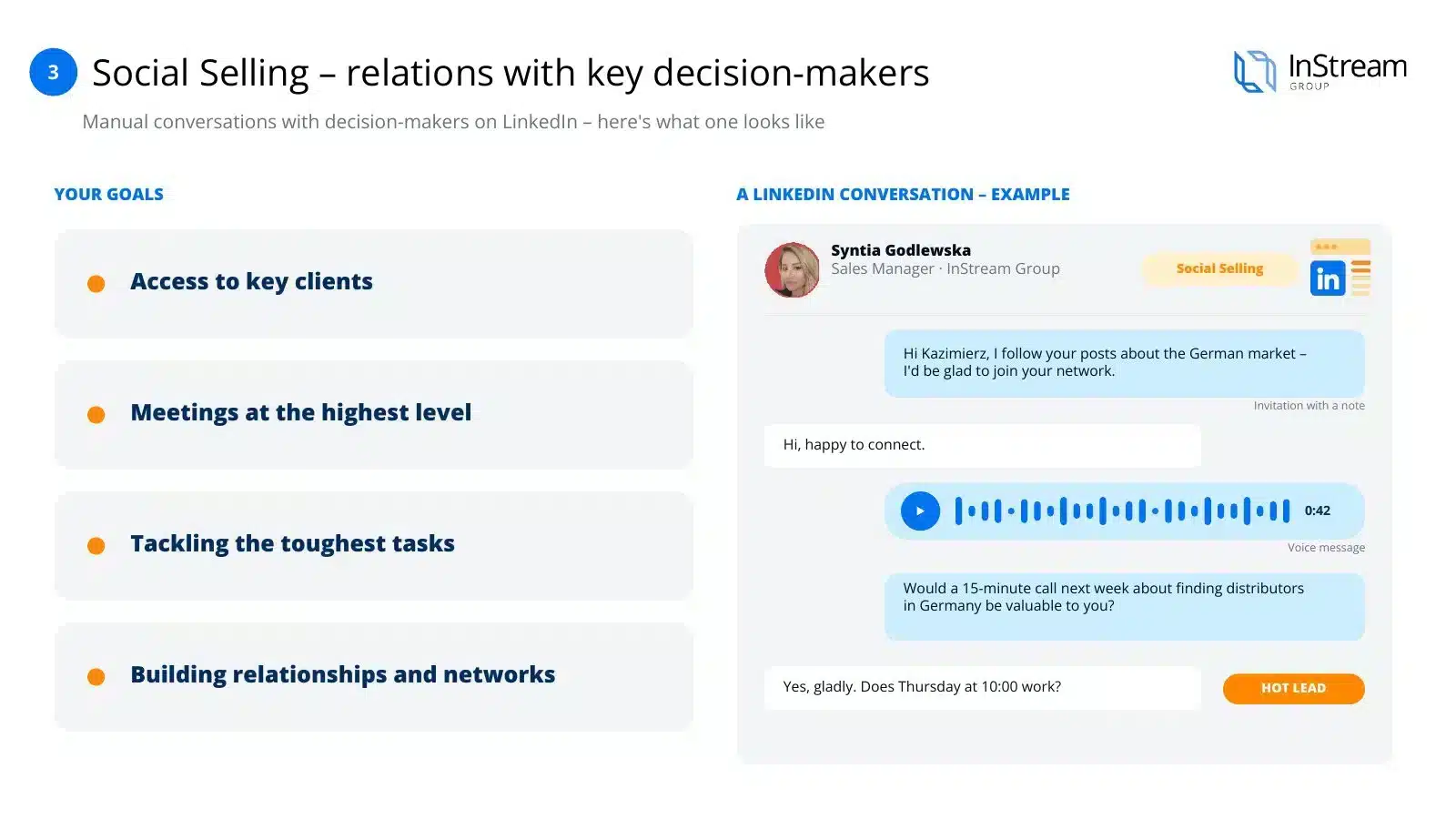
You won't reach your most important clients with a mass message. In Social Selling a person leads the conversation with the decision-maker, from first contact to the meeting. That is how we build relationships that cannot be automated.
Conversations are led by an experienced LinkedIn salesperson supported by our team. We look after your network and the history of every relationship. The Lead Astra platform prepares the work, but every message is sent by a person.
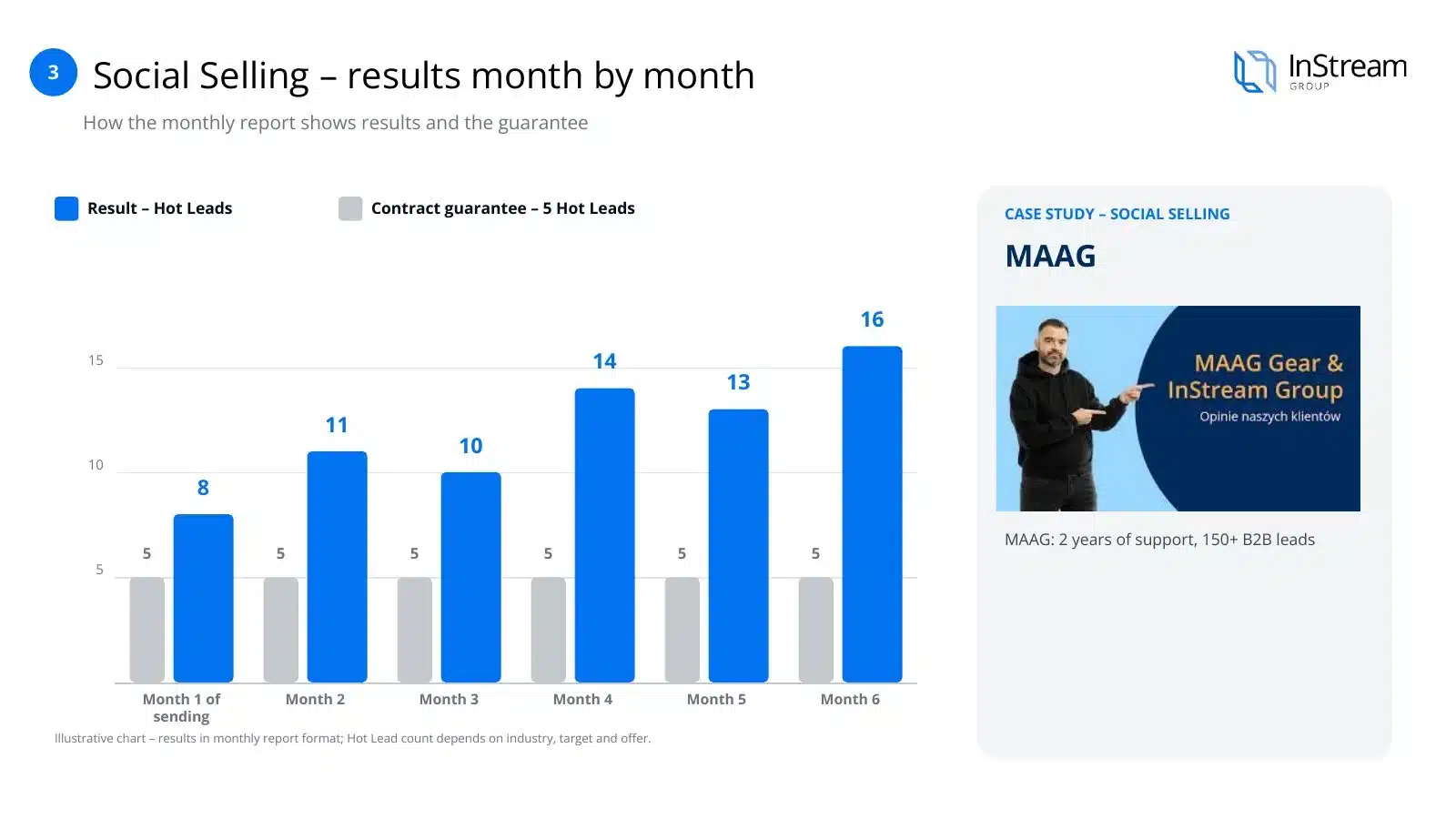
You also see Social Selling results in your monthly report, compared against the guarantee in your contract. We have worked with many clients for years. Relationships built on LinkedIn keep paying off long after the first conversation.
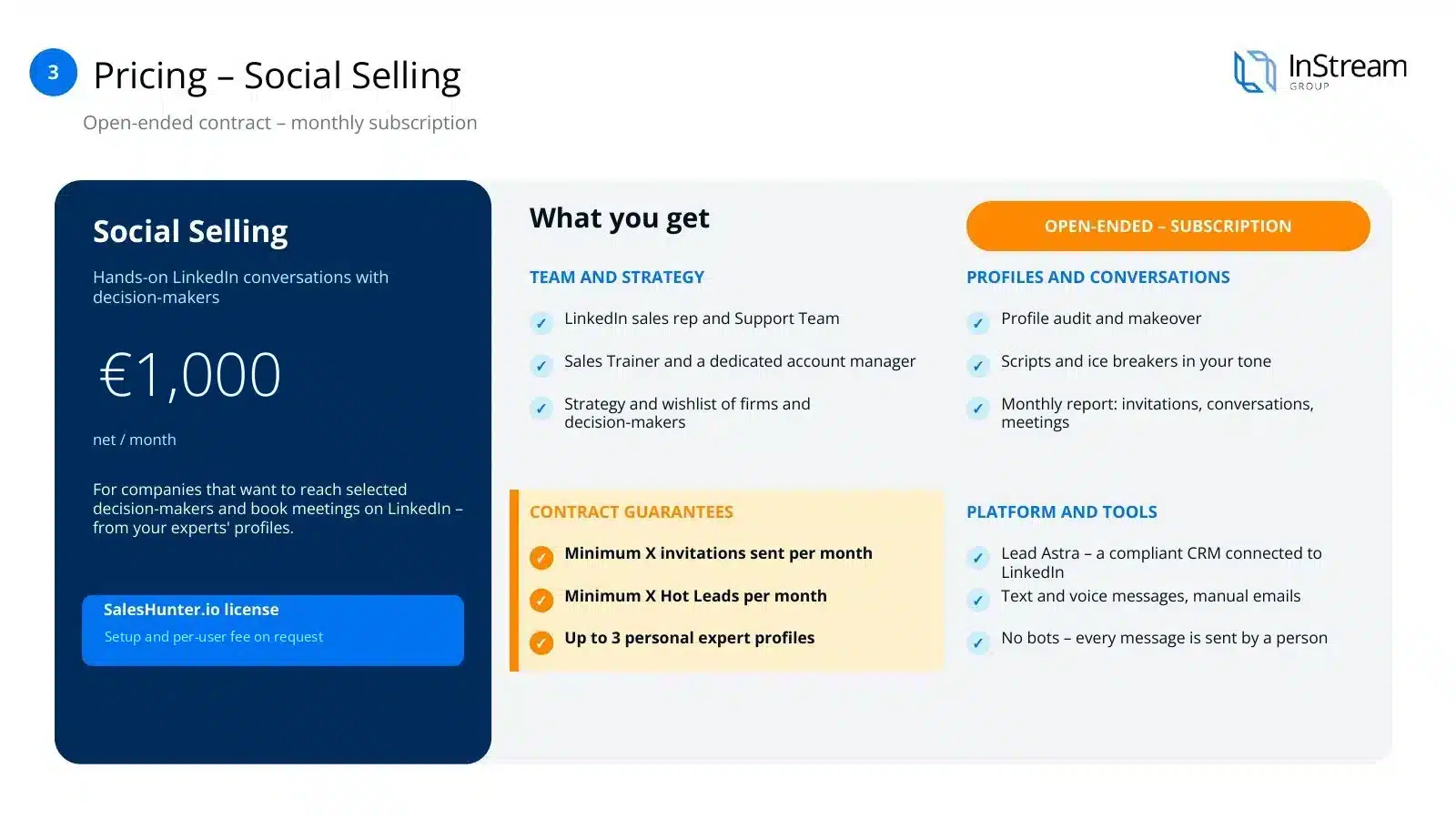
Social Selling is a subscription from €1,000 net per month. We write the minimum number of invitations and Hot Leads into the contract. Conversations are run from your experts' profiles.
Our cooperation has a steady rhythm. The first month is preparation, then we launch campaigns and analyse the results every month. Every 90 days we meet to plan the next stage. We also prepare your team to work with the leads.
The best results come from combining three channels. Visibility on LinkedIn makes clients more willing to reply to emails and messages. That is how Lead Generation 3.0 is born: a steady flow of conversations with your clients.
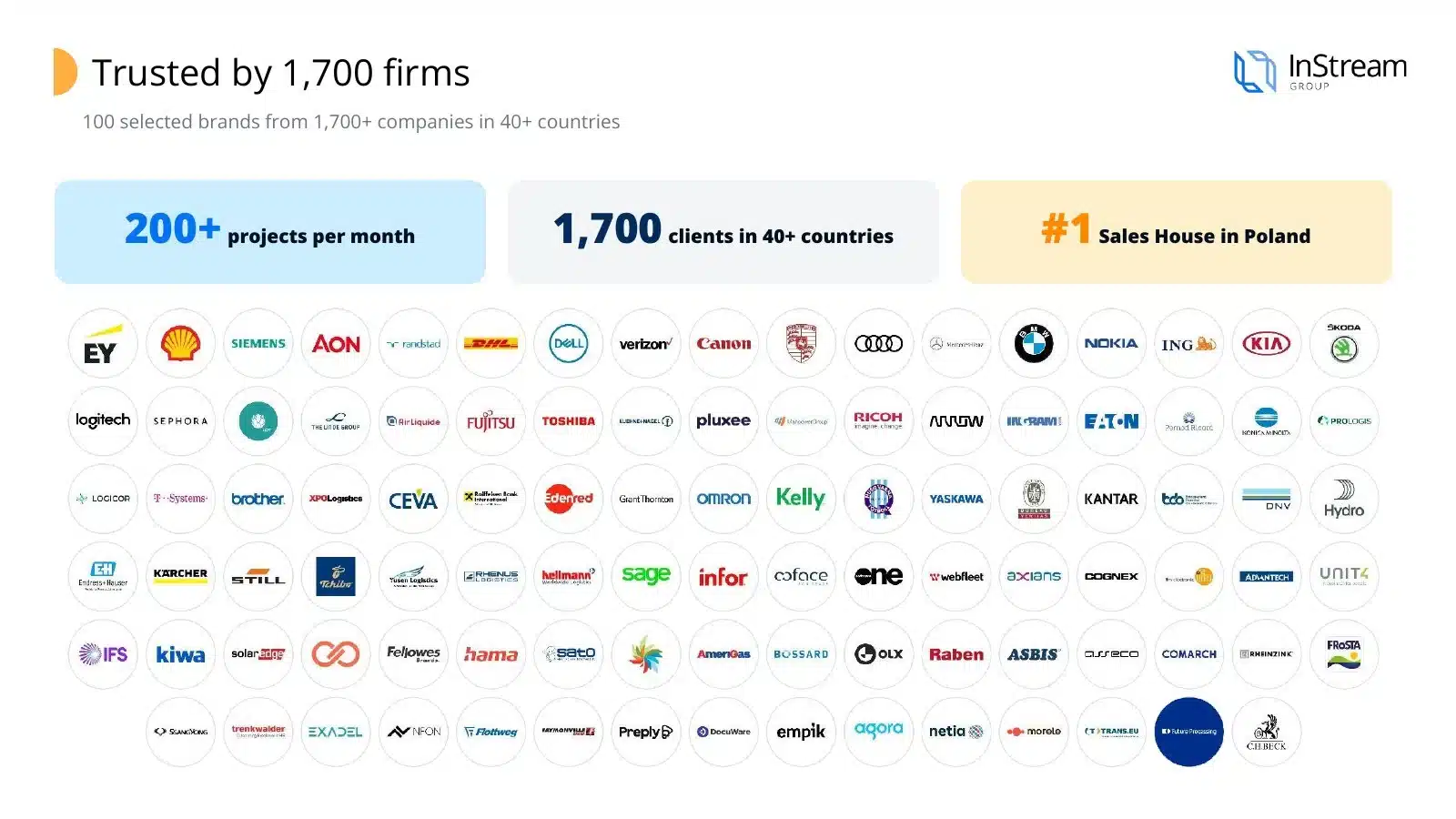
1,700 companies from more than 40 countries have already trusted us, from startups to global brands. Every month we run more than 200 sales projects.
Let's talk about how we can grow sales in your company. Call or write to us. You will find our contact details on the screen.
Brand visibility
Brand visibility: a must in B2B sales
B2B buyers check a supplier before they reply to a message: the company page, expert profiles, reviews and the answers of AI assistants. When your brand is not there, your salesperson starts every conversation from scratch.
- Content
Leaders’ and company profiles
3 personal profiles and a company page, at least 6 posts a month in 3 variants and 5 videos.
LinkedIn Marketing → - AI
Visibility in AI answers
In B2B, next to the company website, LinkedIn is one of the main sources AI uses to learn about a company.
LinkedIn profile audit → - Team
The whole company speaks with one voice
Employee Advocacy involves employees in publishing company content. Your brand message then reaches the networks of the whole team, not just the followers of the company page.
Employee Advocacy →
Take a closer look at how we support clients in social selling on LinkedIn
We work on our own CRM for LinkedIn platform. The salesperson runs conversations manually. The system organises contacts, sequences and results. Legally and without risk to your account.
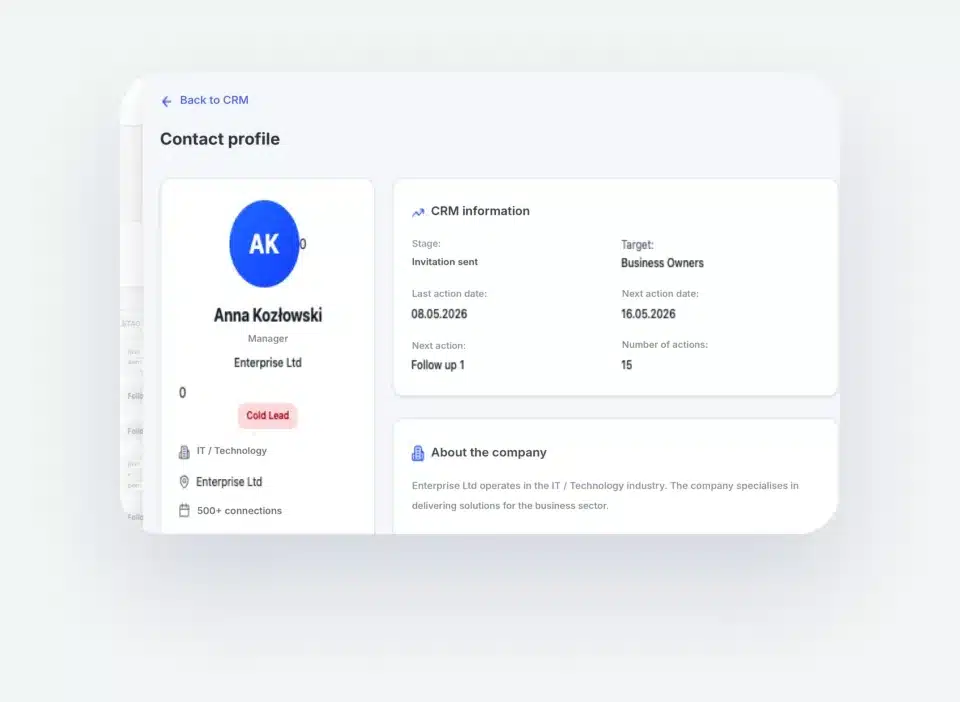
- Voice messages
- AI prepares content
- Hand-written messages
Cold email
Cold email: a scalable way to reach B2B customers
In B2B the buyers are companies from a specific segment, each with several decision-makers. Cold email means personalised messages to these people from a database built for your ICP. It works best when you want to talk to hundreds of companies a month.
- 1
A database for your target
We build it for your ICP and send it for your approval, usually within 48 hours.
- 2
Infrastructure
Subdomains, dedicated servers and 20–40 mailboxes with warm-up.
- 3
Team
A project manager, a data miner, a copywriter, IT and legal, and a sales trainer.
- 4
Hot leads in the contract
A hot lead asks for a meeting, an offer or a call and comes with a phone number and email. At least 5 a month.
The law: PKE and GDPR
In Poland, since 10 November 2024 the first commercial contact has been governed by the Electronic Communications Law (PKE), so the first message is a question, not an offer.
Take a closer look at how we support clients in cold mailing
We run campaigns on our own technology, developed by our specialists. Sending infrastructure, databases and results in one client panel, with no risk to your domain.
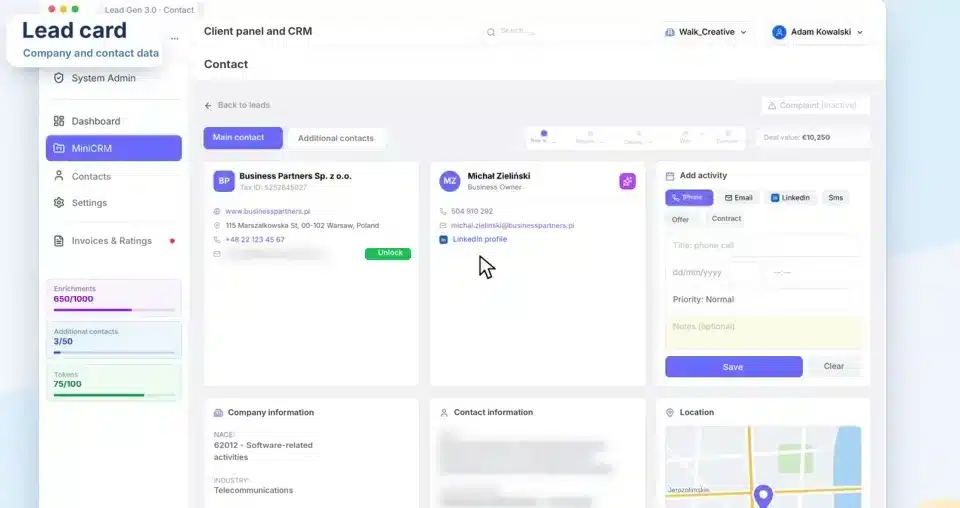

- Our own technology
- Artificial intelligence
- A safe solution
Clients and their stories
Our clients' success and satisfaction matter most to us. Join more than 1,700 companies worldwide for which we have generated leads.
Case study
Emitel × InStream
Cold Email campaign: boosting in-building mobile network coverage.
105 hot leads350% of the guarantee deliveredClient testimonial
Mr Staff Support
Recruitment of drivers and workers from Asia. Magdalena talks about working with InStream.
Case study
Studio201 × InStream
Cold Email campaign for a software house: apps and AI implementations.
119 hot leads3 signed contractsClient testimonial
Packon
Cardboard packaging manufacturer. Konrad Wijata talks about working with InStream.
Case study
Personal System × InStream
Cold Email campaign for a permanent and temporary staffing agency.
40 hot leads in 3 months17,000+ messagesClient testimonial
Proexwork
Staffing agency. Maciej Krutul talks about working with InStream.
Case study
StethoMe × InStream
LinkedIn: the CEO's personal brand and US market outreach in 4 months.
607 invitations13.5% acceptance rateCase study
Iguana Group × InStream
Cold Email campaign to schools: sports equipment.
43 hot leads419 repliesClient testimonial
HSK Consulting
Employee hiring services. Jarosław Multan talks about working with InStream.
Client testimonial
MAAG Gear
LinkedIn campaign, 2 years of working together. Krzysztof Orłowski talks about working with InStream.
Client stories
See how we help companies like yours
Testimonials, case studies and campaign results from our clients in Poland and around the world.
See client storiesThe B2B market in Poland
The B2B market in Poland: how many potential customers do you have?
The Polish B2B market has millions of registered entities, but only a narrow segment buys from you: companies from your ICP that have a need and a budget. Official data from Statistics Poland (GUS) show the scale of the market, while a well-built database shows how many companies you can realistically reach.
5.51 million
entities of the national economy were listed in the Polish REGON business register at the end of July 2026. The register also includes inactive entities, so this is the upper limit of the market, not a list of active buyers.
Source: GUS, July 202674.1%
of Poland’s GDP is generated by enterprises and 46.6% by the SME sector (2022 data). 97.2% of companies in Poland are micro-enterprises, so an “industry” filter alone is not enough: company size, budget and buying signals matter.
Source: PARP, SME sector report 2025KSeF
In Poland every B2B invoice goes through the National e-Invoicing System (KSeF). The obligation has applied since 1 February 2026 to companies with sales above PLN 200 million in 2024 and since 1 April 2026 to all others. Simplifications, including for sales of up to PLN 10,000 a month, apply until the end of 2026, and the final stage of the rollout starts on 1 January 2027.
Source: ksef.podatki.gov.pl, podatki.gov.pl
Sources: Statistics Poland (GUS), monthly information on entities of the national economy in the REGON register, July 2026 (published 11 August 2026) · Polish Agency for Enterprise Development (PARP), report on the state of the SME sector in Poland 2025 (15 July 2025) · Polish Ministry of Finance, ksef.podatki.gov.pl (legal basis and key dates) and podatki.gov.pl (final stage of the KSeF rollout, changes from 1 January 2027).
How to narrow the market down to your ICP
Start with criteria, not with the industry: company size, region, technology, management changes or hiring for sales roles. Out of millions of entities you are left with a list of companies worth writing to this month.
B2B company databases →B2B sales beyond Poland
The B2B market does not end at the border. We have run sales projects in 40 countries, most often in Spain, Germany and the United Kingdom, in the recipient’s local language.
Cold email abroad →The B2B sales team
Selling in B2B: what a sales team needs
An effective B2B sales team stands on four pillars: people, process, tools and data in the CRM. When one is missing, you soon see it in the funnel: leads go cold, offers wait without a follow-up and the forecast misses the result.
People and roles
The SDR generates and qualifies leads, the salesperson runs conversations and closes deals, and the account manager looks after the customer once the contract is signed.
Sales process
Funnel stages, exit criteria, scripts and follow-ups written down so that every salesperson works the same way.
Prospecting tools
Platforms for LinkedIn and cold email plus a company database. Technology prepares the contacts and messages, while the salesperson runs the conversation.
Skills development
Training, coaching and conversation practice with a virtual AI client in PipeChamp, which has more than 113 sales process templates.
Discover PipeChamp →CRM and reports
One place for contacts, deals and activities. A CRM report shows conversion between stages, the length of the cycle and where the funnel loses customers.
CRM implementation →A manager who leads the team
Goals, 1:1 sessions and a weekly funnel review. When the company has no sales director, this role can be filled by a remote sales director.
Growing a B2B company
Growing a B2B company: how to scale sales with Sales House
A Sales House is an organisation that takes on your company’s sales function: from building visibility and generating contacts, through the process and skills, to the system in which a contact turns into revenue.
Three layers you get with Sales House
People
A dedicated team: project managers, data miners, salespeople, copywriters, consultants and trainers, all employed full-time.
Resources and know-how
Company databases, ready processes, scripts and campaign frameworks from more than 3,000 projects.
Technology: Lead Astra
The Lead Astra platform and our own systems on every floor of the funnel: the client panel, CRM and PipeChamp. Technology prepares and a person approves.
Scaling B2B sales in the Sales House model differs from hiring more salespeople because you get a complete team, process and technology from day one. You decide which floors of the funnel we take over and which stay with your team.
Scaling B2B sales
Let’s plan how to scale your B2B sales
In a 30-minute call we will go through your funnel, point out the floor that is blocking growth and show you how our teams work in the Lead Astra platform.
- 3,000+ projects
- 1,700 companies from 40 countries
- 30 minutes, no obligation
The key numbers in B2B
CAC, LTV and churn: the key numbers in B2B sales
Three metrics tell you whether your B2B sales make money. CAC shows what it costs to acquire a customer, LTV how much that customer leaves in your company and churn how quickly customers leave.
- Acquisition cost
CAC
CAC = sales and marketing costs ÷ number of new customers acquired in the same period.
Calculate it in the calculator ↓ - Customer value
LTV
LTV = average monthly revenue per customer × gross margin × average customer lifetime (lifetime = 1 ÷ monthly churn).
Calculate it in the calculator ↓ - Customer loss
Churn
Churn = customers lost in a month ÷ customers at the start of the month × 100%. Lower churn extends customer lifetime and raises LTV.
Ask an expert →
Calculator
CAC and LTV:CAC calculator: do your B2B sales pay off?
Enter your costs, number of new customers, revenue, margin and churn. The calculator works out your customer acquisition cost, customer lifetime value and the LTV:CAC ratio. The values in the fields are examples.
Your numbers
data from your CRM and invoices · example values
- ✓€ / month
- ✓/ month
- ✓€ / month
- ✓%
- ✓%
The values in the fields are examples. Enter data from your CRM and invoices to calculate CAC and LTV for your company.
Result
recalculated live after every change
- Customer cost (CAC)€1,250
- ✓Customer value (LTV)€750 × 50% ÷ 8%€4,688
- ✓LTV : CACLTV ÷ CAC3.8 : 1
- ✓CAC paybackCAC ÷ (revenue × margin)3.3 months
A customer pays back the acquisition cost after about 3.3 months and leaves an average of €4,688 in margin in your company.
Your sales pay off: customer value (€4,688) is 3.8 times higher than the cost of acquiring the customer (€1,250).
Formulas: CAC = costs ÷ number of new customers · LTV = revenue per customer × margin ÷ churn · LTV:CAC = LTV ÷ CAC · CAC payback = CAC ÷ (revenue × margin) · customer lifetime = 1 ÷ churn.
Frequently asked questions: what B2B means and how to sell to companies
What does B2B mean?
B2B (business to business) means sales between companies: the supplier is a company and so is the customer. In such sales a group of people usually decides, the cycle takes weeks or months and the relationship with the customer continues after the contract is signed.
What are B2B sales?
B2B sales are the process in which one company persuades another company to buy: from the first contact with decision-makers, through qualification, needs analysis, a demo and an offer, to negotiation, the buying group’s decision and service after the contract is signed. They are run according to a process recorded in a CRM, and results are measured with customer acquisition cost (CAC) and customer lifetime value (LTV).
What is the difference between B2B and B2C?
B2C means selling to consumers, while B2B means selling to companies. In B2C one person buys, quickly and from a fixed price list. In B2B a group decides, in a complex purchase usually 6–10 people (Gartner), the cycle takes weeks or months, the price is negotiated, payment is made by invoice with payment terms and the relationship with the supplier lasts for years.
What is a B2B customer?
A B2B customer is a company or institution that buys products or services for the needs of its business, not for private use. A buying group decides on its behalf: management, finance, purchasing, users, and IT and quality. Before talking to a salesperson, a B2B customer usually gathers information about suppliers on their own.
How does a B2B customer differ from a B2C customer?
A B2C customer buys alone, for their own needs and often on impulse or because of a promotion. A B2B customer buys on behalf of a company, calculates the return on investment, compares several suppliers and needs arguments for every person in the buying group. That is why selling to companies takes longer and requires a process and a CRM.
What does a B2C business do?
A B2C business sells products and services to consumers, that is private individuals: in a physical shop, in e-commerce or in services. Scale, price, convenience of purchase and the brand matter. Decisions are made quickly and revenue comes from a large number of customers buying for smaller amounts than in B2B.
What do B2G, B2B2C, D2C and C2C mean?
B2G (business to government) means selling to public administration, usually through tenders. B2B2C means selling through a business partner that serves consumers. D2C (direct to consumer) means a manufacturer selling directly to consumers, without intermediaries. C2C (consumer to consumer) means sales between private individuals, for example through a classifieds platform.
What is a B2B system?
A B2B system is a platform where business customers place orders online. They see individual price lists, credit limits, stock availability and their purchase history, and orders flow automatically into the supplier’s ERP and CRM. It is used most often by wholesalers, distributors and manufacturers that serve many regular business customers.
What are some examples of B2B sales?
Examples of B2B sales are: a manufacturer selling components to a distributor, a wholesaler supplying shops, a software supplier selling a CRM subscription to companies, an accounting firm serving businesses, a logistics operator transporting goods for online shops and an agency that generates customers on behalf of another company.
How many people decide on a purchase in a company?
In a complex B2B purchase a typical buying group has 6–10 decision-makers, each with their own criteria and their own materials (Gartner). They are usually management, which approves the budget, finance, purchasing, future users, and IT or quality. A salesperson has to convince the whole group, not one person.
How long do B2B sales take?
From a few weeks to a few months, and longer for large contracts. The length of the cycle depends on the contract value, the number of decision-makers and how the supplier runs the process: a quick follow-up, a demo on the customer’s own case and materials for every person in the buying group shorten the path to a decision.
How do you win B2B customers?
Start with an ideal customer profile (ICP) and a company database, then combine channels: brand visibility on LinkedIn, social selling to selected companies and cold email at scale. Handle replies straight away and manage them in a process in your CRM. Measure customer acquisition cost (CAC) and customer value (LTV). You will find more in our guide to winning B2B customers.
B2B sales in 2026
Build B2B sales that grow together with your company
Start with a call with an expert or with the online demo. We will show you how Sales House wins B2B customers and work out what your own sales department would cost you.
- 3,000+ projects
- 1,700 companies from 40 countries
- 10+ years on the market
Tell us which B2B customers you want to win
In a 30-minute call we will get to know your market and target group, then propose methods and a plan for reaching B2B customers.
- 30 minutes, no obligation
- 3,000+ projects
- 1,700 companies supported in sales
About the author
Filip DuszczakCEO and founder of InStream Group, 17 years in B2B sales. He started as a salesperson in a call centre and today runs the first Sales House in Poland, which has supported the sales of more than 1,700 companies from 40 countries.
LinkedIn profile
Social selling
Effective social selling: relationships and B2B customers on LinkedIn
In B2B several people decide on a purchase and social selling lets you reach each of them individually. These are sales conversations on LinkedIn with specific people in the companies you choose, built on a profile that inspires trust.
Full-time salespeople
Conversations are run by experienced salespeople, not bots and not freelance students.
Social Selling →Voice and email in parallel
Manually recorded voice messages and parallel emails to the same people.
LinkedIn Sales →5–10 dream companies
Every month you name the companies you care about most and we run a separate campaign to reach them.
See the service →